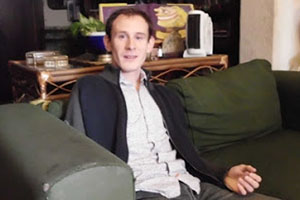
 He came to Uruguay because in his third year of the Political Science program at the Institute of Political Studies You have to experience France from abroad. “I wanted to spend this year in Latin America; it had always appealed to me. I especially loved the River Plate accent,” said Valentin, who spent two semesters at Universidad ORT Uruguay.
“The exchange coordinator for Latin America advised me against Buenos Aires. She told me, ‘That city has no charm; it’s very European but lacks landmarks. It won’t change you in any way—it’s overwhelming. I highly recommend Uruguay instead; it’s much more manageable and has a calmer atmosphere.’ That’s why I put Montevideo as my first choice,” she said, adding, “Now, since people keep asking me why I came to Uruguay, I tell them I chose it after getting a bike.”
Valentin is 21 years old, with brown hair; he’s skinny and has delicate features. His Spanish is good, though you can hear his foreign accent and he sometimes stumbles a bit. Sitting on the couch in the apartment he shares with other exchange students, in a dimly lit room, he blinks his blue eyes as he recalls his year in Uruguay and his life in France.
He describes a world of blurry images, where distances and sounds matter more. “I can see some things, but not much. I always use the example of a person. I can see some details like hair color, skin tone, and height, but not eye color.” He says it’s hard for him to get around in places with stairs, but in places he knows well, he can manage without a cane. His vision isn’t deteriorating, he points out. “Deterioration is the worst thing that can happen to you.”
He says that Montevideo isn’t equipped for blind or visually impaired people, but that this lack of infrastructure is made up for by people’s generosity. “They always want to help you, even when you don’t need it. Sometimes I’m waiting for the bus and someone takes my arm and says, ‘Come on, let’s go.’”
He enjoyed having the stadium just a half-hour walk away, being close to the promenade, going out at night, the fact that everything was cheaper—from going to the theater to skydiving—and being able to be late: “If you show up late somewhere, it doesn’t matter.”
***
Valentin was born in northern France, in a village of 1,500 people in the Lille metropolitan area. He moved to Paris when he started college. “It was a really great experience. It changed everything, because when you’re in a small village, sometimes there’s nothing to do, and suddenly you’re in the hustle and bustle of Paris. The first week I got sick. I wasn’t used to such a fast-paced life, with so much stress, but after that I thought it was great. I had more friends, who also lived nearby and not 20 kilometers away, with only two buses a day, as it was in the countryside. There, I depended a lot on other people. I couldn’t get around on my own.”
-What stresses you out about life in Paris?
-It has nothing to do with the way of life in Uruguay. What stresses you out, mainly, are the people and the atmosphere. You have to rush to make it on time for all your appointments. That’s just how life is there. People are always rushing—rushing to catch the subway, rushing to be on time—and because they’re in such a hurry, they tend to shut themselves off a bit.
-How do you lock it?
-People aren't as close-knit as they are here in Uruguay. People are less open with others. It's much more individualistic; people think more about themselves and care less about others. But it's great to live in Paris because you never get bored. There's always something new to do. It's a very cosmopolitan city. On the metro, you hear people speaking different languages with different accents—it's incredible.
One day, amid all that commotion, someone took advantage of his poor eyesight. At a restaurant, he placed his €10,000 Braille computer under the table, and suddenly it was gone. “No one saw anything. In Paris, there are professional thieves.” And in Montevideo, Valentin nearly fell victim to the Uruguayan version of professional theft: pickpocketing.
One rainy afternoon, I was with a friend at the corner of Uruguay and Florida streets. A man approached us and asked where we were going.
"Let's take a taxi at 6 p.m.," Valentin replied.
“Come on,” said the stranger. He grabbed Valentin by the arm, and without Valentin noticing, he threatened his friend with a knife. The friend stayed behind but immediately alerted others. They ran about 50 meters, and the others caught up with them. Then the thief got away.
***
Valentin likes soccer. When he lived in Lille, he rooted for Lens, a smaller local team. But when he moved to Paris, he became a fan of all the teams from his home region. And since there’s a rivalry between Parisians and people from the provinces, he says that when Lille won the local league and the French Cup in 2011—in a final against Paris Saint-Germain—he took the opportunity to tease his friends in the capital.
-What kind of jokes do the French make about soccer?
-It's just like here.
-Do you call them chickens?
-There's an equivalent: " poule mouillée," which translates to "wet hen." They also take a few jabs at each other. There are plenty of anti-Parisian songs, and they have their own.
As soon as he found out he was coming to Montevideo, he started following Uruguayan soccer, and he took a liking to Peñarol. He would get up at two in the morning to watch the Copa Libertadores matches. When he arrived, he became a member and went to watch them all year long. He didn't have any luck with the ladies.
Valentin would like to play soccer without any limitations, but he can’t see fast balls or those that are high in the air. Other things his poor vision prevents him from doing include winning a marathon (although he has already won the disability category) and moving to Uruguay to live, “but the issue is finding a job. I wrote a report for college, and it’s very complicated.”
-Why do you like Uruguay better than France?
-I’d love to have French beer and wine with Uruguayan hospitality, and with Peñarol, because in Paris they disbanded the fan clubs and the whole atmosphere was lost. That would be the perfect setup. And I’d love to have the mar. You guys don’t realize it, but having the mar amazing. It’s just a 30-minute bus ride to a deserted beach along the waterfront. Wow!
***
Valentin keeps sharing stories from his year in Uruguay. He had lunch at Café Brasilero with Máximo Goñi, the commentator he used to listen to from France when Peñarol was playing in the Copa Libertadores. “He couldn’t believe that someone was listening to him, in the middle of the night, in France.” For the Faculty, he interviewed Pedro Bordaberry and Eduardo Bonomi; in France, “no way” would you talk to the interior minister or a leading senator from his party, he says.
He took a trip with just his twin brother Aurélian, who is also visually impaired, to Ushuaia and Iguazú—something they had never done before. “It was amazing. When people see that we’re on our own, they help us more than when we’re with friends.” And he was in a relationship for a few months.
-What catches your eye when you're looking for a partner?
He laughs.
-The voice. And the appearance, too, because I can see something.
-But more so the voice than the appearance?
-Yes, much more. And humor and touch, because we're more tactile.
-What kind of voice do you like?
-She's pretty hot. When she has a foreign accent, she's absolutely gorgeous. And she has to talk—otherwise she's a total bore.
Valentin doesn't seem to mind talking about his poor eyesight. But he didn't always handle it so well; for one thing, he refused to use a cane until he was 18. “I didn't want to, but it made life really difficult for me. Now I even make jokes about blind people.”
-Can you tell me one?
Valentin stays silent for a moment, then starts laughing again.
-There's a blind man at a nightclub, and a fight breaks out. The police show up, arrest everyone—including the blind man—but then they let him go. Do you know why?
-Why?
-Because it had nothing to do with it.
This interview was conducted by Mauricio Sabaj, a graduate of the Bachelor’s program in Journalism, exclusively for In situ.