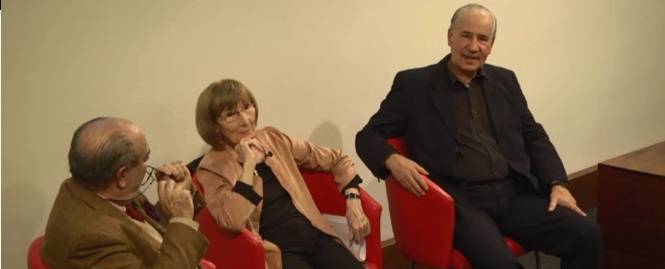
On Wednesday, June 15, 2016, a lecture titled “Behind the Scenesof the Book *The Girl Who Watched the Trains Leave*, ”focusing on the work of Ruperto Long, took place in the auditorium of the Pocitos Campus of Universidad ORT Uruguay.
The event took the form of an open discussion on the philosophical, historical, and human issues that underpin the book’s narrative. Participants in this discussion on the background of the text included the president of Universidad ORT Uruguay, Prof. Charlotte de Grünberg; the book’s author, Ruperto Long; and the coordinator of the Department of International Studies, Prof. Javier Bonilla Saus. Magdalena Long, the author’s daughter, read several passages from the text.
The event began with a historical overview of the period in which the book is set. “One of the dominant themes of that era was an almost obscene obsession with ‘particularism,’ ‘communitarianism,’ ‘nationalism,’ and everything that was ‘anti-universal, ’” Bonilla explained.
According to him, as early as the late 19th century, in addition to the above, a scathing critique of rationalism—Nietzsche being a prime example—had taken hold in the West due to its stubbornly universal nature. In contrast to the assertions of the 18th century and the Enlightenment, the philosopher Johann Herder had argued that every culture had its own truth, its own logic, and its own education.
“That’s why, one day, we just couldn’t go to school anymore,” recalled Prof. de Grünberg. “I don’t know if any of the children realized how serious the situation was. In a very short time, I had no more classes and lost all my friends. I didn’t see anyone, and those who kept going to class, for some strange reason, stopped caring about us—they kind of wiped us off the map; that happened almost instantly and felt very intense.”
“Then came the other atrocities, one after another, usually in the form of written notices posted in public places, as if to make us lose even the desire to go out on the street so we wouldn’t have to see the edicts,” said Prof. de Grünberg. She went on to say that it was common to find, in public places, “notices posted without the slightest shame bearing these simple words: ‘No Jewish children allowed.’”
Why such examples of segregation? Because the idea had taken hold that a nation was no longer defined in terms of a collection of legal and political citizens, but rather had to be defined in terms of belonging to a culture, a history, a language, a religion, or a race. The individual and the citizen of the French Revolution were swept away by the “identity” of the community, which was what defined the belonging of groups of people. And these groups were to be separated by “cultural identities,” in what Bonilla called a “fragmented” humanity, where the important thing was to highlight the differences that separated people rather than their common nature.
Against this historical and philosophical backdrop, Professor de Grünberg took a moment to honor the memory of Raphael Lemkin and Hersch Lauterpacht, two figures who played a key role in developing the concepts of “genocide” and “persecution” and who accurately captured what transpired during that collapse of Enlightenment values.
“Amid all that was happening, there were two people who lost their minds, desperate to make sense of all these atrocious events—for which there were no words—and they left behind a legacy that we all rely on whenever we try to talk about the Shoah.”
“I went through it as a child, and I suffered terribly; I still don’t know how anyone comes out of this kind of experience mentally unscathed. Sometimes nature helps, and some people develop a strength of steel: I think that’s what happened to all the survivors in one way or another,” she said, visibly moved.
“Books are essential to ensuring we never return to this era”
The event also featured the French Ambassador to Uruguay, Sylvain Itté, who shared several reflections inspired by the book. He spoke about Uruguay’s role during World War II, France’s role during that same period, and democracy today.
Itté also acknowledged the strong relationship between Uruguay and France. “Few people know that Uruguay was the first country to recognize General de Gaulle’s government as legitimate.” He also paid tribute to the hundreds of Uruguayans who volunteered to fight for the liberation of France.
He went on to say that in several European countries “there is a temptation to return to a mindset that Europe knew all too well in the 1930s and that ended with a little girl watching the trains leave,” and concluded: “Books are essential to ensuring we never return to that era.”
“Our parents did everything they could to keep us alive”
An emotional moment in the presentation occurred when Prof. Bonilla introduced a particularly tense scene from the book: the arrest of Charlotte’s father and protector of the family. The general director said that her father “had a kind of magic that could lift us out of our depression. It was extraordinary how this quiet man would develop a certain sense of humor (…) and, knowing that we were risking our lives, manage to turn the situation into something satirical. He made it possible for us to catch our breath.”
“We didn’t talk much among ourselves. What was there to say in that situation? We could see that our parents were doing everything in their power to keep us alive, sometimes at the expense of their own lives, ” he said.
Charlotte de Grünberg emphasized the value of solidarity: “There were people who helped my father escape, and that is something you never forget.” She then recalled the “exceptional courage” of the parish priest in a village on the border between France and Switzerland, who risked his life by hiding a group of travelers, among whom she was included.
For Professor de Grünberg, the experience left her and her brother with “a duty to stay alive and try to do something for others.” Her words and the conclusion of her speech were met with a standing ovation.
“The briefest moment of life is stronger than death and defies it”
Later, Ruperto Long spoke of the “incredible decisions” that the father of the family had to make under extreme circumstances and said that “love for life, freedom, family, and friends ultimately triumphs in one way or another.”
The author recalled the conversations he had with Charlotte de Grünberg while working on the book and remembered a quote by the French writer André Gide that captured the situation: “The briefest moment of life is stronger than death and defies it.”
For Long, the decisions made by the various characters in the story “share a common thread”: the defense of family, freedom, and the homeland—both their own and that of others. “There is a convergence of shared ethical values,” which makes it a “universal issue.”
The author believes that the universal nature of the elements depicted in the work allows readers to see themselves in the situations experienced by the protagonists. “For me, writing this marked a turning point.”
https://www.youtube.com/watch?v=q9aNL6K1T9g&ab_channel=EstudiosJudaicos-UniversidadORTUruguay