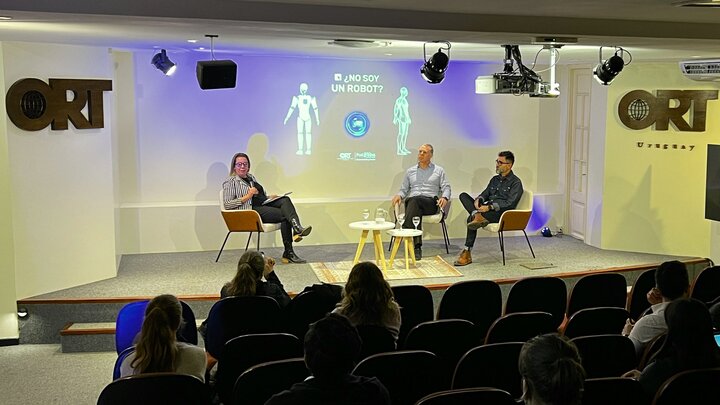
Under the thought-provoking title“I, Robot?”, this event provided a space for gathering and reflection to address the challenges and ethical implications of generative artificial intelligence (AI)—a unique opportunity to delve into the intricacies of technology’s impact on our society.
The event took place on June 26 in the Auditorium of the School of Communication and Design at Universidad ORT Uruguay featured the participation of Enrique Topolansky, MBA —Master’sin Computer Science and Master’s in Business Administration from Universidad ORT Uruguayand Fabián Barros, B.A. —Master’sin Digital Arts from Pompeu Fabra University in Barcelona and Bachelor of Arts in Communication Sciences from the University of the Republic—.
The event also featured a notable presentation by Sabrina Bianchi, M.Ed.—who holds a Master’s degreein Education and a Bachelor’s degree in Advertising Communication from Universidad ORT Uruguay serves as academic secretary of the School of Graduate Studies and professional development. Below are some of the highlights of the event.
The Landscape of Digital Disruption and Generative AI
We live in a hyperconnected age in which digital disruption has radically transformed the way we communicate, innovate, and create.
In this context, artificial intelligence—and generative AI in particular—has emerged as an innovative technology with revolutionary potential across a wide range of fields.
With ChatGPT leading the way as the most widely used and well-known example of this type of technology, this tool has opened up new frontiers in design, communication, and creativity, but it has also raised significant ethical and social questions.
Generative AI refers to systems capable of autonomously generating content—such as images, music, or text—without human intervention.
During the event, participants explored the challenges and opportunities arising from the intersection of technology and creativity. Key topics discussed included the influence of generative AI on the production of artistic content, the automation of creative tasks, and the impact on employment.
Among other questions that arose during the discussion, Bianchi asked Barros whether artificial intelligence limits or enhances our creativity.
All technology is a product of creativity, and creativity, in turn, enriches technology.
Barros
In addition, the need to establish ethical boundaries and appropriate safeguards to prevent bias, censorship, and manipulation in the development and use of generative AI has been explored.
In this regard, Barros, who takes a critical view of technology, asked Topolanski about the fact that this technology involves prior censorship from the outset.
In this regard, drawing on his experience in the practical application of artificial intelligence and its implications for communication and marketing management, he emphasized the importance of using generative AI in an ethical and responsible manner, avoiding the manipulation of information and ensuring transparency in its development and use.
https://www.youtube.com/watch?v=e94rWBnpt_I
Barros went on to question whether technology could completely replace the skill and originality of human creations, but he has also acknowledged the potential of generative AI to spur new creative challenges and enable people to explore new frontiers in design and communication.
Throughout the discussion, speakers emphasized the importance of properly regulating generative AI to ensure its ethical and responsible use. They stressed the need to establish safeguards and transparency mechanisms to prevent bias and manipulation in content generation.
Its potential to foster creativity and open up new opportunities in the fields of design, communication, and innovation has been recognized.
Ultimately, the event has reaffirmed the importance of maintaining a human-centered approach in the development and application of artificial intelligence. As technology advances, it is essential to preserve empathy, authenticity, and human connection in our interactions.
Generative AI poses ethical and social challenges, but it also offers significant potential to drive human progress and creativity.