At the School of Communication, the initiative consisted of three activities related to the different specializations offered by the Bachelor’s Degree in Communication.
The Essay
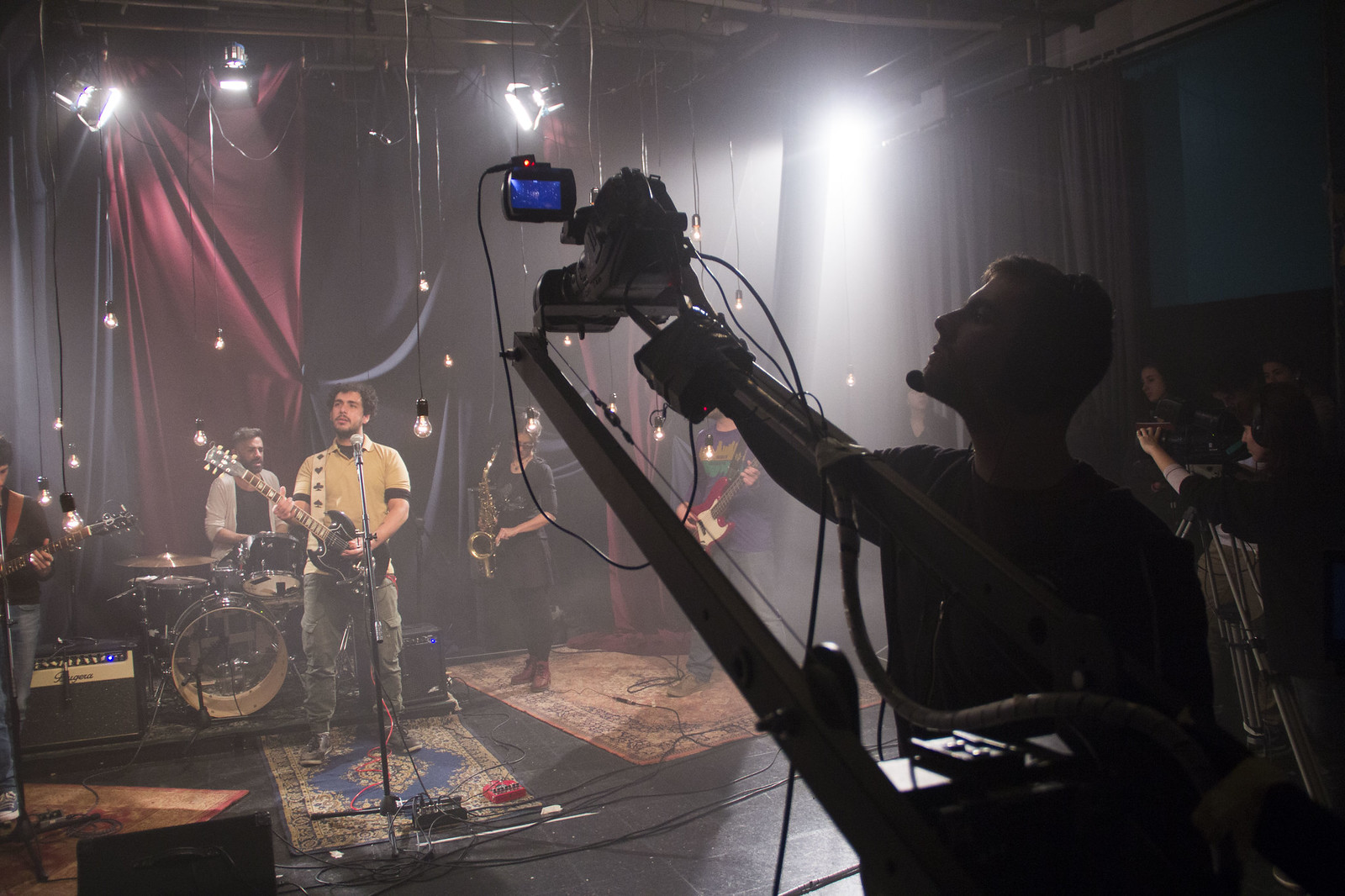
Vincent Vega—a quartet consisting of Matias González Marichal (guitars and vocals), Mauricio Sepúlveda (guitars and vocals), Fernando Martín (electric bass), and Fa Bonilla (drums)—was the band chosen for students in the Bachelor of Communication program (Audiovisual track) to record the song“Maquinaire” in the TV studio.
High school students were able to watch the recording and go behind the scenes.
https://www.youtube.com/watch?v=pxqHZsyesAY
La Celeste: a brand, a company, a passion
In the run-up to the World Cup in Russia, we’re taking a closer look at how the Uruguayan national team handles its internal communications, public relations, and media relations, as well as its advertising and marketing strategy, philosophy and values, and management of its online communities and corporate reputation.
Alejandro Sonsol, a graduate in Business Communication, Advertising, and Marketing, interviewed Matías Faral, the press officer for the Uruguayan Football Association and the Uruguayan national team.
In certain companies or organizations, work processes guarantee results, Sonsol noted, “but that’s not the case in soccer, where you can be the best coach but the ball might still hit the post.” How do you approach that from a communications perspective? Faral replied that, first and foremost, you have to be discerning and use common sense. “You also have to understand that soccer stirs up passions and emotions, which are often difficult to control. Now the World Cup is about to start, and there will be 31 countries that won’t win. Does that mean they did a bad job and did things wrong? No.”
Meanwhile, Virginia Silva, M.A., academic coordinator of Communication, highlighted what sets La Celeste apart from other organizations. “In addition to building bridges, serving as a link between so many different audiences, and addressing issues of leadership, conflict, negotiations, media relations, and more, it has one unique feature: its raw material is emotion.”
In this regard, Matías Faral noted that this has been evident throughout the national team’s journey, particularly since the 2010 World Cup in South Africa. “A lot of things started happening that hadn’t happened before, such as women and children becoming more involved in soccer. People thank the Maestro for bringing families back together through soccer,” he said. “That’s something you can’t predict; you can work toward it, but you can’t predict it.”
For his part, Federico Laimason, a professor and CEO at Punto Ogilvy, acknowledged that “it’s a privilege in advertising to be able to work in soccer” because “soccer has everything brands want.”
“Why do brands sign soccer players?” he asked. “What they’re after is their values. Godín’s leadership, for example.”
https://www.youtube.com/watch?v=Neo1QEamc4Q
Robots and News in the Age of Social Media
Journalism has changed at a rapid pace, presenting new challenges for media outlets and entrepreneurs as they strive to uncover the truth. Today, news is found on cell phones, social media, and in millions of conversations and platforms, and artificial intelligence is helping to produce more and better stories.
In this workshop, instructor Gonzalo Sobral provided tools for exploring the future of journalism and digital content through the lens of robotics.
“Imagine being in a journalism class without a cell phone. Think of an architecture class—it’s like telling a future architect not to have a pencil handy,” he said. “It’s the same with cell phones in a journalism class, because most of what we talk about is data, and cell phones are a wonderful tool for finding it.”
“Each of us lives alongside robots—that is, technological tools that perform the functions for which they have been programmed,” he continued, explaining that phones, for example, use technologies that execute an action when given a command. “These robots we live with help improve our lives, perform repetitive tasks, and process vast amounts of data that can help us make decisions,” he said.
Sobral asked prospective students to check their cell phones to see what news stories were making headlines in the media, what people in Uruguay were talking about based on Twitter trends, and what they were discussing in their WhatsApp groups. “What’s in the media is what journalists decided to tell us; for some reason, they decided it was important. On Twitter, you find what people spontaneously share with others. And in WhatsApp groups, you find what we talk about with our friends. Think of all that as, at the end of the day, a mountain of information, and we have to decide what we’re going to report.”
Given all that information, he said, a journalist must “be able to figure out which parts to use.”
https://www.youtube.com/watch?v=EngH-Qldg6o