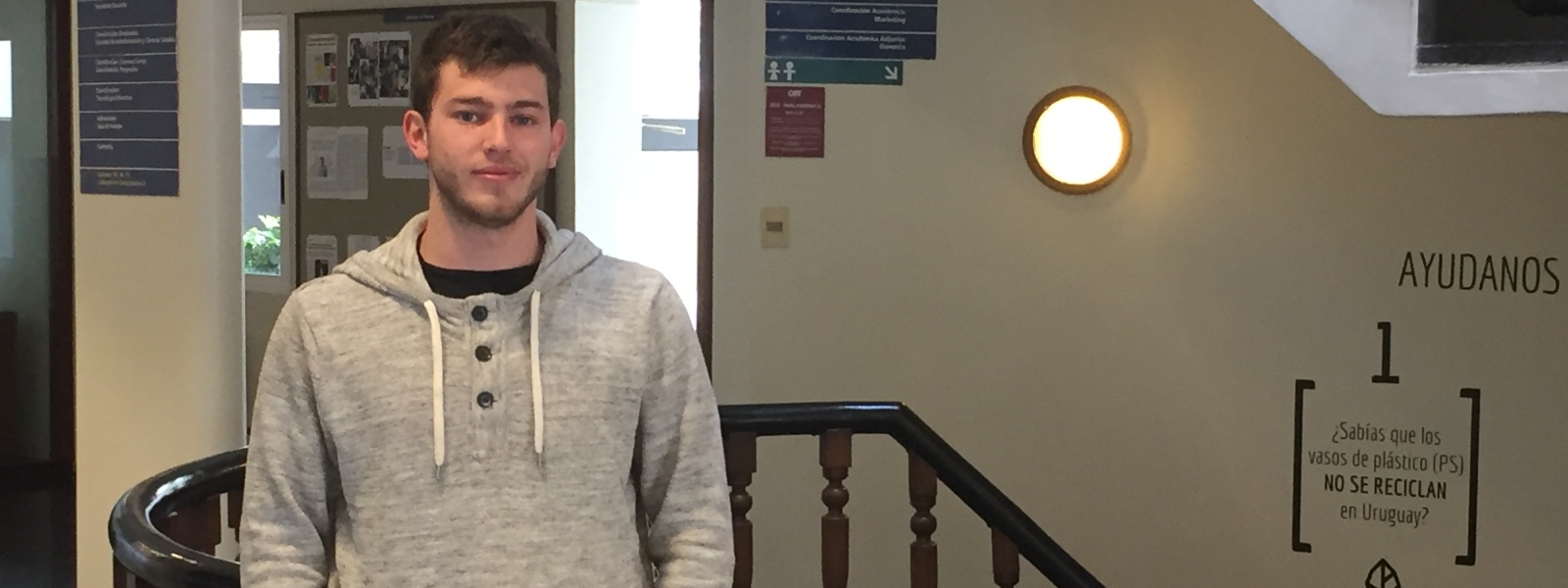
Mauro Padula, a student in the Bachelor’s Degree Program in International Studies, was one of 32 Latin American students selected to represent Uruguay in the 9th edition of the Program for the Strengthening of the Civil Service in Latin America. This year, a total of 5,208 candidates from 20 Latin American countries applied.
The program, designed by the Botín Foundation, lasts eight weeks. Between October and November 2018, the selected participants will attend classes at universities in Spain and Brazil, participate in conferences, go on field trips, and meet with individuals and institutions that will serve as role models. At the end of the program, participants will present a project applicable to the reality of a Latin American country.
What does the program consist of?
Itconsists of a scholarship for a leadership course for Latin Americans interested in public service, who have the potential to serve in their countries or in the region.
What was the application process like?
Exhaustive. There was an initial stage with a reasoning test and practical questions: what would you do in a given situation, what are your development plans, which leaders do you admire, what are your ideas.
Once I passed that first phase, I took a psychological test with over 600 questions. The idea was to ensure consistency and clarity of thought. The questions were phrased in different ways to throw the participant off.
Then they presented a case study. They gave a time limit to respond with what one would do in the situation they described. After that stage, you had to make a video and get a person who knew you personally and admired your qualities to recommend you.
I made the video with my boss at the Uruguayan Council for International Relations (CURI). The final stage was an interview with the Botín selection committee. Then they published the results.
What are your expectations for the program?
Several participants have told me that you have to go in with low expectations and let the program surprise you. I want to grow, learn, and meet people who may hold public office in the future, connect with them, find out what they think, their perspectives and opinions, and work together to see how we can improve Latin America.
It is said that the Botín Foundation values candidates who are focused on something beyond themselves. How do you think that applies to you?
I have empathy. I’m interested in learning about other people’s different realities, understanding them, and helping them. Botín values that ability to connect, to form bonds that last beyond the program’s eight weeks.
In Uruguay, I volunteer with Montevideo International Students (MIS), an NGO for international students. We organize activities to connect them, so they not only get to know Uruguay and Uruguayan culture but also build relationships with one another, ensuring they leave Uruguay with the best possible experience.
I also work at CURI, which evaluates potential public policies for implementation at the national and regional levels. Through this work, I apply the knowledge I gain at university.
What are your main interests regarding the Bachelor’s Degree in International Studies?
The interesting thing about the program is that it’s very broad. It covers various aspects of international issues, whether it’s economics, trade, politics, or culture. It gives an overview of each of these areas so that students can develop an interest in one or all of them.
The program culminates with the presentation of a project on best practices. Have you already thought of a topic you’d like to address?
Many participants come with an idea of a career they want to pursue, but the program shakes things up and changes their perspective, worldview, and mindset. I’d like to focus my career on diplomacy, but I don’t know how the program might change or transform me.
As for the project, I haven’t thought about it yet. The idea of the program is to work on it during those eight weeks and then put it into practice in the country or region.
News
“I want to grow, learn, and meet people so we can work together to figure out how to improve Latin America”
August 23, 2018
Interview with Mauro Padula, who was selected to represent his country in the 9th edition of the Program for Strengthening the Civil Service in Latin America.