Tell us about your project that was selected for the Ibero-American Design Biennial.
Je Suis was founded in 2010, after I finished my degree and began exploring career opportunities in the market to further my professional development. That’s when I decided to join my family’s business: Óptica Lamaison. Je Suis is the result of a collaboration between the optical shop (founded by my grandfather, Hector Lamaison, in 1928), a craftsman, and me, as a designer.
With a small-scale production and under the motto "What you see is one-of-a-kind," we aim to break away from the mass production that characterizes this industry by focusing on the local market, interpreting global fashion trends without neglecting the technical aspects, and highlighting the added value of craftsmanship.
Our complete collection (sunglasses and prescription eyewear) is currently available at our stores on Cordón and Parque Batlle, but you can also find our sunglasses line at La Pasionaria and Etniico.
It was a pleasant surprise for us to be selected as finalists in the "Fashion Design – Textiles and Accessories" category at the Ibero-American Design Biennial. We believe that this kind of recognition shows us that we are on the right track and motivates us to keep moving forward.
What design patterns can you identify in the models you created?
Coming from the industrial sector and working closely with the opticians, we place an emphasis on the functional aspects of the product.
Today, eyeglasses are a fashion accessory. More and more people are choosing eyeglasses as just another accessory, without seeking to hide a vision problem. That’s why, while we care about aesthetics, we mustn’t forget that eyeglasses are an accessory that affects eye health and must therefore meet certain functional requirements.
With this approach as our foundation, we aim to introduce more exclusive products to the Uruguayan market that reflect local culture and traditions.
Do you draw inspiration from any particular designer or company, or do you consider your work to be entirely original?
When it comes to design, a great deal of preliminary research goes into it. It’s important to know what the global trends are and what’s happening in different areas of design, but always with the local audience in mind. Having my own retail space means I get a lot of feedback firsthand. This, combined with the trends, is the “feedback” I listen to when designing.
What do you hope to convey through your designs to the people who will wear your creations?
I want eyewear to be an extension of the person, to convey who they are. Since it’s an accessory that sits on the face and involves the eyes, I believe it should reflect each person’s personality. These concepts gave rise to the brand name, Je suis, which means “I am” in French, and our commitment to creating exclusive pieces.
You just launched your new eyewear collection. What can you tell us about this venture?
We’ll have the images for the new campaign soon. This time, each model’s name is inspired by a bird found in Uruguay, which is why we’ve introduced new colors that evoke their plumage.
We have new colors and new lenses. On the one hand, we’ve added a line of mirrored lenses for those who want to add a pop of color to their glasses and stay on-trend. On the other hand, for those with more traditional tastes, we offer sunglasses lenses from the prestigious German manufacturer Rodenstock.
How has the public responded to the products you designed?
The response has been very positive. People are surprised that a project like this—which combines design with Uruguayan craftsmanship—has achieved such results. More and more people are coming to see local design as an added value.
Is the optical industry the one that interests you the most? Are you considering expanding your work into other areas?
Working in this industry wasn't something I had in mind when I decided to study design, or even while I was in school. It was an opportunity that came my way, and I felt I couldn't pass it up. I enjoy working in this field, but I'm open to trying other things as well.
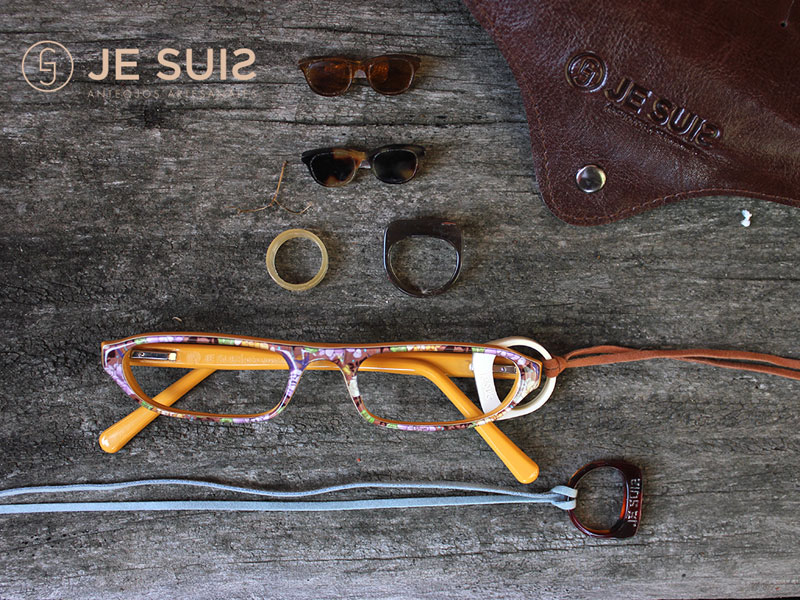
For example, last year we launched "Petit Je Suis," a line of accessories (pins and eyeglass clips) that we made from surplus materials left over from eyeglass production. In addition, my work at Óptica Lamaison also involves developing the aesthetic design of our stores and booths at the trade shows the company attends.
There are many ideas, and experimenting and exchanging ideas with others is what allows us to bring them to fruition in the future. It is through this experimentation and exchange that our product continues to improve in some way each year. Extending this practice to other areas could be a possibility.