Although the previous logo of the Museum of Pre-Columbian and Indigenous Art (MAPI) was “deeply ingrained” in its members’ minds, the design by Patricia Cerban, a graduate of the Bachelor’s program in Graphic Design, managed to inspire them to such an extent that they decided to embrace the new visual identity. “Because from the very beginning, we had been told that, while they were interested in implementing the parts of our projects that were interesting and feasible, a radical change in the museum’s visual identity was unlikely to be possible,” said Cerban.
Their project was selected as part of “Recreación,” a program run by the School of Communication and Design in which local businesses and institutions participate so that senior design students can develop projects tailored to each organization.
What inspired you when you designed the logo?
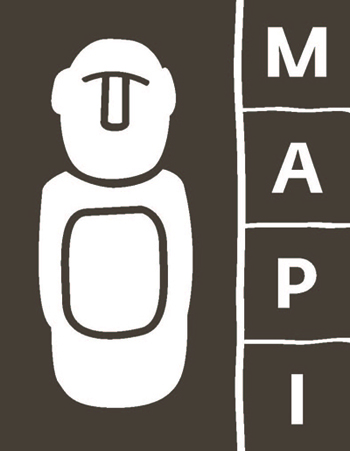
The logo, like the rest of my project’s visual style, is inspired by my observations of the pieces in the museum’s collection. From those observations emerged images, shapes, textures, lines, and colors that served as my inspiration for developing the MAPI’s visual identity.
 What message do you want to convey through the logo you designed?
The image featured in the logo is that of the Antropolito (an anthropomorphic stone artifact) from Rocha, one of the highlights of the MAPI collection. It is significant because it is part of the collection of artifacts discovered in Uruguay. It is a well-known artifact in the field and is strongly associated with this particular museum.
Why did you choose MAPI to carry out your project?
Because I’m interested in working on projects that promote the dissemination of culture, and I feel that this is something this museum places a strong emphasis on. Beyond simply being a museum, they seek to attract the public to workshops, courses, and activities, always with the goal of fostering engagement with art and culture. Furthermore, from my very first visit to the museum—before I had even decided to work there—I saw that it had great potential for work, that there was a lot to be done, and that if a design project were implemented—whether mine or not—it would be very beneficial.
As you mentioned in an interview with the In Situ website, “the issue of identity” was seen as something difficult to implement. Why?
Because from the very beginning, we were told that, while they were interested in implementing the parts of our projects that were interesting and feasible, a radical change to the museum’s visual identity was unlikely. This was because the previous image was deeply ingrained among the members of the MAPI Foundation, and at first they were not interested in changing it. However, upon seeing the final result of the project, they became enthusiastic about the idea and decided to make the change.
Why do you think you were selected? What do you think you brought to the organization?
I believe that what the museum needed was to better communicate everything it does—in terms of activities, exhibitions, and its educational program—and I think that, to some extent, this design project achieves that. I believe that the fact that I immersed myself in the museum’s subject matter and developed an aesthetic and visual identity that directly relates to the collection was key to their decision to choose my project.
How did you feel when your project was recognized?
The truth is, I’m really happy that MAPI has decided to implement my project—first of all, because that was the goal when we started Recreación, and it’s been achieved; and second, because it’s the result of so many months of work and a very important career opportunity.
Did you design any other items for MAPI besides the logo?
In addition to the logo, the project included corporate stationery, promotional items, a website, and museum graphics (signage for the museum’s main hall). It also involved the development of the MAPI Diseño sub-brand, which refers to a store selling design products related to the museum’s exhibitions.
What will your relationship with the institution be like going forward?
Right now, I'm working on the graphics for the main hall at MAPI and implementing some of the elements from my academic project. I'm also working on the design of exhibitions that will be presented at the museum in the near future.
How long have you been interested in design?
I'm not sure if there's a clear-cut answer to that. Looking at it from my current perspective, I'd say I've always been interested in it, although I probably didn't fully understand what design really was back then.
Why did you choose to pursue a Bachelor's degree in Graphic Design?
Because I looked into what the program was all about and discovered that it was exactly what I wanted to study. I may not have fully understood everything that a design degree entailed, but I knew that was what I wanted to do.
Were you able to apply the tools you learned during the training in this project?
Yes, absolutely. That’s exactly what “Recreación” is all about: developing a comprehensive project that applies all the areas of design we’ve studied throughout our degree program.
Do you feel like this experience opened doors for you?
I think it opened up a lot of opportunities for me. First of all, from a professional standpoint, since in addition to the pieces included in the Recreation project, we plan to continue working with MAPI on future projects. Second, it allowed me to break into this field, which, in addition to being a personal interest, is an area where there is room for specialization and for creating original work.