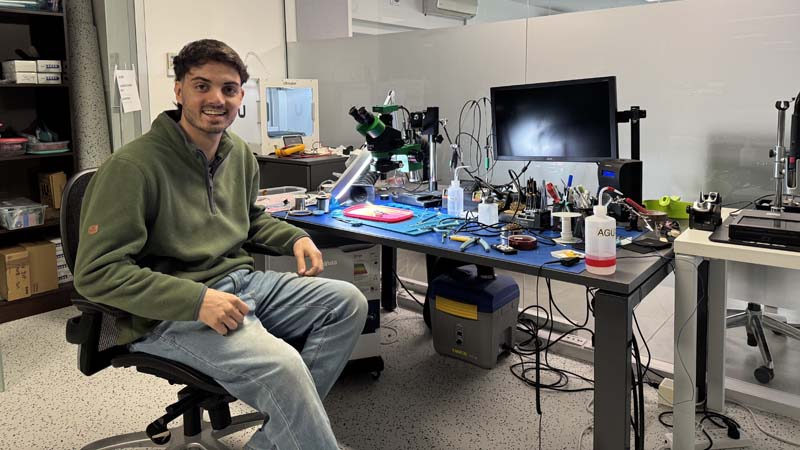
Lucas currently works at Impulse Dynamics, an international company dedicated to the development of implantable medical devices. His current role focuses on the development team for the Integra 1.5, a device designed for patients with heart failure.
“The impact of these devices is truly significant. Hearing directly from patients about how they’ve changed their lives is incredibly rewarding,” says Lucas.
A journey that began with curiosity
Her interest in the healthcare field emerged while she was in college, during the career fair organized by the school.
“I came across Integer, a company that manufactures medical implants in Uruguay. After an interview, they hired me, and that’s how I discovered this fascinating field.”
Following that initial experience in the field of electronic quality assurance, his career path led him to BQN, where he worked on electronic systems for animal monitoring. Later, a recommendation from Dr. Fernando Paganini, a professor and associate dean of research, was instrumental in his joining Impulse Dynamics.
Electronic engineering applied to improving lives
In his current role, Lucas doesn’t interact directly with doctors, but he does receive constant feedback on how the devices are performing: “We get very valuable information from the clinical team, particularly regarding improvements to the user interface or unexpected device behavior.”
Complex technologies for critical functions
The development of implantable devices requires expertise in firmware, signal processing, and radio frequency, as well as a thorough understanding of circuits and dynamic systems.
“These devices incorporate a lot of technology. It’s not just about knowing electronics; it also requires expertise in programming, antennas, analog signals, and more.”
A profound human impact
Lucas explains that every month his team participates in a global video call during which a patient shares their experience with the implanted Integra.
“You hear stories about people who used to be unable to walk two blocks but now run with their grandchildren. That’s when you realize the real impact of what you do.”
What does the future hold?
Based on his experience, Lucas sees a future in which electronic engineering will play a more prominent role in medicine: “More and more diseases will be treated with implantable devices. They already exist to induce sleep or treat back pain. As costs come down, they will become widespread.”
The subjects that made the difference
For Lucas, certain courses in his degree program proved particularly useful for his work in the development of implantable medical devices. Among them, he highlights:“Circuits, dynamic systems (for understanding filters), C programming, and electromagnetism were essential.”
He also emphasizes the importance of accessing more specialized courses: “We need training in C programming for engineers, analog signal processing, radio frequency, and antennas. Sometimes these courses aren’t offered because there aren’t enough students interested in them, but they’re essential for those of us who want to work in this field.”