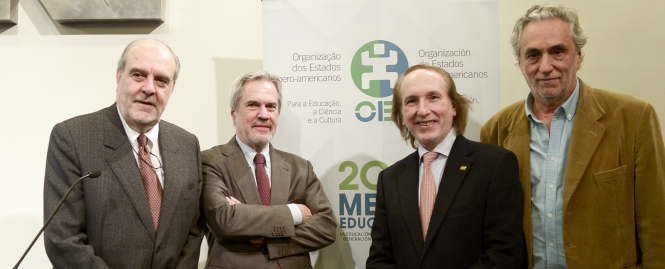
On Thursday, August 20, 2015, the Faculty of Administration and Social Sciences hosted the inauguration of the Ibero-American Chair in Human Rights and Education, which will be established within the Academic Coordination Office of the Bachelor’s Program in International Studies.
The event, which included the signing of the agreement and an open class, was organized by the International Office of the Office of the Provost and the Department of International Studies.
The agreement was signed by Dr. Paulo Speller, Secretary General of the Organization of Ibero-American States for Education, Science, and Culture (OEI), and by the rector Universidad ORT Uruguay, Dr. Jorge Grünberg, who stated that human rights are part of the university’s DNA.
Grünberg explained that the institution was founded as a grassroots movement to help Jews who were facing discrimination at the time. “That is why we see this today as a continuation of our mission. We are pleased to have a distinguished partner like the OEI, founded in 1949, which, like the university, has a long history of working in Latin America.”
The rector that they hope to contribute to Uruguayan society through a project focused on raising awareness of human rights and ensuring their continued relevance. “Thank you very much for placing your trust in us. We all hope this will be the first of many fruitful meetings.”
Dr. Paulo Speller said, "The chair is very important to us. It is with great pleasure that we are here today to sign this agreement, which I hope will also be very fruitful."
This was followed by an open lecture on the topic, presented by Dr. Paulo Speller and the coordinator of the Department of International Studies, Javier Bonilla Saus.
"The topic of human rights plays a relatively significant role in our coursework, particularly when we examine the emergence of political modernity," said Bonilla Saus.
“But we haven’t even begun to explore the issue in depth,” added the coordinator. “We welcome this opportunity to focus more on human rights than we have in the past. The issue is central to both national and international policy.”
Bonilla Saus addressed the issue of the universality of human rights. He said that they are considered universal because human nature is seen as the cornerstone that grants us rights simply because we are human.
According to Bonilla Saus, some scholars argue that human rights have always existed. Others maintain that they emerged with the advent of modern politics. He subscribes to the latter view. “Human rights must be respected. Fewer countries respect them than sign up to them.”
For his part, Speller added: "There is a constructive process ahead of us, and it's not simply a matter of adding a course. Human rights are fostered throughout the entire educational process."
“The OEI itself is a constructive process, and it led to the establishment of the Human Rights Research Institute. That is where all the work we do in education, science, and culture takes root.”
Finally, Speller said they hope this chair will serve as a model for many others that may be established in Latin America.
https://youtu.be/-KfxJ4x6-Uw