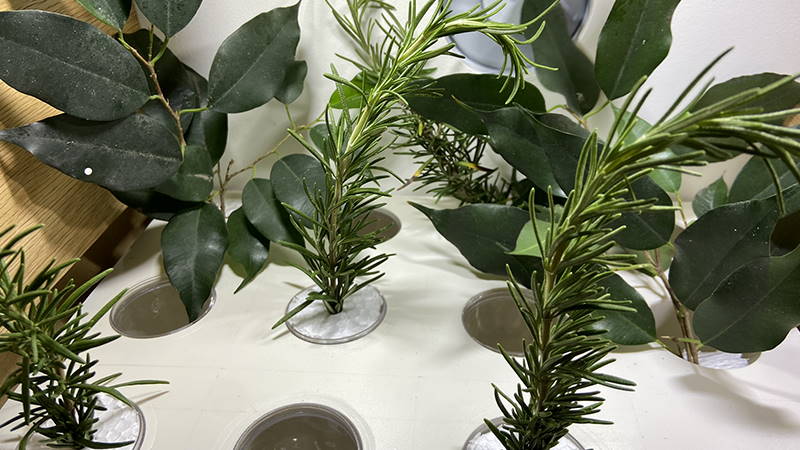
On December 20, an academic presentation was held for projects developed by students in the Bachelor of Industrial Design program and built in the School of Design’s laboratories, incorporating electronics provided by the partner organization. For Industrial Design students, this presentation constitutes the result of the second mandatory assignment for the course Industrial Design 4 – Market, in the sixth semester, taught by professors Maximiliano Izzi and Pablo D’Angelo.
The initial contact was made between the Academic Coordination Office for Systems Engineering and that for Industrial Design. They were invited to submit a proposal for the Integrative Project—Recreation in the previous edition, but were not selected. Given the interest in the project, the Industrial Design department decided to incorporate it into the curriculum.
Industrial Design students
, Paula Baptista, Paula Bordes, Martín Brandani, Emilia Cardozo, Gianfranco D’Alessandro, Gonzalo Martirene, Ignacio Núñez, Mateo Pagliano, Jerónimo Picerno, Pilar Pírez, Dana Tinsky, and Florencia Torrendell.
During the academic year, Industrial Design students interacted with Mathías Talon and Luciano Rufo, Systems Engineering students at ORT. For their final project, the future engineers carried out the Terrarium project, developing automated indoor gardens.
"Terrarium was created as a solution for anyone interested in having their own garden without having to invest space, time, and effort in acquiring the knowledge needed to grow crops successfully," explained Mathías Talon. “That’s why we’re not limited to automated gardens; instead, we plan to offer a suite of services and tools—including gardens, computer systems, maintenance services, and supplies—to ensure a complete experience for our users.”
-
What are the features of an automated garden?
They are self-contained, clean, and efficient. They operate without the need for land or sunlight, and thanks to their compact design, they can be used in small spaces.
To ensure that the plants remain healthy, the greenhouses are equipped with a ventilation system that maintains the ideal climate and simulates a gentle breeze, promoting strong and rapid plant growth.
The roots are well-nourished and oxygenated to maximize crop potential, thanks to the use of effective hydroponic techniques and a quiet water filtration system.
-
What role does the app they developed play?
With this approach, we’ve created a solution that doesn’t require a significant investment of space or time, but there’s still the challenge of acquiring the knowledge needed to ensure a successful harvest: that’s where our app comes in, allowing users to connect to their garden, customize it to their liking, and manage their crops.
This system is designed to assist and guide users through the entire growing cycle—from seed germination to tips on how to use the harvest—so they can get the most out of their garden without needing any prior knowledge or experience.
-
How did you determine that the project needed industrial designers?
From the very beginning, our methodology was based on researching, building, and testing in short cycles, and repeating this process many times. That is why, to understand what we were doing, we built several prototypes that, as we moved forward, addressed problems and became increasingly functional and efficient.
But we eventually hit a wall: our prototypes worked well, but they lacked the qualities needed to be considered a high-quality, scalable product. That’s when we started looking for experts in the field.
When Daniel Domínguez—academic coordinator of the Bachelor’s Degree in Industrial Design—and Maximiliano Izzi—the course instructor—contacted us, we naturally agreed wholeheartedly that this was an excellent opportunity that would benefit both parties. So we introduced ourselves to the group, and the process of research and prototype development began.
-
How was the work carried out?
We will provide all the necessary support and remain available to the groups should they have any questions or issues they would like to discuss with us.
Every week, we attended one of their classes to check on their progress, answer questions, and offer guidance when needed. This was the process we followed throughout the entire experience.
When building the prototypes, we handled certain technical aspects that were beyond the scope of the course—such as constructing the necessary circuits for the prototypes—so that, working together, we could create fully functional prototypes.
-
How good were the results?
At the end of the workshop, the groups presented their prototypes, and the teachers and the Terrarium team provided final feedback, highlighting both the strengths and the areas that needed refinement to achieve a better result.
For our part, we were amazed and very pleased with the final products: the results achieved were far beyond what we could have hoped for. We’re happy with that.
For us, the most important thing is that we built a strong relationship with the teams, fostered a positive work environment, and had a lot to offer each other. That’s why we’re committed to staying in touch and continuing to move forward together. As I mentioned earlier, we believe that being able to work with people from a field completely different from our own was very enriching, as we were able to achieve much more comprehensive results than we could have without this experience.
(The final prototypes will be unveiled in March 2022, when Mathías Talon and Luciano Rufo present their thesis.)
Design for I-Grow
"The goal of the Design 4 course is to 'make products that users will want,'" summarized instructor Maximiliano Izzi. Each year, they aim to tackle a topic of current interest, "such as the importance of physical activity for children, pet care in urban areas, or improving the cycling experience."
"The project selected this year 'will help improve people's diet and support the trend toward decentralizing production,' he said. It involves balcony gardens for indoor use, equipped with automation or remote-control systems."
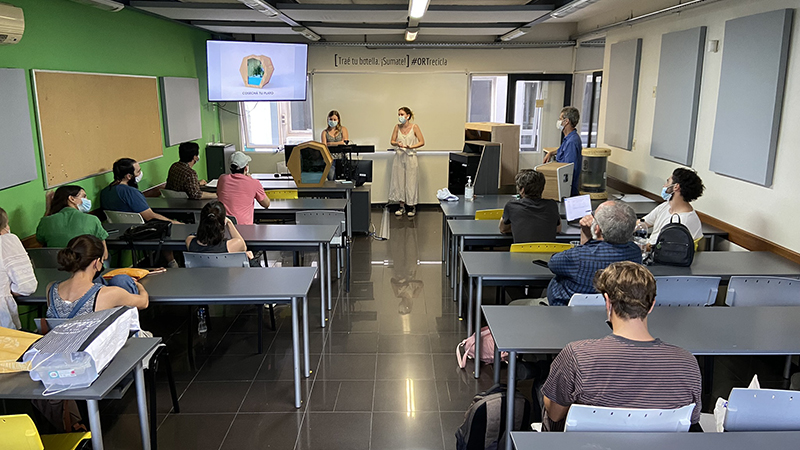
The team then set to work designing a small indoor greenhouse controlled by an app. The systems engineering students had already developed a working prototype; they had the app and the control board figured out, but “it didn’t fit the spaces available to people and potential users.”
The students began their work by identifying potential use cases, and each team selected the context and user for the product they would develop. Based on this definition, they determined the product’s functional features, dimensions, and manufacturing details. The entire process was overseen by Terrarium. In the final stages, support was more intensive as they assisted the students with the installation and assembly of the electronic components—circuit board, sensors, lights, fans, and product commissioning. The six projects presented conclude the academic process and open the stage for potential prototype testing with users, where feedback will be gathered to help improve the product—an exchange that will take place between Terrarium and the students.
The overall experience has been very rewarding for the students, as they had to collaborate with another professional to develop a functional product tailored to Terrarium’s requirements. Added to this was the challenge of working with a range of sensors and electronic components connected to an app via Wi-Fi, creating a product linked to the Internet of Things.
Mr. Maximiliano Izzi