Since the third team member left in early 2012, they have also been handling matters related to programming and design. However, Rodrigo Barcia, 24, and Facundo Puig, 18, are journalists: the former is about to graduate, and the latter is just about to start.
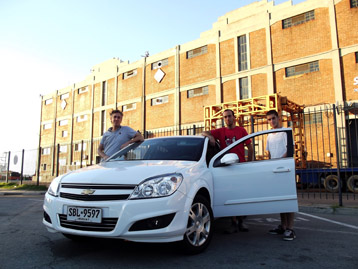 The first day that Autoblog Uruguay While it was online, 29 people visited the site. Today, after more than two years in operation, it averages 6,000 visits per day, with peaks of over 7,000.
Autoblog started out as a blog, but quickly became a leading source for automotive news. The idea was to create a website featuring news from the local market as well as international coverage, to update it constantly, and, most importantly, to practice journalism—not simply regurgitate press releases.
“Nothing like this had ever been done in Uruguay,” said Rodrigo Barcia, one of the organizers, who acknowledges that the idea actually came from Carlos Cristófalo of Autoblog Argentina: “One day, while chatting online, he suggested we start an Autoblog Uruguay. I’d known Carlos since 2006 through online chats, when he was the Uruguay correspondent for Autoblog Argentina.”
He asked Alexis Vilariño for help with the design and programming of the site; Rodrigo was solely responsible for writing the articles. At the time, Facundo Puig had a similar blog called Urucars. At first, they just exchanged links, but a few days later he was already posting on Autoblog.
"The goal," Facundo sums up, "was always to create a media outlet that was up-to-date, objective, and on par with the quality of the biggest blogs from around the world. We both wanted to read good reviews, 'fresh' news, and content that wasn't bought by sponsors. No one else was doing it—so what better idea than for us to do it?"
Rodrigo recalls that when he was looking for car news in local media, especially online, “what I saw was that there wasn’t a single site that was more interested in reporting the facts than in anything else.” He says he was “fed up with paid articles that only sang the praises” of the cars. That’s why at Autoblog they decided to cover the pros and cons of every vehicle: to do that, manufacturers lend them cars to test-drive when they hit the local market. “In this industry, some journalists care more about looking good to a brand than about serving the guy reading your work. That’s something that doesn’t happen at Autoblog: for us, it’s written in stone that you don’t work for companies, you work for the reader,” he says. “It’s one thing for a company to support you financially, but it must never interfere with the editorial side; in fact, some articles have cost us sponsors. I don’t regret that professionally. I like to say that we practice ‘anti-press release’ journalism; we write what we choose, not what’s already been chewed up and packaged for us by a media agency.”
 No office
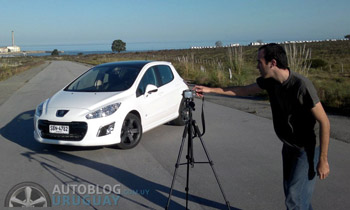
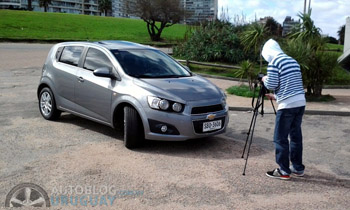
Their work routine depends on the stories they have planned. If they have to do “desk journalism” (which accounts for nearly 90% of the site’s content, Rodrigo notes), they discuss it via chat: “It’s like a meeting in a newspaper newsroom, but from our homes, and we laugh about the things that happen to us during the day, because it’s more like a chat among friends than work.” When they have to go out to test-drive a car or cover an event, the plan changes and they’re “a bit more methodical.” In any case, it’s always well over eight hours a day, squeezed in between the studies required by college or even high school.
Facundo, who is just starting college this year, says that while they’ve kept their original goals, their approach has changed. “You can really tell we’ve gained experience; sometimes we look back at last year’s posts and cringe, both at the text and at the photos or videos.”
Rodrigo—who is currently taking his final courses toward a Bachelor’s degree in Journalism at Universidad ORT Uruguaysays that the relationship with sources is what has changed the most over the years. “It’s gone from them ignoring us and us having to chase after them, calling them, to them being the ones who come to us for this or that story, to lend us a car, or to ask for our opinion.”
Autoblog has also built a small but loyal community. “There are those who comment on every post, engage in discussions, and get really passionate about certain topics, and then there are those who, while they read, never comment—or almost never,” “Those are the majority, and they’re the ones who drive the traffic we get,” says Rodrigo. “In the first group, a community of followers has formed; they email each other and meet up outside the site.”
“There’s no better motivation when it comes to writing than getting a response from the other side, even if it’s not always positive,” says Facundo. “An interesting community has formed: we got together with some of them a while back, and it was a great idea to meet in person.” In his opinion, Autoblog has two types of readers: those who are looking to buy a car—and sometimes don’t even know much about the subject—and the loyal ones who visit every day, leave comments, and are a more informed audience.”
 From the toy cars
For both Rodrigo and Facundo, their interest in journalism came long after their love of cars. “When I was four or five years old, I obviously liked playing with toy cars, watching races on TV, and reading car magazines. I also used to watch—and still have on VHS—the auto show programs hosted by Mario Uberti, for example,” says Rodrigo.
The team at Autoblog has already covered an International Auto Show, in 2011 in Buenos Aires. In total, they have covered six international events.
Facundo, for his part, admits that “there may be a genetic component” to his love of cars: “I have relatives who collect cars, who race, and who work in the industry, but I don’t think it’s just down to that.”
“While my classmates in kindergarten played ball, I stayed behind with the toy cars, racing them or even doing some DIY tuning with dry pens and bottle caps,” he says. “My room was always covered in car posters, and ever since I started reading at age five, I asked for car magazines. My parents tell me it was unbearable to walk down the street with me: they say I’d look at parked cars and name the make and model. I believe them.”