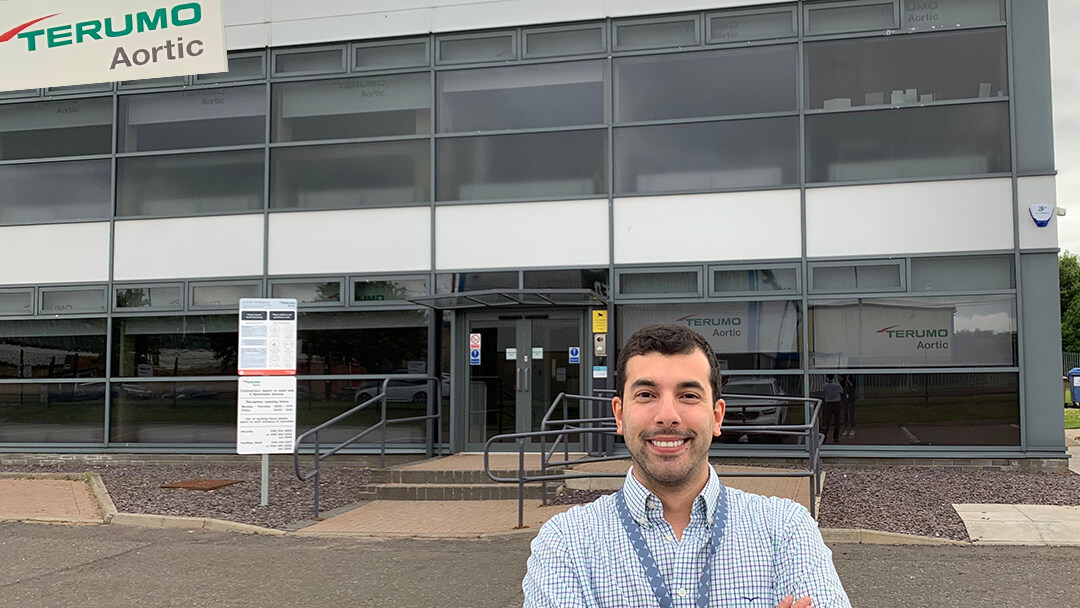
You completed your Master’s degree in Biomedical Engineering at the University of Strathclyde in Scotland in September 2020, graduating with honors. What were those two years like? What did you learn, and what did you discover about the profession?
Biomedical engineering has been a personal challenge ever since I completed my degree in electrical engineering. For my final project, I had the opportunity to develop an automated testing device for implantable medical devices, in collaboration with one of the leading companies in the field in Uruguay.
The master’s program followed a format very similar to that of an engineering degree, including a practical capstone project as well as required and elective theoretical courses. I took a wide range of theoretical courses, ranging from robotics and cardiovascular devices to regulatory frameworks. During the capstone project, I had the opportunity to contribute to a research group working on the next generation of stents. Given my background in electronics, I developed a system that monitors stent performance by measuring, in real time and non-invasively, the interface between the medical device and the internal tissue and arteries. This provides physicians with valuable information about treatment progress, enabling more effective management and the prevention of future problems.
These past two years living in the United Kingdom have been very intense and challenging. As far as my academic experience goes, I’ve learned a great deal about how engineering can be applied to improve people’s quality of life, and it’s incredible to see how the boundaries between the impossible and the possible are blurring as technology advances—and, even better, to be a part of that progress.
You work as a consultant on electronic devices for surgeons in the United Kingdom. What is your role in that capacity, and what kinds of devices do you work with?
Right after finishing my master’s degree, and on the recommendation of the director of the university’s Department of Biomedical Engineering, I began working for a surgeon in Scotland who is also the CEO of a medical device company that performs coronary bypass surgery, heart valve replacement, and other cardiovascular surgical procedures.
This experience allowed me to observe various surgical procedures; I worked alongside a multidisciplinary team, providing training and ensuring that the necessary digital tools were available for the surgeon to perform the procedure. In order to assist and train various surgeons, I had the opportunity to travel to many cities across the United Kingdom, including London, Manchester, Liverpool, Aberdeen, Dundee, and Edinburgh.
I also had the opportunity to conduct two market studies for new products, applying all the knowledge I gained from the Master of Business Administration (MBA) program at Universidad ORT Uruguay, as well as from my previous work experience. As a consultant, I have also carried out various research projects to contribute to the publication of articles, as well as drafted regulatory documents and provided translations into Spanish and Italian.
"Our academic standards are on par with those of graduates from the top European universities."
In February, you started working as a Product Development Engineer at Terumo Aortic, a Japanese multinational company. What is your role within the company?
I joined a multidisciplinary team dedicated to developing solutions for peripheral vascular diseases, including the treatment of thoracic, abdominal, and peripheral aneurysms, acute and chronic dissections, and peripheral occlusions.
In the department where I work as a Product Development Engineer, we specialize in creating custom-made devices, which are generally intended for critically ill patients who require the device for surgical procedures. The team consists of various specialists based in the United Kingdom, the United States, and Japan, and we naturally collaborate with the medical team treating the patient. The products we manufacture in Glasgow are exported to more than 100 countries (including Latin America).
Working on the creation of custom-designed devices allowed me to be part of a very dynamic work environment, where multiple projects are carried out simultaneously and where I participate in the entire device development cycle. This includes understanding each patient’s needs, evaluating the feasibility of each project, design, prototyping, testing, preparing risk management documents, and liaising with various specialists.
Did you ever imagine you’d be making these contributions to healthcare when you started studying electronic engineering?
When I started my degree program, my expectations were very modest; the plan was to finish quickly and, once I had my degree, begin building a career and expand my knowledge abroad. I never imagined what came next, but fortunately, my path has led me to this point, where I can apply my knowledge and efforts in the field of healthcare.
Do you feel that the education you received in college helped you get into such a prestigious university?
This is undoubtedly the question we all ask ourselves when we take on the challenge of pursuing graduate studies abroad. It was a topic of conversation with other ORT classmates who began their specializations in the United Kingdom, and it’s a pleasant surprise—and a source of comfort—to see that our academic standards are every bit as high as those of graduates from the top European universities.