Although this issue is critical to the success of startups, it is often underestimated in academic and professional circles.
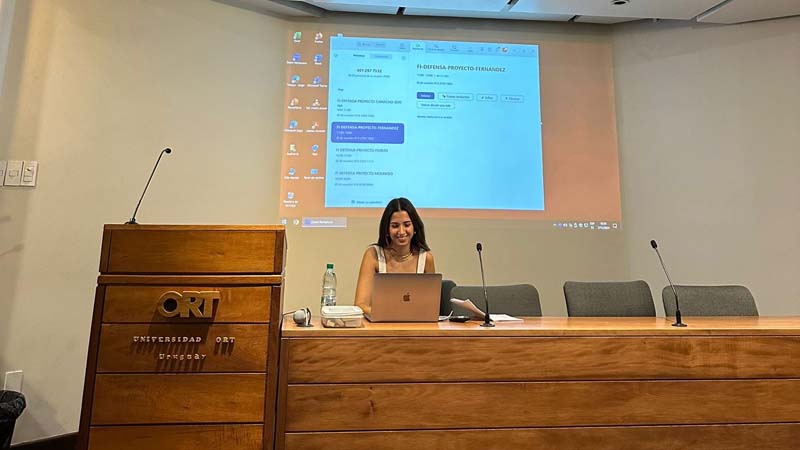
As a result of her work, Josefina created RoleCards, a practical methodological tool designed specifically for startups.
The idea came about following conversations with Dr. Gerardo Matturro, the faculty’s research coordinator for that area, who suggested she explore a topic related to startups and the challenges they face in product management. Inspired by the experiences of other students, Josefina decided to undertake this research on her own.
A journey through interviews and data analysis
To conduct her research, Josefina contacted 35 startups and managed to interview the founders of eight of them—seven of which were incubated at the Center for Innovation and Entrepreneurship (CIE) at Universidad ORT Uruguay one at another incubator. The interviews focused on understanding how the role of the product manager in startups is defined and has evolved.
One of the biggest challenges during the process was analyzing responses from entrepreneurs from diverse backgrounds. This involved identifying patterns and synthesizing data to build a model applicable to everyone.
Ten Key Responsibilities for Product Managers at Startups
Josefina's study identified ten key responsibilities for product managers at startups:
- Define the product's vision, strategy, and roadmap.
- Collect, manage, and prioritize customer and market requirements.
- Act as an advocate for the client, articulating their needs.
- Work closely with other departments, such as sales, marketing, and support.
- Solve problems and make data-driven decisions.
- Lead product teams and coordinate cross-functional efforts.
- Create and manage documentation of product requirements and specifications.
- Gather and prioritize customer and market requirements.
- Be an expert on the market and the product.
- Implement strategies that drive product development.
These responsibilities tend to be decentralized as startups grow. In the early stages, the product manager must take on multiple roles, but over time, these tasks are delegated to specialized teams.

The Importance of Soft Skills
The role of product manager at startups requires strong soft skills. Communication and empathy were the most frequently cited skills in the interviews.
According to Josefina, these professionals should serve as a bridge between the client’s needs and the technical team, ensuring that those needs are effectively communicated.
“Communication is key to understanding what the customer really needs and conveying that information accurately to the team,” Josefina explained.
RoleCards: A Practical and Adaptable Tool
The most tangible outcome of this research was the creation of the RoleCards, a guide consisting of 12 cards that describe essential product management activities in startups. Each card includes:
- Functions or areas related to the conduct of the activity.
- Responsibilities associated with each activity.
- A description of the activity.
- The stage of the product life cycle in which it is most relevant.
- The skills required to carry it out.
- Further reading for those who wish to learn more.
Flexibility is one of the key strengths of RoleCards. They are designed to be practical and adaptable to the needs of each startup, allowing entrepreneurs to choose the most relevant activities based on the current stage of their product.
Validation and Future Opportunities
The RoleCards were validated by four of the startups participating in the initial study. The entrepreneurs found them to be useful, clear, and easy to implement. Although there wasn’t enough time to incorporate all the suggested changes, Josefina noted that the feedback received confirms their potential as a practical resource for startups.
“It’s a guide that can help many startups structure their product management, something that’s often done on the fly,” he said.
Conclusions and Lessons Learned
Josefina Fernández's research represents a significant contribution to a largely unexplored field. Beyond technical knowledge, this project allowed her to develop key skills such as time management, adaptability, and the ability to synthesize information.
“Working on my own taught me how to manage my own schedule and adapt to the unexpected,” she reflected. “This project showed me how important it is to persevere and stay organized at all times.”
With RoleCards as her legacy, Josefina hopes that her work will inspire other startups and future researchers to continue exploring product management as a crucial factor in business success.