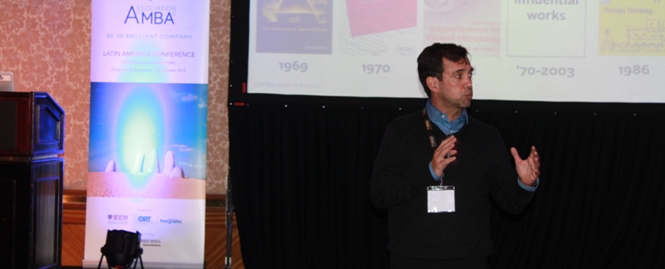
Interview with Dr. Carlos Osorio, director and professor of the Master’s in Innovation program and the Innovation and Entrepreneurship academic unit at Adolfo Ibáñez University, on the occasion of his participation in the 12th Latin America Conference for Deans and Directors organized by the Association of MBAs (AMBA), which took place as part of the 25th anniversary of the Master of Business Administration (MBA) program at Universidad ORT Uruguay.
Osorio is also the founder of the innovation consulting firm Designing Better Futures and serves as a visiting professor at prestigious institutions such as Deusto Business School (Spain) and Amsterdam Business School (Netherlands).
-What are the key strategies business schools use to promote innovation?
-First, you need a faculty that can ensure the sustainability of the programs. Implementing innovation at a university takes time; it can take three, four, or five years to do it right. The first step is to be willing to invest in a team that can do the job well.
The second thing is to be willing to give that team the time and space to do that work. One of the most important aspects of this is understanding that innovation isn’t something you learn by reading—you learn it by doing. People are going to make mistakes, and that has to be recognized and accepted at the university.
Third, we must recognize that the impact of education on innovation depends on what students are able to do with the training they receive. Ultimately, the ultimate test lies in what students are able to achieve once they complete their education. Are they capable of innovating? If they are, we are doing a good job. If they are not, we are doing a poor job, regardless of whether they have excellent grades or the tests are very difficult.

-How do you teach someone to be innovative?
-The key is to help course participants learn to feel comfortable with ambiguity, uncertainty, and risk. Or, even if they don’t feel comfortable, to learn to function under high levels of ambiguity, uncertainty, and risk. When someone reacts poorly to these conditions, that’s when they start making mistakes.
I’ve come across companies that say, “We don’t have an innovation department; we don’t have an innovation manager; we don’t have an innovation model.” But they do innovate because they’re used to operating in environments marked by a lack of clarity, a great deal of ambiguity, a high degree of uncertainty, and high risk—and because they handle these conditions well, they’re able to learn quickly.
-What tools should business schools adopt?
-There are about four hundred tools used to facilitate innovation education. There are two types of tools: those that help us illustrate or document the status of a project at different stages, and those that make our work easier—these are procedural guides.
It will depend a lot on the type of process: developing an innovation in the pharmaceutical industry is different from developing one for software or banking.
Ultimately, what you end up with is a group of people who know how to support students and how to give them the tools they need to figure out for themselves which ones to use.
-What are the benefits of design thinking in business schools?
-The benefits stem from the way we approach problems—not based on what we know, but on our understanding of others. Much of design is based on understanding what the client needs, but more importantly, why they need it. It is important for us to adopt these kinds of tools to foster empathy.
On the other hand, unlike business schools (which are very focused on thinking and planning), design teaches us that, in the end, you have to take action, you have to create something, and you have to have something that works. Only then can we say that we’re doing something that has an impact on the world.
-In which degree programs would you incorporate innovation education?
-In all of them. I would incorporate it starting in elementary school and continuing through high school. It’s like math or learning to read; to me, it’s not much different from that. A doctor, an architect, a chef, an engineer, or a police officer has to know how to innovate. It should be as fundamental as learning to read.
In fact, one of the most striking things is that we’re born with the ability to innovate, but our formal education stifles it. Because we’re taught to do things right, get them right the first time, not repeat them, and not make mistakes. These are rules that don’t make much sense unless you’ve already done something thirty times over.
If you've tried making the same bread recipe thirty times, it's bound to turn out right. You can't go wrong. But if you're making it for the first time, it's impossible not to make a mistake.