 Rodrigo Barreto, who holds a bachelor’s degree in biotechnology, developed an innovative system that improves the efficiency of producing clostridial vaccines for a bacterial toxin that affects livestock.
Bacteria are microscopic living organisms that may seem insignificant, but they play a vital role in maintaining the balance of ecosystems.
They help maintain the delicate biological balance among all organisms that live together and benefit from this relationship.
Bacteria are widely distributed in the environment. In fact, they can be found in the soil, on the skin, and in the gastrointestinal tract of mammals, to the extent that it is estimated there are approximately ten bacterial cells for every human cell in our bodies.
However, just as they can “act” in favor of the natural balance of living organisms, they can sometimes act against it, causing disease when the right conditions are present.
This is the case with the bacterium Clostridium perfringens, which naturally occurs in the gastrointestinal tract of livestock without causing any problems, until its growth and multiplication accelerate due to the overcrowding and overfeeding that animals are subjected to in order to improve livestock productivity.
“When animals are overfed, their diet becomes higher in protein and their gastrointestinal system becomes more acidic. This encourages bacterial growth and promotes the production of a toxin known as epsilon,” explains Barreto, who spent six months studying this toxin as part of his thesis and a partnership between Universidad ORT Uruguay Santa Elena Laboratories.
The epsilon toxin produced by Clostridium perfringens forms molecular complexes that create pores in intestinal cells, allowing the bacteria to enter the bloodstream through these pores and spread throughout the body.
Infection caused by this bacterium leads to massive edema in the affected animal's organs, resulting in death within 24 hours of the onset of symptoms.
Given the critical importance of preventing and controlling this bacterium, Laboratorios Santa Elena produces a vaccine that stimulates the production of antibodies in livestock, thereby conferring resistance to the effects of the epsilon toxin.
“If you look at it from an economic perspective, the infection caused by this bacterium can result in significant losses. It’s very difficult to control once it’s already spreading and producing the toxin,” notes Barreto. That’s why preventive vaccines are developed.
“The vaccine consists of a preparation containing highly purified inactivated epsilon toxin, which works by stimulating the animal’s immune system to produce antibodies that confer resistance against the toxin’s effects.”
The production of this vaccine involves growing the bacteria at Laboratorios Santa Elena’s industrial facilities under optimal conditions so that they produce the epsilon toxin, and then extracting only the toxin from the culture medium to inactivate it and formulate the vaccine doses. To achieve this, a toxin purification process must be carried out.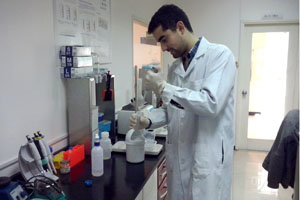
“These cultures contain traces of the bacteria, metabolic waste, and residues from the growth medium. And then there’s the toxin. A specific process must be followed to obtain the pure toxin.”
“There is currently a standardized purification process that is efficient but could be improved. Once production is complete, the laboratory obtains a vaccine that is effective and elicits an immune response against the toxin, but also against any remaining contaminants. The purity yield they achieve is between 80 and 85%,” explains Barreto.
Barreto developed a state-of-the-art method to improve the level of toxin purification and increase the purity of the material to over 90%. The technique he used is called chromatography, a method for separating molecules.
Microspheres made of agarose—a complex sugar produced by algae—were taken and modified by coating their surfaces with antibodies specific to the epsilon toxin. In this way, the antibodies “trapped” the toxin, successfully separating it from the other components of the culture medium.
Barreto also tested another method that also relies on agarose microspheres. “We studied the surface charge of the toxin—whether it was positive or negative. Since we found that it had a predominantly negative charge, we charged the agarose surface positively to attract it, and we also demonstrated that this system could purify the toxin to more than 90%.”
The project was completed once the vaccine containing the epsilon toxin—purified using the new technology—was administered to the animal, which then produced specific antibodies against it.
Using a procedure similar to the one used to purify the epsilon toxin, the antibodies can be purified for use in the initial stage of vaccine production. This part of the project was not fully developed as part of the thesis, and it is what Barreto is currently working on.
“The method we designed is valuable because it helps the company save money. Current purification processes rely on very expensive systems that use filters imported from abroad, and these imports sometimes delay production itself. Producing the supplies needed to implement the methodology we developed is much cheaper, and the laboratory can produce them in-house.”
“There are direct benefits for the company in terms of production savings, benefits because they offer a higher-quality product, and because the vaccine is formulated in smaller doses,” he summarizes.