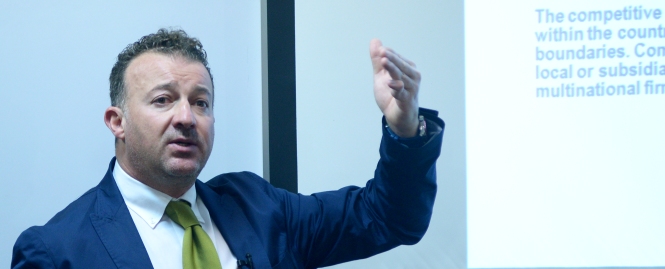
The conference “Challenges of Global Leadership: How to Approach the Internationalization Process?” was held on Thursday, February 12, 2015, in the Hemiciclo at the Pocitos Campus of Universidad ORT Uruguay.
The speaker was José Pla-Barber, a visiting professor in the university’s Master of Business Administration (MBA) program, who holds a Ph.D. in Economics, is a professor of business organization, and serves as director of the doctoral program in Business Administration at the University of Valencia.
The event was part of the Management and Business Lecture Series organized by the Graduate School of the Faculty of Administration and Social Sciences.
Internationalization
Today, it is less of a challenge and more of a necessity. “You shouldn’t ask yourself whether or not you should go global,” said Pla-Barber. “Instead, you should ask yourself: How can I successfully go global?” Going global opens the door to larger markets and resources that we don’t currently have, and allows us to integrate and coordinate on a global scale.
"It's important to have an international outlook, but it's not easy," he noted. There are several challenges that global leaders must face. Pla-Barber focused on the following four:
Challenge 1 - Assess whether the company has the necessary resources and appropriate capabilities
“The key is to have something unique that will make someone want to work with me. We need to have a product or service that creates value,” explained Pla-Barber.
“Companies need people who can adapt to different cultures. But Latinos like to live and work in the same place. On Sundays, we want to make paella at Mom’s house—or, in your case, a barbecue. And companies notice this. When they need to send someone abroad, no one wants to go,” said Pla-Barber.
Human resources are important and, above all, a strategic model for internationalization. Internationalization must be an ongoing process.
In summary, he noted: “We need to grow in size, secure the necessary financial resources, create value, and have a skilled workforce and well-trained managers. Only then will we be able to successfully navigate the process.”
Challenge 2 - Staying informed about what's happening in the world and keeping up with new trends
"Countries and industries are becoming increasingly global," the expert said. "As a result, there is growing interdependence and less room to establish a foothold in these sectors."
The world is changing. “It no longer has a center and a periphery, nor a North and a South. The rise of emerging markets is both powerful and rapid, driven by different models of internationalization, through partnerships and other factors. They seek what they lack. They buy to acquire—among other things—brands and technology,” explained Pla-Barber.
The speaker noted that well-funded companies are entering Europe and the United States. They acquire other companies that are struggling. This results in a two-pronged process of upgrading.
On the one hand, these low-cost products improve in quality because they incorporate the expertise of the company they have acquired. On the other hand, they make the acquiring company more efficient by integrating all of its business processes from the emerging market.
There is a very interesting trend that is producing global leaders. "Forty percent of the world's multinational companies are now based in emerging economies. And that completely changes the landscape of these industries."
“Their internationalization strategies are completely different. Not only are they expanding into emerging markets, but nearly 30% of this investment from emerging markets is flowing into developed countries.”
“Furthermore, 50% of the purchases made by these emerging economies are from companies in developed countries. As a result,emerging-market multinationalsare extremely powerful,” explained Pla-Barber.
Another major change concerns China. “It’s very difficult to compete with this country because it has cutthroat capitalism and—at the same time—a form of communism that keeps them in check.”
“Furthermore, Chinese culture is very important. Among its traditions is the value of hard work. The only way to get rich in a country where there are no princes, no heirs, and no politicians is by working hard. And the Chinese are very hardworking,” he said.
"The playing field has expanded," he said. "Now we're talking about regional or global markets. 'As your industry globalizes and is dominated by multinational companies with a global reach, things get more complicated. There comes a point where, if you don't grow or acquire others, you'll be acquired. You'll disappear,'" the speaker noted.
Pla-Barber noted that the basic export model is becoming obsolete. We have moved from that model to another, in which a value chain was extended and replicated in another country. But this model, too, is becoming obsolete.
"International companies now tend to have value chains spread across the globe," he added. As a result, they are becoming increasingly competitive and difficult to manage.
As the global environment changes, so do businesses. This means, for example, that video rental stores are gradually disappearing, the expert noted. It also leads to the emergence of new businesses. For example: taxi apps.
Challenge 3 - Knowing where to go (which country) and how to get there (what entry options are available)
“Which markets should we target first? The ones where we feel the most cultural affinity,” said Pla-Barber. Understanding cultural differences is vital.
In general, Latin American cultures tend to be more hierarchical, he noted. There is an unequal distribution of power. Their structures are more pyramid-shaped. In contrast, in other societies, hierarchy is virtually nonexistent.
This is very important when deciding who will be in charge and how employees will be managed. Employees in hierarchical cultures want someone to be in charge of them. Those in non-hierarchical cultures want to have leaders, the speaker said.
In some countries, rewards are based on individual performance. In others, the collective is what matters most. In some places, punctuality is very important, and schedules are strictly adhered to. In others, things are more relaxed.
In expressive cultures, we tend to talk a lot, touch each other, and kiss when we greet one another. “If you do that to a Chinese person, they’ll die,” remarked Pla-Barber.
“The countries to visit should be chosen rationally, not just based on intuition; you need to take the time to analyze this aspect,” he said.
There are two very important decisions to make when deciding how to approach an international market. The first is: Should I invest or not? The second is: Should I go it alone or partner with others?
When it comes to the first decision, country-specific factors (market potential, country risk, cultural differences) play a greater role. As for the second decision, the type of product or service being exported has a significant influence.
Challenge 4 - How do I manage and coordinate these international operations?
The final challenge is management. In the initial phase, the subsidiary reports directly to the president. The problem, the expert continued, is that the rest of the company is left out of the loop.
The next step would be to consolidate all international operations under a single umbrella. This is where we stand if it’s a company of average size. The company can grow by adding more countries to the same business. Another avenue for growth, rather than expanding into new countries, is to add new lines of business. The structure must align with the company’s growth model, he said.
https://youtu.be/RgJ6057OawU