In this interview, we’ll hear about the experiences of Federico Palermo, Mauricio Pisabarro, and Ian Spektor, Systems Engineering students who, in the midst of the COVID-19 pandemic, were accepted into internships abroad. With the support of their mentors and the knowledge they gained during their studies, they were able to overcome the challenges the job presented.
Federico Palermo
How did you get in touch with the companies, and what was the interview process like?
I had been thinking about doing an internship abroad, but I didn’t know which company to choose. I started applying online to a bunch of them—some through platforms like LinkedIn or Glassdoor, and others directly through their websites. In the case of Amazon, which was the company that selected me, they have a portal called amazon.jobs, and that’s where I applied.
 About a week later, I received an email invitation to participate in a coding challenge online, which was divided into three parts with programming exercises and multiple-choice questions, which I completed on a platform with a timer.
After passing this stage, I was contacted for interviews—there were two of them, with different members of the team in Italy. During these interviews, I had to solve programming problems while they asked me questions, and then they asked me about my work and academic experience. A week later, they called to tell me I had been selected.
What was it like working at a company as large and well-known as Amazon?
When I joined the company, I had to learn a lot of new internal tools and familiarize myself with Amazon’s various products and services.
I went there expecting to find myself in a huge office, like Google’s famous campus in California, but at the company located in Asti, in northwestern Italy, there were about 30 of us, and the office was quite small.
Everyone knew each other, and many were friends; it had a family-like atmosphere, more like that of a small company. For the first three weeks, I was able to go to the office and meet several colleagues from the various development teams, but as the pandemic worsened, they closed the office, and I worked remotely for the remaining five months.
What was your role at the company?
My position at Amazon was Software Development Engineer Intern. I think there’s a common misconception that, in large companies, new employees are just another face in the crowd. However, given the responsibilities and tasks I was assigned, I never felt that way; on the contrary, my team entrusted me with important projects and came to rely on me in many ways.
On the projects I worked on, I handled almost everything myself—from architectural design and coding to development and quality assurance. Of course, I always had the support of my mentor and other team members, who reviewed my work and were there to help me whenever I had questions.
The internship ran from September 2020 to March 2021, right in the middle of a very difficult period. How did you find that experience?
Since the quarantine rules were pretty strict, I spent almost all my time in my apartment; I’d wake up and get to work, spend the afternoon working on my thesis, chat with friends or family for a while, and then go to sleep.
The pandemic made it hard to meet people and settle into the city. Also, since it’s such a small town, there weren’t many activities to do or places to socialize. Maybe if I’d worked in a bigger city or somewhere where I spoke the language—I don’t speak Italian—it would have been easier to meet people.
Do you think your college education helped you land the internship and do the job?
The training at ORT was crucial in helping me land the internship. The coding exercises—both in the online challenge and during the interviews—are very similar to those covered in courses like Algorithms I and II. You don’t have to be a genius to do well on these exercises; with a solid understanding of those courses and a little review, you can easily perform excellently.
Another important point is that when asked about projects I’ve completed or challenges I’ve faced, they aren’t looking for answers related to work experience; in fact, most of my answers were about assignments I did for my degree program.
As for the work I’ve done in practice, the knowledge I gained in courses like Application Design I and II and Software Architecture is essential for my day-to-day work. It’s very important to understand different patterns and strategies that enable me to write high-quality code, weigh possible alternatives, and discuss which design or architecture is superior to another. Although I had to learn new technologies, mostly related to Amazon Web Services, I believe that the theoretical foundation I acquired at ORT allowed me to participate in and lead these design and architecture discussions very effectively.
Mauricio Pisabarro
What was the interview process like, and how did you get in touch with the companies?
Generally, the process includes a coding challenge, a phone interview, and on-site interviews, which can range from one to four. The on-site interviews are usually conducted remotely for candidates in Uruguay, especially at this time.
In the first part, you must complete one to three programming exercises—which are automatically graded—focused on data structures and algorithms. The goal is to pass the visible (and sometimes hidden) tests to advance to the next round. Then comes the phone interview, where you’ll again complete algorithmic exercises, but this time you’ll explain your reasoning to an engineer—that is, why you arrived at that result and why that solution is the best one.
Finally, on-site interviews are similar to phone interviews, but longer and a bit more challenging. All of these are elimination rounds; while it’s true that you need a bit of luck, you can improve your chances by practicing. I contacted the companies online, but having good references or recommendations ensures that they’ll take a look at your resume.
"ORT gives us a solid foundation in algorithms and data structures; I'd say it's on par with the best universities in the world."
Which company did you get selected for?
My situation was quite unique given the pandemic we’re currently facing. Although I received offers from Google, Facebook, Adobe, and Microsoft, they were unfortunately canceled due to logistical issues. In other cases, such as internships that were to take place in the United States, they were canceled because of the remote work restrictions for international students imposed by former President Donald Trump.
In any case, I now have two job offers: a 12-week internship at Facebook in London starting in August 2021, and a full-time position at Microsoft in Vancouver, Canada, starting in January 2022.
Do you think your education at Universidad ORT Uruguay helped Universidad ORT Uruguay get through all these stages and land the internship?
As for the university’s role in my success, I’d say it was incredibly helpful. First, from an academic standpoint, ORT provides excellent training in algorithms and data structures—which is what’s most useful for interviews—and while you do need to practice to deepen your knowledge, I’d say the preparation is on par with that of the world’s top universities.
Then, from a personal perspective, it was thanks to the students I met in college that I discovered the opportunity to do these internships—for example, Diego Zuluaga, Kevin Chacón, and Martín Copes. They all helped me prepare for the interviews.
Ian Spektor
How did the opportunity to do an internship at Amazon come about, and what tests did you have to take?
The idea of getting an internship like this came up while talking to a friend from college. He told me he knew people his age who had managed to get this kind of experience and that you can apply to any country in the world without hesitation. Generally, they cover all your expenses—travel and accommodation, and in some cases meals—in addition to your salary.
Just to see how it would go, I started applying for jobs in various fields around the world, applying to companies like Google, Facebook, Amazon, and Microsoft, both in the United States and in Europe.
I must have sent out about 20 or 30 applications, and Amazon Madrid got back to me. Within two weeks, I found out the format of the interviews, prepared myself, and went through the interviews, which involved solving two data structure and algorithm problems while explaining what I was doing. Although the position was based in Madrid, the interview was conducted in English, since you’ll be working with people from other countries.
What was it like working at such a large and well-known company?
It's a whole different world. The company's structure, the team, and the work schedule were less laid-back than I expected, especially since I was joining such a young and dynamic team.
This was partly because I was working remotely—my internship began shortly after the start of the COVID-19 pandemic—but also because I was working with highly experienced colleagues on a high-impact product: the Amazon Business website.
It took me a while to get used to it, but once I got my head around it, I was able to make the most of the opportunity and improve my technique a lot; I learned a ton, and I think that’s the most valuable thing I’m taking away from this.
What was your role? 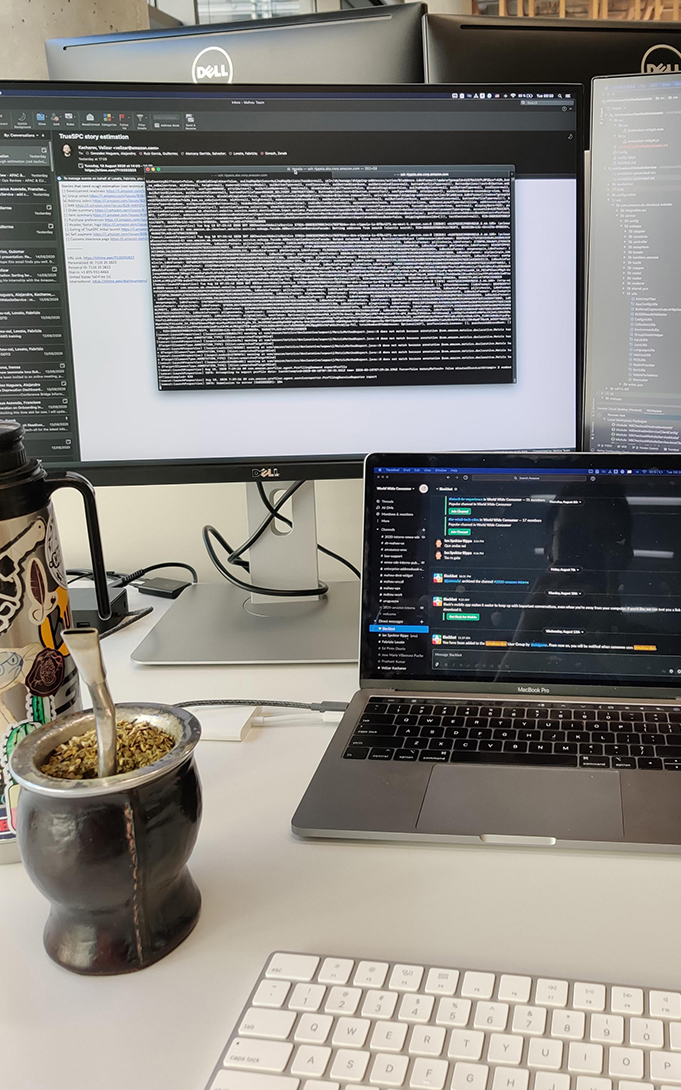 within the company?
During my three-month internship, I was part of one of the development teams at Amazon Business. There were about 12 people on my team, including my manager and the mentor assigned to me—who served as my first point of contact for any questions, whether technical or personal.
This mentor devoted a great deal of time to helping me; I felt very supported by him and the team during times when I felt overwhelmed by the complexity of what I was doing.
How was your experience in Spain, and how did the health situation at the time affect it?
Day-to-day life was tough. Since I’d been on an exchange program in Seville since February, the plan was to finish my classes and head to Madrid for my internship, but the pandemic put a stop to that, and I had to do it online.
Luckily, I was living with friends, so I always had people around me and wasn't alone in my free time, but at work there were times when I felt lost or like I wasn't communicating well with my team.
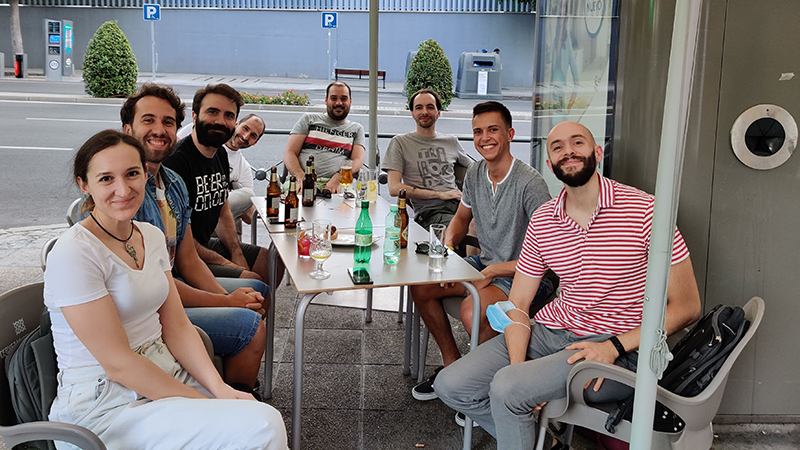
We had a daily standup where I spoke with the team, but beyond that, we communicated whenever I needed them to review my code or answer a question. Luckily, toward the end of my internship, I got to go to Madrid, and that was a whole new world. Being in the office (a huge building in the city center, with every amenity you could want while working) is nothing like sitting alone at a desk. I met almost the entire team; we went out for beers and chatted, and I’m still in touch with some of them to this day.
Do you think your college education helped you land this internship and perform your job well?
While some of the technologies I had to use on a daily basis were owned by Amazon, I was already familiar with many others from having used them in college projects. Plus, I’m sure that having a good GPA at a university like ORT must have played a role in them giving me this opportunity.