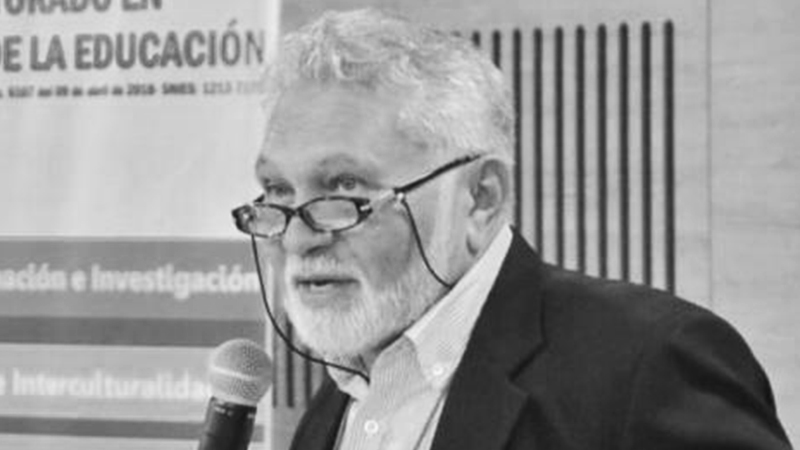
After decades of study and research in the field of Latin American education, Dr. José Rubens Lima Jardilino reflected on the direction that the region’s education systems have taken.
In dialogue with the Latin American educational tradition—and particularly with the legacy of José Pedro Varela—the professor from the Department of Education at the Federal University of Ouro Preto (Brazil) warned of the risks of an increasingly standardized and market-oriented education system, which undermines the holistic development of individuals.
From that perspective, he argued that the challenge is a profoundly human one: rethinking what kind of citizens we aim to educate and what role teachers play in that endeavor.
The Legacy of José Pedro Varela
More than thirty years ago, José Rubens Lima Jardilino arrived in Montevideo with a goal that was unusual in Brazilian education: to delve into the work of a Latin American thinker. While English, French, and American authors were analyzed in detail in his country, regional educational thought was hardly addressed at all.
That absence led him to scour libraries, researching Simón Rodríguez, José Martí, Domingo Faustino Sarmiento, and, in particular, José Pedro Varela.
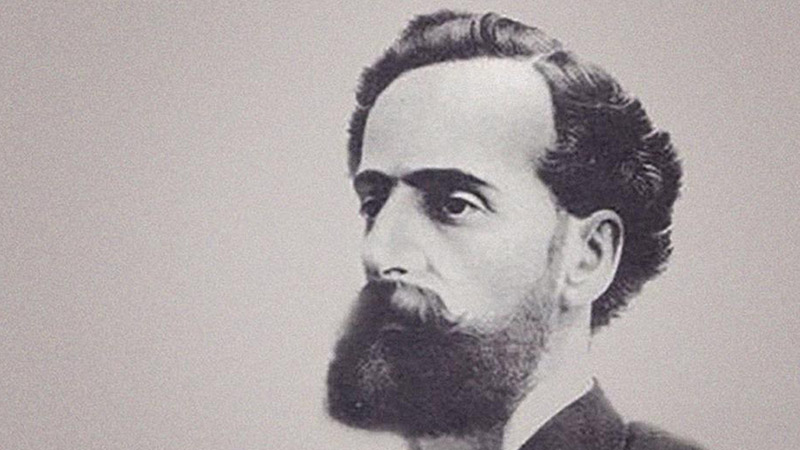
He spent long hours in the library of the Pedagogical Museum reading, analyzing, and summarizing Varela’s work. In addition to developing a course for doctoral students, he was invited to compile a series of books on the subject, intended to introduce Brazilian professors and teachers to the Latin American educational philosophy.
“It was very important, because we never studied Latin American topics in the field of education, ”he recalled. Since then, his connection to Uruguay and the region’s educational tradition has never been broken.
A wave that came from outside
With a long-standing track record in the study of the right to education and teacher training in Latin America, Jardilino avoided simplistic comparisons between countries. However, he identified a common trend: Latin American education systems have been shaped by global dynamics that have prioritized standardization.
“We are caught up in an educational philosophy that comes from outside, like a wave washing over us,” he said. That wave—driven primarily by international organizations—has, in his view, given rise to similar systems, from Mexico to Uruguay.
Today, we have a great responsibility when it comes to raising our children, from a human perspective.
What kind of citizens do we want to raise?
One of the central questions that ran through Jardilino’s reflections was the same one that, as he noted, Varela posed in the 19th century: what kind of citizen do we wish to cultivate?
The current problem, in his view, is that education is geared toward “for”: preparing students for the job market, for technology, and for specific skills.
According to the scholar, schools have moved away from an ontological conception of education, which is aimed at providing a well-rounded education. And external demands—economic, productive, and technological—end up dictating what and how we teach. “We teach specific skills, specific abilities, and specific methods… but we don’t educate the whole person, ”he emphasized.
The idea is to provide education for economic and social development, rather than for the sake of education itself.
Jardilino recalled the time he told his father he wanted to study philosophy.“Can you support a family as a philosopher?” his father asked him. He wasn’t sure, but he was determined to give it a try.
The anecdote highlights a persistent tension: the need for employment “cannot override a well-rounded and comprehensive education, ” especially in basic education.
Although he did not downplay the importance of vocational education, his concern is that education today is focused on “training for work.” In his view, the greatest challenge facing this generation is to overcome the “trend toward technicality” and rediscover the deeper meaning of education. How? “By educating people, not just workers,” he replied.
Teacher training: a persistent challenge
“Today, nothing—absolutely nothing— is more important than teacher training, ”Jardilino stated. Although political speeches often echo this sentiment, he felt that, more often than not, these words end up being empty of substance.
“Our main concern should be teacher training. Meanwhile, what our teachers receive today is standardized training, ”he added.
This is not a new problem: it dates back centuries and has yet to be resolved. What’s more, since the 18th century, teachers “have never been properly valued.”
We need to value teachers if we want to create a different kind of society.
Therefore, his hope is that school systems and education policy will truly recognize the value of teachers, their work, their role, and their training. Beyond social, political, and economic recognition, that would be “the great educational transformation.”
A Utopia for Our Grandchildren
If Jardilino could dream and close his eyes, what would his grandchildren’s education be like? “I’m not much of a dreamer,” he cautioned, though he said he had “more utopian ideals than hope.”
“My wish is for a different world,” he said. Not a world without technological change—because that is “natural”—but a world in which children have the right and the opportunity to “play and be children.”
“My grandson studies every day, all the time; he doesn’t have time to play. And for an 8-year-old not to be able to play is a tragedy, ”he said.
The professor at the Federal University of Ouro Preto revisited Lev Vygotsky’s idea that learning takes place at all times and in many different ways. However, he lamented that schools today have become “people-grinding machines.”
“People, who are all different, enter a box called education. When they come out, they’re all educated and exactly the same, ”he pointed out. In contrast, he believes that school should be a space for collective learning aimed at “shaping different people.”
“I would like my grandchildren to learn without any set standards. I want them to learn through life, and for school to support their growth and development, ”she added.
I am very much in favor of school; I don't believe in a society without schools. It's not possible; there has to be school. But school has to change.
Jardilino hopes to see some changes. “I’d like a different kind of school for my grandchildren: one that shapes compassionate individuals who are aware of their rights.” Specifically, an education for life rather than for the service of others, characterized by “strong ethical values and many learning relationships.”