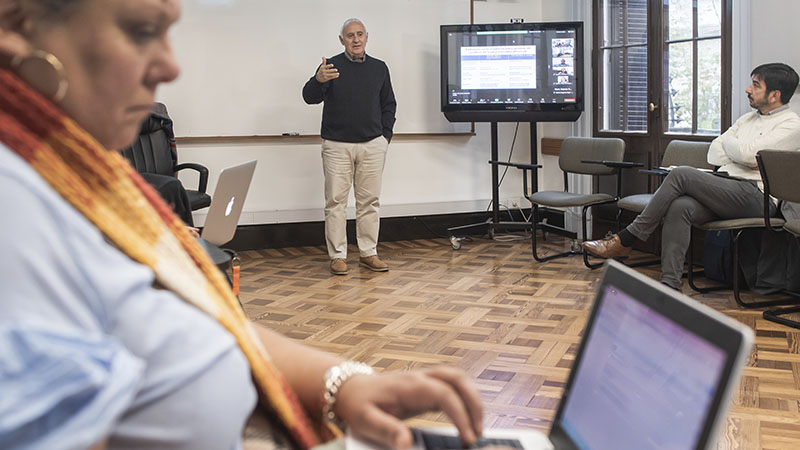
In an ever-changing educational landscape, educational management and the training of educators are becoming crucial to addressing today’s challenges.
In an interview with Dr. Joaquín Gairín, the director of the Center for Research and Studies on Organizational Development at the Autonomous University of Barcelona (Spain) reflected on the challenges faced by current school administrators and offered suggestions for fostering leadership that promotes inclusive, high-quality education.
In addition to analyzing the current challenges facing universities, Gairín delved into the key factors to consider in the training of trainers.
In closing, the chair of the Executive Committee ofthe Educational Management Support Network(RedAGE) emphasized the importance of networking and assessed the impact of this initiative, which aims to bring together institutions involved in educational management in the Ibero-American region.
EDUCATIONAL MANAGEMENT
https://www.youtube.com/watch?v=7H5mMfe2jXI
-
From an academic perspective, what are the main recommendations or suggestions for current school principals?
The first point is that leadership is not just a matter of experience, but also a technical skill. And it is assumed that, to the extent that leaders possess certain strategies and work systems, this can help them exert greater influence.
According to studies by the OECD and other organizations, when it comes to educational quality, the most influential factor is teamwork among teachers, followed by school administrators. But that does not mean that simply being an administrator guarantees good results.
This means that when managers have strategies to foster collaborative work, focus on change management, promote distributed leadership, and champion inclusion and certain values, this can lead to more effective outcomes.
-
In your experience, what are the main challenges facing school principals today?
We live in a constantly changing, highly dynamic world that continually introduces new developments that should be of interest to students—and, therefore, to educational institutions.
In recent years, there has been a strong emphasis—both within schools and on the international stage—on quality and equity. This means providing a higher-quality education, but one that also takes into account the differences among individuals.
Another key factor is the digital transformation of society. For schools, it is important that teachers possess the necessary digital skills and continue to develop them, so that students can acquire those skills as well.
Therefore, it is important for schools to focus on inclusivity, digital literacy, and strengthening values-based education. Many of these issues were not on school administrators’ agendas a few years ago, but they are now prominently featured.
Education-centered leadership, pedagogical leadership, school administrators as agents of social change (not just educational change), and the ability to influence teacher training are new elements that school administrators must address and for which they must develop strategies and working systems.
-
What strategies should we focus on to address these issues?
Schooling systems have made education widely accessible, which is generally viewed as a positive development. However, they have also increased the complexity of the educational process, as new content and teaching methods have emerged.
It is important to understand that leadership and work must be collaborative. That is why we speak of distributed leadership—a leadership style that is strongly focused on change. We also speak of leadership teams, since the challenge is not just for one person, but for the entire faculty and for the individuals who coordinate the faculty’s work.
In other words, teamwork that is always focused on achieving the best educational outcomes, for a society that increasingly demands citizens who are more critical and more engaged.
TRAINING OF TRAINERS
https://www.youtube.com/watch?v=P1X7j7iFpbE
-
What are the current challenges facing universities in fostering the skills of teacher educators?
Like many institutions, universities have been affected by the rapid changes of recent times. And, in my view, they have been particularly impacted by the COVID-19 pandemic, which forced them to suspend their activities.
It is true that it had a positive effect: the expansion of virtual systems. But it also had a negative effect, which is a certain loss of what universities are all about: in-person interaction.
One of the first challenges facing universities is to redefine their role in a society that has changed substantially, and to widely integrate both in-person and online learning models. This is taking place in a context where knowledge is increasingly disseminated through various channels, with students who sometimes struggle to stay focused and, at other times, are better informed than the professors themselves.
In other words, from an educational perspective, the challenges facing universities include updating teaching methods, revising assessment systems, and promoting knowledge—all while engaging students and maintaining high standards of professionalism.
It is true that these challenges are not the only ones, because in order to address them, structural changes will likely be necessary. We must also seek out financial resources, which have sometimes been limited due to the socioeconomic circumstances of these countries.
On the other hand, certain policies have prioritized teaching over research and fail to recognize that a university must train professionals who are capable of continuously updating their knowledge. And that has to do with research, development, and transparency.
-
How can we improve the training of trainers?
The training of educators is currently under review in virtually all countries. This is partly understandable, as the social context has changed significantly, as have the demands of the educational world.
This necessitates changes to school curricula and the programs designed to implement them. In this regard, teacher training is currently undergoing a major overhaul to address the need to make schools more inclusive, more technologically advanced, and better equipped to promote values-based education, as well as to foster collaborative work and the soft skills of the students themselves.
Therefore, as contexts change, curricula change, organizational systems change, and, naturally, teachers must be able to adapt to these changes. This raises questions about initial teacher training. In other words, are we giving them the tools they will need to handle these new situations? The answer is no.
In many places, progress has already been made toward a training model that focuses less on content and more on professional skills. Significant progress has also been made in incorporating longer-term curricular internships at educational institutions into the training program. Progress has also been made in what we might call project-based learning. But all of this must be seamlessly integrated into the curricula, which need to be updated.
Finally, a change in the programs must entail a change in the trainers of trainers for those programs, in the evaluation systems, and, of course, in the improvements that need to be made based on the results obtained.
REDAGE
https://www.youtube.com/watch?v=7TkbzDyIW2s
-
More than 15 years after the creation of RedAGE, what is the overall assessment of the initiative? What are its most significant contributions to education management in Ibero-America?
As its name suggests, RedAGE is a network. It was originally created to bring together institutions from Latin American countries that recognized that collaborative work is more effective than working alone. The idea was that this collaborative effort could be focused on promoting and advancing educational management in Latin America.
An educational management system that needed to evolve: from highly authoritarian models, heavily reliant on centralized educational systems, to more decentralized models tailored to specific contexts and the needs of students. In this regard, the network was designed to foster a more context-specific and nuanced reflection on management within the various educational settings.
Over the years, we have published an annual report on issues affecting school administration. These topics range from how to approach school operations during the pandemic to the responsibilities of school principals and how teamwork among teachers and the administrative team is evolving.
But I believe that, beyond those annual reports and the occasional supplementary publication we’ve produced, the greatest achievement is that we’ve established a network of institutions capable of collaborating through representatives from 15 countries, more than 32 member organizations, and over 400 institutions.
Work is underway on the concept of a vast Ibero-American region where people, taking advantage of their shared language, exchange experiences. It is the only example I know of, on a broad scale, in Ibero-America, that has stood the test of time. So it must have done something right.
-
In particular, what is your view of the work that RedAGE Uruguay has been doing?
Many countries are involved in the network, which is understood as a group of nodes. Each country is a node, within which various institutions are expected to be integrated.
We could say that, in a way, Universidad ORT Uruguay the pioneer in promoting this idea within the country. Others have followed suit, but ORT—which launched this initiative in partnership with the Autonomous University of Barcelona—has been the most active.
RedAGE Uruguay has successfully established its own network within the country and has carried out several initiatives in collaboration with the public education administration. As a result, it has become a model that other countries look to with envy, because here they have managed to involve the ANEP, the ministry, as well as various agencies and schools.
I think they're on the right track, and in any case, the goal is to expand the initiative a bit further and invite more institutions to join in.
-
Why is networking important? What are the key lessons you’ve learned from this way of working?
In a globalized world, networking is a necessity. We should not duplicate knowledge, but rather share it, because we can learn from one another. And in a knowledge society, networking is indispensable.
Furthermore, it enriches us. We learn new approaches, solutions to specific problems, ways to approach management interventions, and new concepts. Networking strengthens our own expertise and contributes to an indirect benefit: the formation of friendships.
We have a lot in common, beyond just language. And the network itself facilitates this exchange. I would say that those who were involved in launching the initiative are no longer a group of people representing institutions, but rather a group of friends, so to speak, who have ties to institutions.
And one positive outcome has been that the network has helped promote international projects. We’ve had the ACCEDES project and the ORACLE project. Now we have another project, which focuses more on Central America but also uses the network to promote innovation and change.
Beyond these general effects, there is the fact that it promotes exchanges. Central American countries have engaged in exchanges with other countries thanks to the network. And South American countries have engaged in exchanges with Central American countries. We are building a network, which was the goal.

In June 2024, Dr. Joaquín Gairín visited theInstitute of Educationto teach the following courses:
- Organizational Development Process Management, part of the third semester ofthe Master’s in Educational Management(offered by the Universidad ORT Uruguay, in partnership withthe ReachingU Foundation).
- Training Needs Assessment, part of the third semester ofthe Master’s Program in Training of Trainers.