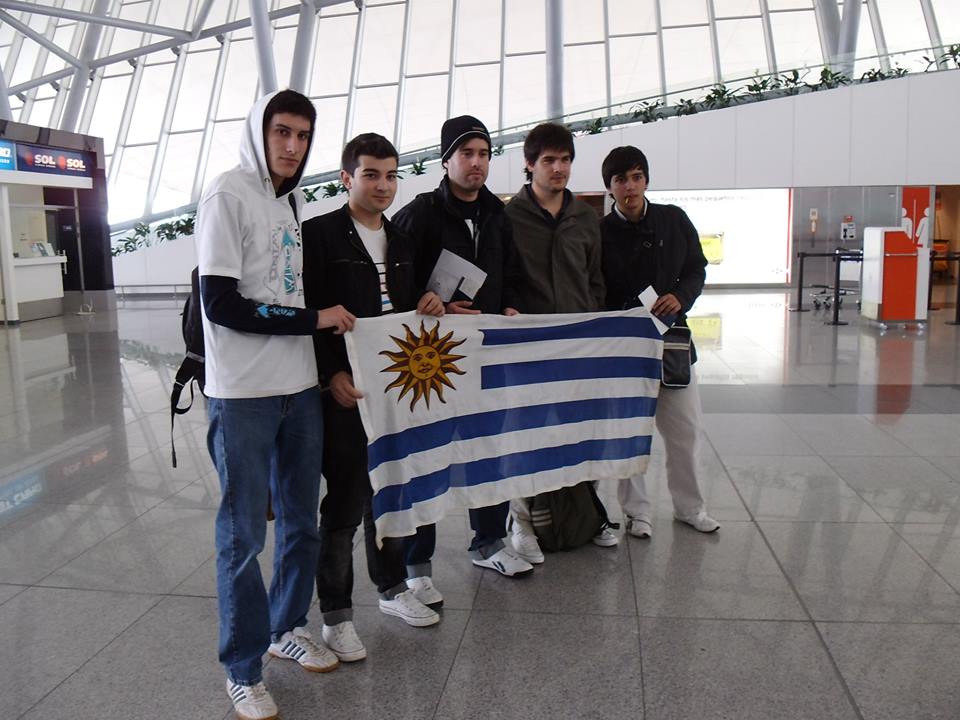
In a sporting feat of the kind we Uruguayans have come to expect, five young men from Colonia—Manuel Bravo, a bachelor’s student in Information Systems at Universidad ORT Uruguay, Christian Zurbrigg, Lucas Díaz, Santiago Rosa, and Matías López—won the title in the IEEE Standard Education Kits (SEK) category at the XII LARC robotics competition.
Getting Started
Their foray into robotics dates back to 2010, when Manuel and Christian were in 6th grade at Liceo No. 1 in Colonia.
Both are young people who were invited to participate in a robotics workshop to learn how to program using Lego Mindstorms NXT, and thus take part in the departmental and national Student Robotics Competition—RAES (Robotics Applied to Secondary Education).
“We didn’t have the faintest idea what robotics was, let alone programming, but our curiosity got the better of us, and Christian and I signed up for that workshop. That’s when our adventure with Lego robots began,” recalls Manuel.
Contests
The adventure had its ups and downs: they placed second in the 2010 Sumo.uy event; in the 2011 edition, they took first and second place in different categories; in 2012, they decided to compete in a more challenging category that served as a qualifier for an international event, but they didn’t make the cut that time—they knew they needed to train harder.
For their part, Santiago, Matías, and Lucas competed in RAES and took first place.
So, the five young people decided to pool their knowledge and enthusiasm, and began preparing well in advance to compete in several categories of the 2013 edition of Sumo.uy.
The Big Leap
Manuel says that preparing for the test took a long time, but it was worth the effort.
They had to buy the materials and build the tracks because they had nowhere to test the robot, and they went through many different designs.
They finally secured victory in the qualifying round to compete in the 12th LARC, held in Peru in October.
From Cologne to Peru
How do I pay for the trip?
There was still a month to go before the competition, and they still didn't know if they would be able to travel because they didn't have enough money to pay for the tickets.
From that moment on, they began a race against time to secure the remaining funds; they approached several companies in Colonia but received little support, so Manuel decided to seek help from the ORT School of Engineering, where he was studying at the time.
ORT contributed a substantial amount toward the travel expenses, and the Faculty of Engineering at the University of the Republic (UdelaR) awarded them an additional cash prize for winning first place in the Suma.uy competition.
Although these two contributions were a great help, the young people were nowhere near covering the full cost of the trip, which came to seven thousand dollars.
With two weeks to go before the trip, they hadn't managed to raise the money, so they dipped into their own pockets and took out a loan offered to them by the Parent-Teacher Association of Colonia High School No. 1.
As a last resort, they set up an account with Abitab so that anyone who wanted to could contribute.
So, by scraping together a little here and there, they managed to raise all the money they needed to set off for Peru in pursuit of the title.
The game
Around noon on Monday, October 21, 2013, they left Colonia and headed to Carrasco Airport. Six hours later, the plane took off for Arequipa, Peru.
Once in Peru, the experience was excellent. Manuel says it was a very friendly competition: “The interactions were very friendly with all the teams right from the start. Young people from Brazil, Chile, Bolivia, Paraguay, Peru, Mexico, and Venezuela took part, and everyone was always in good spirits.”
Uruguay 1 – Brazil 0
The competition
This year's event was called THball (Throw and Hold), and the competition took place on a two-meter-by-two-meter court divided in half by a net ten centimeters high. The game involved using a robot to throw small balls into the opposing team's half of the court.
The winning team was the one that scored the most points during the game.
The Uruguayan team finished third in the group stage. The next day, they won all four of their group matches without much trouble, advancing to the quarterfinals as group winners.
Finalists
Up to that point, they had managed to win without much trouble, but when they reached the final, they had to face the 2012 runners-up, the Brazilian team Univille.
Manuel says, “That was the only game where we had to fight hard for the win. They relied heavily on strategy…”
There were twenty seconds left, and the Brazilians kept fighting relentlessly, but Manuel and his teammates weren't letting up either—fifteen seconds, ten, five… and finally they heard the final whistle.
Chanting “Uruguay nomá” and sharing a group hug, the five men from Colonia celebrated their victory.
But the competition wasn't over yet; the judges still had to tally the points. They had to review the game footage to verify each team's score.
The tension returned for another five interminable minutes; thanks to a tactical error by the Brazilians, who lost two points, there was no tie and no second match.
The Uruguayan team was the winner of the night, and the joy was immense.
Welcome, champions!
Meanwhile, in Cologne, people were following the game minute by minute via Facebook and text messages.
The young people's victory was a cause for celebration among their friends, family, and high school teachers. Plans for a grand welcome for the champions were immediately set in motion.
On Sunday, October 27, 2013, at Carrasco Airport, a group of people from Colonia waited eagerly with flags and signs for Manuel, Christian, Lucas, Santiago, and Matías, the heroes of the moment.
“It was a wonderful surprise to be greeted like that. The next day, in Colonia, we were welcomed at the high school by students, teachers, and our families—it was another very emotional moment,” recalls Manuel.