In 1982, González Alonso published his first comic strip: *El almohadón de plumas* (The Feather Pillow), an adaptation by Elvio Gandolfo of Horacio Quiroga’s short story, in the magazine *El Dedo*. Since then, he has published sporadically in *Guambia*, *La República*, *Punto y aparte*, *Sábado Show*, and other weekly publications. In 2001, he collaborated with Tunda, Ombú, Renzo Vayra, and Eduardo Barreto on thegraphic novel*Historiet@s.uy*, adapting Acevedo Díaz’s *El combate de la tapera *.
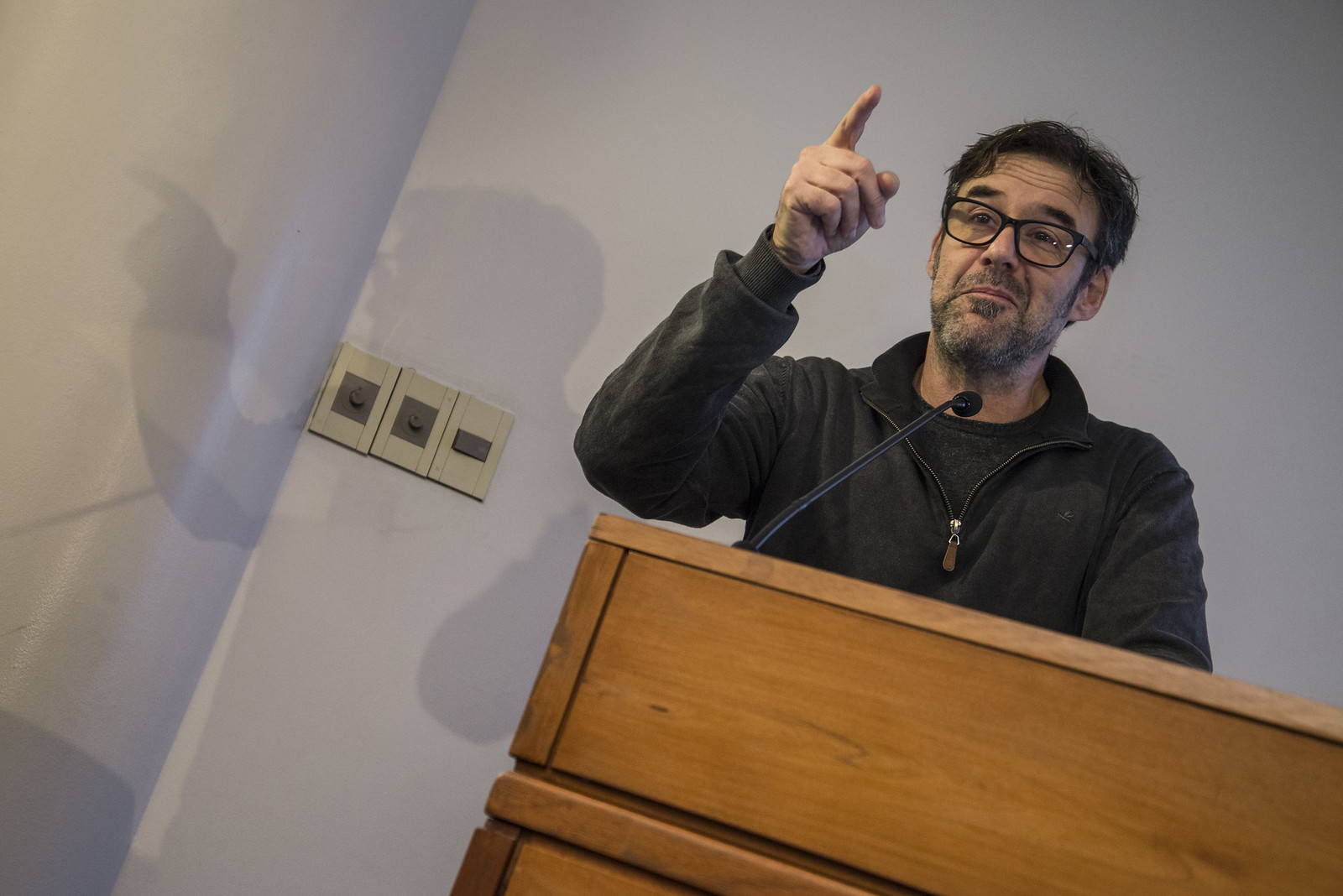
The illustrator visited the School of Design to talk about how he creates his comics.
“I’ve always loved drawing and telling stories,” he remarked. “How does a comic start? In various ways: from an idea—which may or may not come from me—from reading stories, hearing anecdotes, or from something I read that stays with me. Another option is to receive a script.” He added that he had never written his own script.
I can't read books because I'm constantly seeing images; my mind translates everything into frames. I apply my knowledge of film to comics: I visualize frames, timing, and everything else related to storytelling.
Every story, he said, “has a beginning, a middle, and an end.” The same should be true for every page: there should be a beginning, a middle, and an end. “Each page must be wrapped up before moving on to the next,” he remarked. “For the reader, it has to flow smoothly; they shouldn’t have to stop and think about who is speaking to whom or who is chasing whom. It must be clear in every panel based on the perspective.”
“Knowing how to draw means knowing how to communicate; it’s not about copying reality,” he said.
He recalled that he read *El combate de la tapera* in fifth or sixth grade and adapted it into a comic book in 2000. “It’s a very visual story,” he noted.
González Alonso currently works for an American publisher of Spanish-language books. He has worked in advertising and film. He is now “80 or 90 percent” focused on comics.