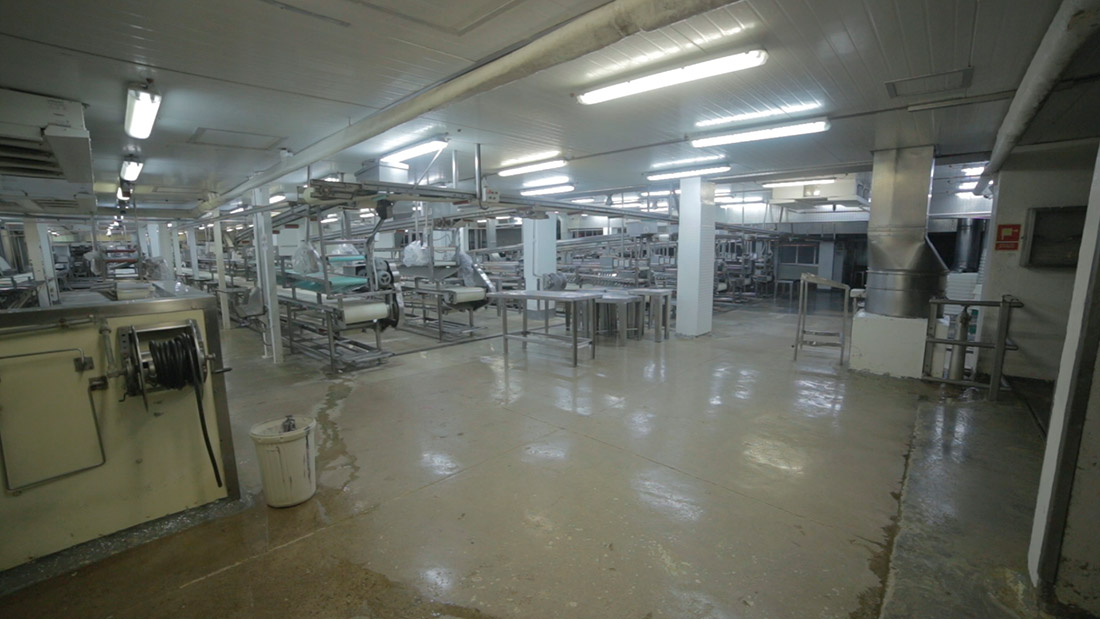
Pecera addresses the conflict that began in August 2015 between the company Fripur and its workers. After 39 years in business and with a workforce composed of 90% female heads of household, the company laid off its 960 employees. In the wake of the layoffs and the debts Fripur owed its workers, some of the employees decided to occupy the company in search of a solution. It is in this context that Marlen appears, a 52-year-old woman who has worked her entire life at the company. Marlen takes us through every corner of a paralyzed factory where every nook and cranny hides a story.
This is *Pecera* (Ping Pong Audiovisual Content), the first feature-length documentary by Emiliano Grassi, who holds a degree in Audiovisual Production from Universidad ORT Uruguay.
This Thursday, July 13, at 7:00 p.m., *Pecera* will be screened at the Spanish Cultural Center, with free admission. It will then tour various film festivals, and discussions are already underway with several theaters regarding its screening.
https://www.youtube.com/watch?v=CYL3c_UiIwU
When did you start working on the idea that led to Pecera?
*Pecera* emerged out of necessity. 2015 was a year of great turmoil as the government was allocating budget funds. Against that backdrop, and for various reasons, several companies shut down. When Fripur ceased operations, it was an instinctive reaction to go film what was happening. From my perspective—and I believe from that of every filmmaker—the most natural way to engage with what’s happening around us is through the camera, and that’s how I first experienced what was going on at the plant.
Does "Pecera " tell the story of Marlen or the closure of Fripur?
First of all, our intention was never to tell a story through the documentary. From the very beginning, we committed ourselves to serving as a bridge between what was happening inside the plant and the outside world, but also to being a listening ear for the people who were occupying it. We took the Brazilian master Eduardo Coutinho as our inspiration and let the act of sharing an experience or a feeling on camera take center stage and guide the documentary. This led the film to follow two narrative threads: the Fripur conflict and everything that unfolded at the plant during the year it was occupied, and the experience of Marlen, who managed to set aside her pain to become a role model for the other women.
How did you find her?
Working with Pecera taught me that the most important quality for anyone who wants to make a documentary—besides listening and observing everything around them—is to always be open to being surprised. To be prepared for the unexpected at all times.
Marlen just showed up like that. It was a surprise. Since I, as the director, had no intention of telling a story from my own perspective, her character unfolded before her—and before us—at the same time.
This is your first feature-length documentary. Have you always been interested in the genre, or did you simply feel it was the right choice for telling this story?
I’ve made several short documentaries and have explored the genre. I feel comfortable with it and enjoy the storytelling I find in documentary film. For this project, I never doubted that the documentary was the only way to capture what people were experiencing at Fripur.
On the other hand, the process of building an idea from scratch—something that exists entirely in my mind—and bringing it to life seems incredible to me. I’m currently working on a screenplay for a feature film.
What was the biggest challenge you faced in terms of storytelling?
The biggest challenge was sifting through endless hours of footage and finding a way to stay true to the characters' stories while having thousands of different stories to tell.