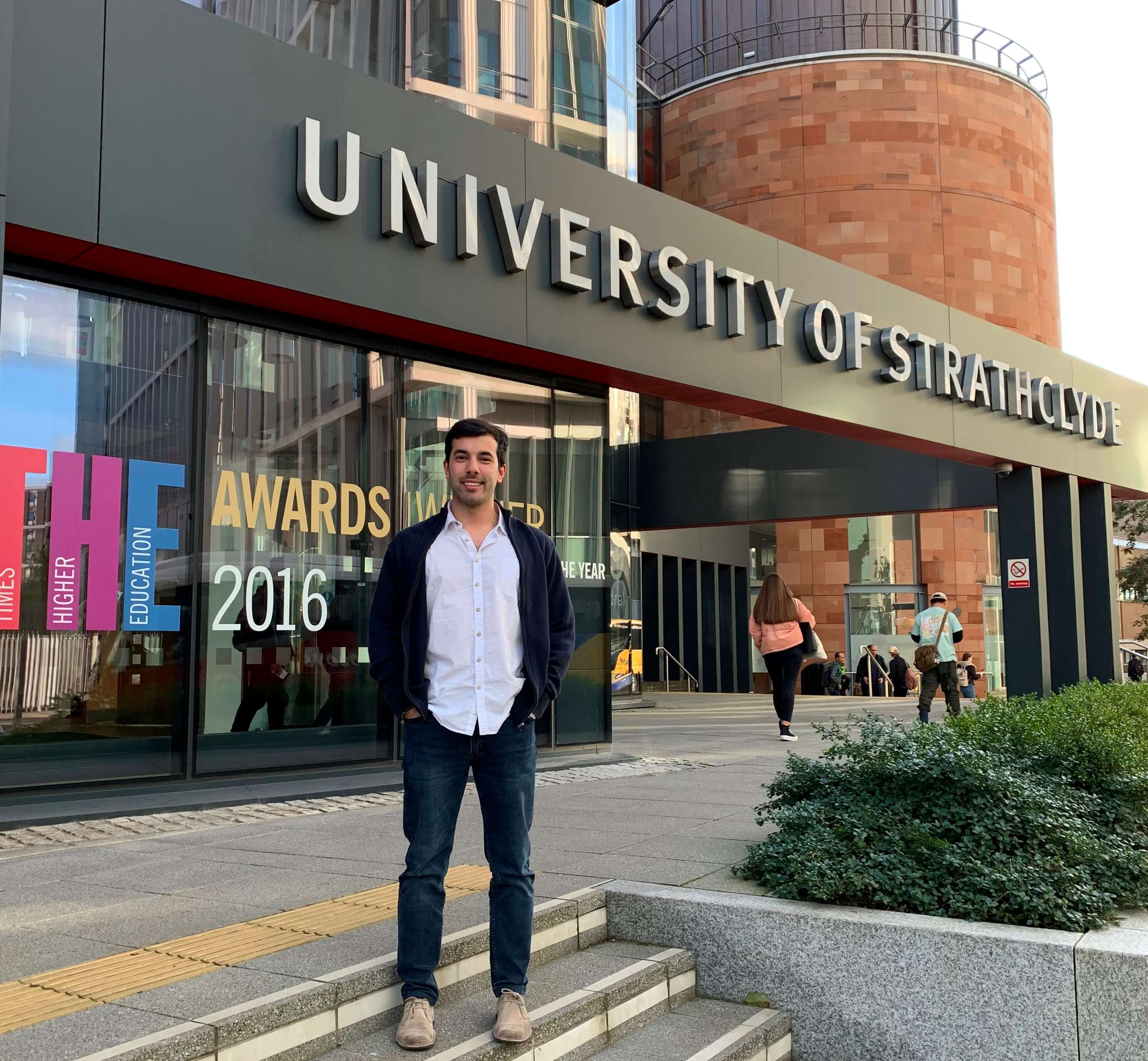
Inspired by his final thesis project and the opportunities offered by the field, Mascheroni decided to specialize in biomedical engineering—a field that often goes unnoticed but helps improve people’s quality of life.
How and when did you decide to study abroad?
After completing my master’s degree in ORT, I began exploring the possibility of studying abroad, primarily with the goal of expanding my knowledge in the field of biomedical engineering. Inspired by my final thesis project—in which I collaborated with CCC Medical Devices on an automated testing system for implantable devices—I decided to specialize in what I truly love: electronic engineering and its contributions to healthcare.
What was it like to apply to a university abroad—and one as prestigious as that?
For a while, I researched universities specializing in biomedical engineering, reviewing the various programs, faculty, and ongoing projects at each institution.
After considering all my options, I decided that the United Kingdom would be the best choice, not only because of the high academic standards but also because it would give me the chance to improve my English.
Universities in the UK are very selective; you must complete a series of procedures and submit various documents, as well as a personal statement in which you explain your interests and why you’ve chosen that particular university. In addition, you must submit two letters of recommendation from professors; in my case, I am grateful to my thesis advisor, Ismael Garrido, and to André Fonseca, two of my most outstanding professors, and finally, I had two remote interviews.
Your final project was related to the healthcare field. How does electronics contribute to this field, and what benefits and opportunities does it offer?
Electronics are a constant presence in our lives, from computers to cell phones. But in medicine, this presence isn’t as obvious, even though it accompanies us from birth to death—for example, in detecting the fetal heart rate via ultrasound or obtaining the first images of the fetus with ultrasound machines, all the way through to coronary care units and intensive care units. All these medical tools aid in diagnosis, treatment, and improving our quality of life.
My project helped me understand and appreciate the wonderful contributions that electronics can make to improving people's lives and addressing health issues in a field with limitless potential for growth.
Now, at the University of Strathclyde, I can clearly see the noble potential of this field, which promises greater well-being, benefits, and opportunities for society.
How did your degree prepare you to take on these new challenges?
I believe that my two years of study at the university allowed me to gain new knowledge and strengthened my desire to take on new challenges. In fact, this drive to take on new challenges is something I developed while studying at ORT, and it was crucial in helping me navigate this new phase of my life—so far from home and with so many changes.
What's life like for you in Glasgow?
I'm still trying to adjust because the schedules here are quite different from those in Uruguay—they have dinner around 7:00 p.m., and in winter the sun sets at 4:00 p.m.
The university campus is located in the heart of Glasgow, so I'm close to everything. I'm currently living in a building exclusively for students, which, luckily, allows me to have my own apartment and gives me more independence.
My day starts at 7 a.m., and I usually have five hours of classes every day. After that, I study for a few hours in the library, and then I go to the gym to relax and clear my head for a while.
On the weekends, I try to explore the city. Glasgow is beautiful, offers a wide variety of things to do, and the people are friendly to visitors. Sometimes I try to visit nearby places; I’ve already been to London, Edinburgh, and Stirling.
Fortunately, I got along well with several students, and we organized weekend outings; we formed a great group, and we all come from different parts of the world.
I think one of the best experiences is interacting with people from such different countries, because it allows you to learn about other cultures and different perspectives.