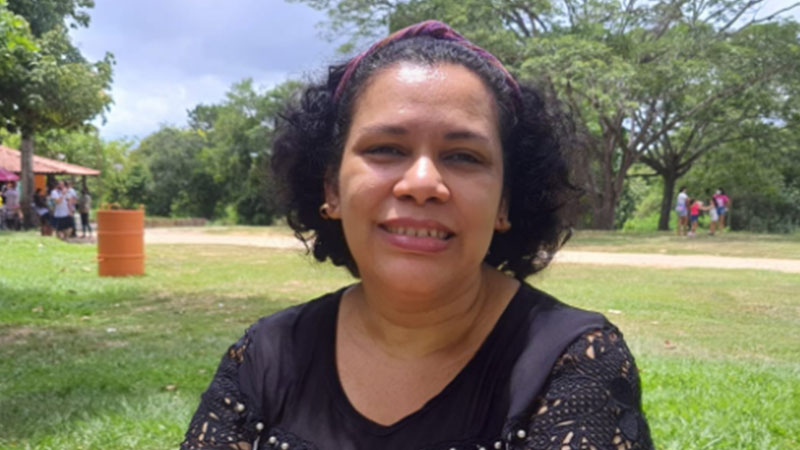
“There are things in life that are extremely difficult to measure, others that are impossible, and this experience is one of them,” said Dr. Lucía Ferreira Trindade.
The professor at the Federal University of Recôncavo da Bahia (UFRB) and the State University of Southwest Bahia (UESB)—who completed a postdoctoral fellowship at the Institute of Education at Universidad ORT Uruguayemphasized that the experience was “priceless.”
Ferreira Trindade also described what her internship entailed and explained what she learned from the experience.
Why did you decide to study at the Institute of Education at Universidad ORT Uruguay?
I first learned about the Institute of Education through Dr. Denise Vaillant, whose writings form part of my theoretical framework. In my opinion, Universidad ORT Uruguay plays a prominent role in the construction of knowledge, as it is the institution with which this researcher is affiliated, which also highlights many works on the topic I am studying: professional development for teachers.
Since this is a subject I have been researching for eight years—writing articles, advising undergraduate research projects, dissertations, and theses—I had no doubt that my time at the institution would mark a turning point in my teaching career.
At the same time, I felt that Vaillant’s guidance would be essential to my personal, academic, scientific, and cultural growth.
I applied for an internship at Universidad ORT Uruguay in Universidad ORT Uruguay I wanted to keep challenging myself; to grow, move forward, and learn from the best.
Specifically, what duties did you perform at the Institute?
I held regular meetings with the supervisor, attended a class in the Doctor of Education program at Universidad ORT Uruguay, and produced an introductory video for new students in that program.
I also launched a study aimed at examining the experiences of new elementary school teachers in Latin America regarding their transition into the teaching profession and their professional development over the past five years.
What differences and similarities did you find between the education system in Uruguay and that of your country?
Brazil and Uruguay are neighboring countries, but there are significant differences between them when it comes to education. Uruguay is in a better position in terms of its population’s literacy rates. Compared to Brazil, my country still has a long way to go in this area.
As for the internship, how would you sum up the experience? What do you think you’ve contributed to the institute, and what have you gained from it?
It was a formative experience. The lessons I learned at the Institute of Education led me to reflect on my research and teaching practices. As a university professor, I believe this postdoctoral fellowship gave me the opportunity to deepen my understanding of the topic of teacher professional development, with a particular focus on the unique challenges faced by beginning teachers.
I have gained many different insights, all of which have been rewarding and have helped me grow at every stage of the process. As a result, I now have a clearer understanding of my responsibilities as a teacher educator and researcher.
As for the contribution I made to the institution, I believe what stands out is the openness to collaboration, the willingness to continue working together, and the potential for change. I felt that, through this internship, I could contribute in some way to the University, ensuring that I honored the commitment to doing science. I hope I succeeded.
It was a very important process for my growth as a researcher, as a trainer of trainers, and as a person.
What do you think is the value and importance of having the opportunity to do an internship like this? Would you recommend it to other students?
Undertaking an internship like this has enabled me to engage in scientific work. And this is very important, because in the scientific field, one contributes by arguing, asking questions, analyzing, constructing and deconstructing, producing, and promoting research.
During this internship, I sought—and found—an experience that would allow me to transform myself and be transformed. Now that it’s over, the word that best describes it is gratitude. That’s why I recommend it to other students, as it’s an unparalleled opportunity for cultural, social, and professional growth—especially when you’re committed to it.
Finally, what three pieces of advice would you give to students pursuing a Ph.D.?
First of all, a doctoral program is an unparalleled opportunity to gain knowledge, so make the most of it.
Second, it is both a challenge and a responsibility. It is the final stage of academic training that leads many professionals into the teaching profession. In that regard, my suggestion is that they pursue their training through and within the doctoral program.
In conclusion, research plays a fundamental role in the professional development of researchers. I therefore encourage you to challenge yourselves to conduct research, innovate, and make discoveries possible.