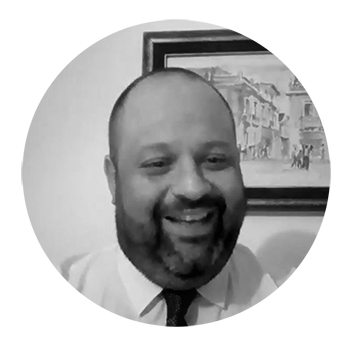
 Rodolfo Sosa has been working in educational administration and as a classroom teacher in secondary education for over twenty years. He is a professor at Universidad ORT Uruguay, specifically in the School of Architecture and in the School of Communication and Design. He has also been a member of the Board of Directors of the St. George's School.
In the midst of the pandemic, what was it like to defend your thesis online?
I view this experience of navigating this unconventional setting very positively and recognize that the virtual environment entails new ways of working, with a different logic than that of in-person interactions.
Presenting the defense in a virtual format required striking a better balance between visual aids and oral presentation, so that the message would be clear to the court and highlight the most relevant aspects of the research.
Together with other classmates in our cohort, and after consulting with the program coordinator, we decided to try out different styles of virtual presentations to anticipate and avoid potential difficulties.
Virtual thesis defenses offer several advantages, such as allowing for greater control over teaching materials and enabling the presenter to focus more fully on the content of the presentation. Another advantage of the virtual format is the ability to include international experts on the evaluation committee. In my case, I had the support of Dr. Ana María de Albuquerque Moreira from the University of Brasília, who provided substantial critiques and contributions to my thesis.
The personalized support provided by the tutors and coordinators at the Institute of Education was essential to successfully navigating this stage; they consistently contributed their experience and professionalism
What was it like to finish your final project under those circumstances?
It was an intense work experience: many hours of reading, writing, and rewriting. The process was marked by the uncertainty caused by the global pandemic, compounded by the pressure of completing a phase of my education.
Another aspect I would like to highlight is the high degree of organization of the various courses in the master’s program. As a student, I never had any trouble accessing all the information, faculty feedback, and assessments. To some extent, we were prepared for a virtual defense scenario thanks to our prior experience.
What motivated you to continue your education and training?
The main motivation stemmed from the very nature of the field of education and its ever-changing nature. The demands of the new horizons that guide us day by day are not consistent with the undergraduate training that most of us teachers received.
I decided to pursue a master’s degree in Educational Management because I wanted a structured program that would foster deeper reflection on institutional practices and guide efforts toward change.
What have you learned, or what is the most valuable insight you’ve gained from the graduate program?
I am very satisfied with the graduate program. As a side note, while preparing for my thesis defense, I reviewed the program outcomes on the university’s website and, as a way of reviewing the material, I was able to confirm that I feel well-prepared to carry out the tasks expected of someone with a Master’s degree in Educational Management.
There are several points I would like to highlight regarding what I have learned over the years, but I would like to emphasize two in particular. First, the importance of considering institutional advisory processes—not only from the perspective of diagnosis, but also in terms of developing and implementing institutional improvement plans. Second, the importance of involving institutional stakeholders in research and organizational change processes.
If we want to continue improving education in Uruguay, graduates of the Master’s in Educational Management have a lot to contribute—and even more to do—within the education system
In your work, what aspect do you think you’ll be able to improve or enhance as a result of completing your master’s degree?
In educational administration, there is a wealth of accumulated experience that is not always accompanied by theoretical reflection, much less by the development of proposals that are tailored to the complex institutional landscape of Uruguayan education.
In times of uncertainty, choosing to professionalize management—not only in terms of assessment but also in the implementation and monitoring of improvement plans—means establishing frameworks that foster creativity and educational innovation.
The master’s program prepared me to create opportunities for real change led by institutional stakeholders, because, as Bernardo Blejmar says, “management is about making things happen.”