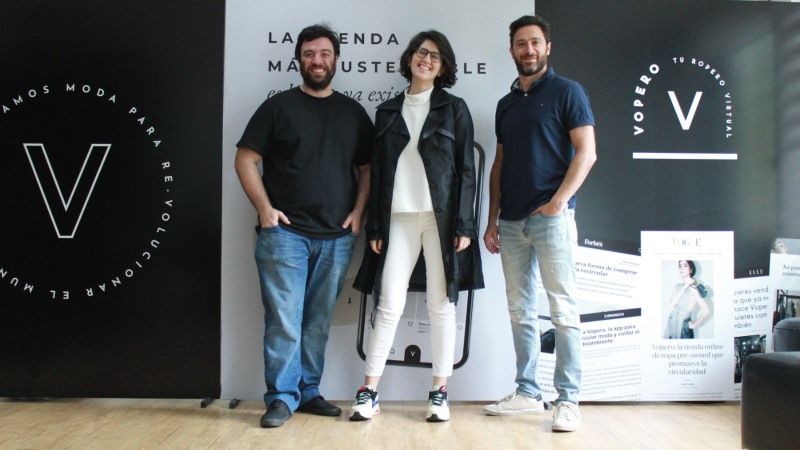
This Uruguayan startup was founded to boost the resale clothing industry by reintroducing items in good condition to the market, allowing new customers to access an affordable and sustainable fashion collection through a unique personalized experience.
How did the idea to create Vopero come about?
The idea came from Maggie Ferber, my business partner, who lived in the United States for 10 years and comes from a family in the fashion industry, so the topic often comes up in family conversations.
She decided to return to Uruguay and launch the platform. That’s when she brought Ignacio Cattivelli and me on board; we formed the team and chose the business model we would use. We celebrated our first anniversary in November 2021.
Who is Vopero's target audience?
It's a verydiverse crowd, both in terms of sellers and buyers.
Sellers are generally women between the ages of 18 and 50 who have a portion of their wardrobe that they’ve never worn. It’s a process in which they feel they’re in control, while also feeling our support. For example, by providing them with technology that allows them to showcase the clothes they want to sell in the best possible way.
Our goal is to make the process comfortable for all buyers, knowing that we check the quality and provide consistent service.
Why is buying secondhand clothing a good idea?
It has a direct impact on the ecosystem and the environment. Creating and manufacturing clothing causes irreparable damage. The fashion industry is one of the most polluting industries in the world.
When you buy secondhand clothing, you’re helping the environment by giving a second chance to items that, in our case, are in perfect condition and deserve that opportunity. It closes the loop so they don’t end up in a landfill.
Are Uruguayans open to buying secondhand clothing?
When it comes to Uruguayans and secondhand clothing, that was one of the biggest challenges we faced. Although it’s a small market, we launched the idea with the optimism that Uruguayans would embrace it. In the end, word of mouth has worked in our favor.
Today, thousands of people are selling on Vopero—people who never in their wildest dreams imagined they’d be selling clothes on an online platform. There are also thousands of people buying—people who never thought they’d buy secondhand clothes.
Vopero offers high quality at low prices. We’ve been doing well, and we’re going to keep getting better. This allows us to expand our reach through the service and products we offer.
How do you see the company's growth?
It’s turned out just as we expected—in fact, the speed at which it’s happened has exceeded our expectations. Obviously, as entrepreneurs, we dream that things will go well, and that’s what we work toward every day. But we’re very happy with the results and excited that this momentum isn’t slowing down, allowing us to reach more and more new buyers and sellers.
Given that you are currently seeking to expand your market presence in Latin America, how did your degree in International Studies broaden your perspective on this market?
I think my degree has helped me throughout my professional development. In other words, I got my first job through ORT at a shipping company. That allowed me to work in a field with a lot of exposure to the world of goods and to get to know the ecosystem of importers and exporters, not only in Uruguay but throughout South America.
I believe that engaging with the world and getting to know different countries is very important for putting into practice that idea of thinking big.
Staying in touch with what’s happening allows you to understand or gauge the opportunities and identify the real barriers to entry, as well as the scope of the opportunity. That encourages you to go for it. In that sense, your degree is a huge help.
Studying at ORT was a wonderful time in my life. It involved setting goals and working to achieve them within a specific timeframe. That’s what a degree program offers: a framework and personal context that enable you to succeed in your professional life as you face its various challenges.
What skills did you learn in college that you use in your professional life today?
We’re all, in a way, a blend of everything we learn and experience. My degree has undoubtedly had a positive impact on both my personal and professional lives. I’m grateful for this experience, just as I am for the various jobs I’ve had.
It is precisely the combination of academic and professional experience that makes for a good professional, and in that regard, I am very grateful to the university.