“For wood to be a material that designers, engineers, or architects consider, they need to understand it and be confident in its properties,” says Argentine engineer Alfredo Guillaumet*, a tenured professor in the Structural Engineering Department at Argentina’s National Technological University (UTN), who visited the School of Architecture at Universidad ORT Uruguay give a lecture and meet with university officials to establish a collaborative network aimed at “normalizing the use of wood in structural applications in our countries.” To learn a little more about this network and the reality of wood as a valid construction material, we interviewed Guillaumet.
-You came to Montevideo on a technology-related visit. What was the purpose of your visit?
-The goal is to establish a collaborative network between Universidad ORT Uruguay, University of Valladolid, the National University of the Northwest in the province of Buenos Aires and the National Technological University from Argentina. The aim is to lay the groundwork for sharing experiences and information among universities, to work toward common goals in standardizing the use of wood for structural purposes in our countries, and to encourage its use in construction.
-What is the purpose of the agreement?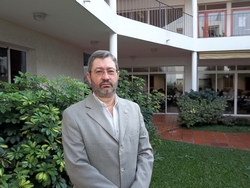
-To establish a broad collaboration agreement between institutions, which we will implement directly between universities. We will not be signing a charter establishing a network, but rather a bilateral agreement between universities, accompanied by specific agreements for which we are currently defining tasks. We intend to carry out research projects, provide mutual assistance to develop joint projects, and work on graduate programs involving faculty exchanges and thesis advisors, both at the master’s and doctoral levels.
-The plan is to work with poplar wood from Uruguay and Argentina.
-Within the general guidelines, we’re trying to see what’s working for us and compare the results. We’ve now brought in some poplar wood, which we’ve already tested at the Venado Tuerto testing facility, so we can repeat the test here and compare the results. The plan is to send some wood for durability studies. It’s part of our collaborative efforts. We’ll see what results we get in both locations when we use poplar.
-Why did you decide to specialize in the use of wood in construction?
-The research group we started working with in Venado Tuerto began by focusing on concrete structures. But I was interested in studying wood, so a small group of us began working in that area, guided and supported by a faculty member with whom I had previously collaborated on structural timber projects. That’s how we began developing the project, driven by a particular interest in that field.
-Why do you think it's important to build with wood?
-Actually, it’s just another material we have at our disposal. In Argentina, students are heavily trained to build concrete and steel structures. Wood is a very user-friendly material because of its warmth. It gives spaces a special look, and wood has a cycle that is compatible with the environment. Encouraging the use of wood means encouraging the expansion of planted forests; protecting native forests, because alternatives are being provided; there is an entire carbon cycle that is recovered through wood; the final disposal of wood after its useful life is over is environmentally friendly, unlike other products that generate waste, such as concrete or masonry structures. The same applies to steel structures, because recycling must be considered. But for wood to be a material considered by designers, engineers, or architects, they must understand it and be confident in its properties—which, unlike those of concrete and steel, which are purely the result of an industrial process, vary depending on the source and the treatment it underwent along the way. If we do not provide professionals with the information they need to use it with confidence in its properties, they will not use it.
-Do you think, then, that architects need to be better informed about the properties of wood?
-Yes, and we researchers still need to provide them with the necessary information. Neither Argentina nor Uruguay has a tradition of timber construction. We need to assess the material’s properties and identify any defects; once that information is made available to professionals, it makes using the material much simpler. On top of that, the current trend in structural materials is not sawn timber—where the log is cut into the familiar shapes like beams—but rather structural laminated timber, which involves an industrial process of bonding layers with adhesive using specific techniques. This provides us with a very important structural alternative. We are adding value to the original wood product through a technological process, and providing construction professionals with a truly useful and advantageous product.
-Is wood underappreciated in the field of architecture?
-I'm not sure if the term is underrated. It really depends on the department. I’m more familiar with the situation in Argentina (I can’t speak much about Uruguayan universities), where in the training of both civil engineers and architects, wood as a material, the process of building with wood, and wooden structures rank third in terms of training time after concrete and steel—and sometimes they’re quite far behind. So, rather than being undervalued, it’s ignored in some curricula for certain degree programs.
-That covers the colleges and degree programs, but what about professional performance? Is that aspect also overlooked?
-The thing is, professionals aren’t going to use a material they’re not familiar with. Those who took the initiative and showed an interest in the subject are working with wood, but this isn’t happening on a large scale because of a lack of knowledge. We all tend to use what we know—what we’re confident works—and leave what we don’t know for when we have time to study it. It’s a matter of safety when using products. No one is going to design a major structure using a material whose properties they don’t know.