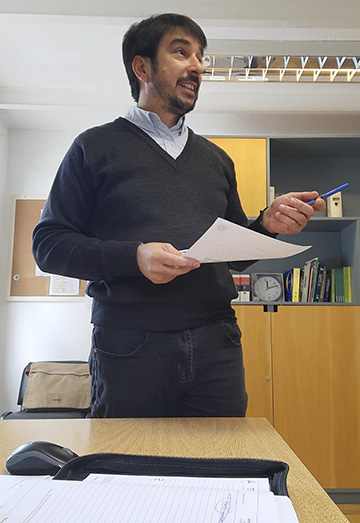
Di Lorenzi serves as the secondary school director at the Colegio y Liceo Latinoamericano. In addition, he currently teaches philosophy at the General Directorate of Secondary Education and epistemology at the Education Training Council of the National Public Education Administration.
Was the health crisis an opportunity to modernize education? Or are we still facing the same challenges and problems we had before the pandemic?
The COVID-19 health crisis, in its early stages of 2020, gave rise to mixed feelings from which opportunities emerged. On the one hand, it was necessary to cope with periods of despair. On the other hand, however, new learning opportunities arose, as it became necessary to use tools that, although they already existed, had to be reinvented and adapted to meet current requirements.
The pandemic has shattered some of the golden rules of education, particularly regarding the notion that education must take place in person, in a physical classroom.
After two years of COVID-19, what lessons have we learned? Of all the measures we’ve implemented and lessons we’ve learned, which ones can we continue to apply in the classroom in the future?
The pandemic had an impact on the key stakeholders. For teachers, it reinforced the need to view teaching as a process of ongoing professional development. Not only did they have to quickly adapt to using various teaching and communication tools, but it also became clear that this was an opportunity to start developing new lesson plans tailored to new realities. That is why I believe teachers were particularly challenged during the initial phase of the health crisis.
From the students’ perspective, it became clear that the concept of “digital natives” was inadequate and unhelpful. While they possess certain skills in using ICT, this did not necessarily have a positive impact on their learning; therefore, it was necessary to rethink digital learning and recognize that new tools alone are not enough.
As for families, they transformed their homes. Not only because of remote work, but also because they had to actively participate—as never before—in their children’s learning processes. They came to understand that teaching is not merely about conveying information, and that learning requires opportunities to interact with peers. It was a deeply enriching experience because they came to appreciate the value of school as a means of building knowledge and skills.
Finally, educational institutions found themselves overwhelmed while also having to manage the situation. They had to support their teachers—understanding them, listening to them, training them, and providing emotional support. They also had to manage their students, who participated in classes intermittently—with cameras off or disconnections, for example—since 2020 saw student disengagement rates rarely seen before. In conclusion, institutions finally realized that teachers need support, training, and new classroom formats.
And what, exactly, should we definitely stop doing in class?
That’s an interesting question. During the early stages of the pandemic, several teachers noted that trying to do the same things on Zoom or other platforms as they did in person didn’t make sense. We had to come up with emergency teaching methods and then redefine them to find a deeper meaning.
Several years ago, sociologist Mariano Fernández Enguita had already raised the need to transition from the physical classroom to a “hyperclassroom,” in which the boundaries of the classroom are blurred within an expanded learning environment. This is not only due to the use of the internet, but also because students learn a great deal—and in meaningful ways—outside of traditional classrooms.
Therefore, I believe we should recognize that what happens in the classroom is not the most important aspect of the teaching and learning process. The other key point, in my view, is to understand—perhaps belatedly—that rote memorization does not lead to the development of skills in our students.
Education must move away from teaching dates, facts, and abstract concepts, and instead focus on providing tools that enable students to understand the diversity and complexity of today’s realities.
Thinking about the students who experienced the closure of schools and that emergency remote learning, what distinctive and positive traits do you think they will have in 20 years’ time, compared to other generations?
It’s hard to say. In the case of Uruguay, there has been a renewed appreciation for the empirical sciences, and that’s significant because they were always seen as something distant or characteristic of developed countries. We could also say that these are generations that have come to value physical and interpersonal interaction once again.
In this way, what has been a shortcoming might just turn into an opportunity. It is difficult to share, negotiate agreements, and think collectively across distances. Perhaps these are generations that value face-to-face interaction above all else. To that end, I believe we must continue to combat the effects of isolation left behind by the pandemic.
Are there any areas of knowledge or skills that students have not developed as a result of the pandemic, school closures, and the lack of in-person instruction?
The greatest impact was on emotional skills, and this also exposed a major shortcoming in the Uruguayan education system: the lack of planning regarding emotional education. Fortunately, legislation addressing these issues is currently being drafted.
However, for many decades, learning was understood as an individual cognitive process unique to each person. Fortunately, today we have come to understand that learning not only involves others, but also—and in particular—the kinds of connections and relationships we form with them.
It is important to note that during 2020 and 2021, school never came to a halt; perhaps at times it acted intuitively and reactively, but it never stopped. And there were many lessons learned, both in terms of the curriculum and in quantitative terms.
What do you think teachers should focus on today in order to address the consequences of pandemic-era education?
The concept of ongoing professional development for teachers must take root. Another important aspect concerns the use of ICT. ICT leaves a different “learning footprint” than other media if—and only if—we use it intentionally and in a way that differs from other media. In other words, using ICT is not simply projecting a text onto the board, since changing the medium does not generate new results or processes.
The pandemic introduced many teachers who had not previously used technology to these tools, but when we lack the pedagogical training to incorporate them into our classrooms, we may mistakenly believe that simply using them guarantees better learning outcomes. To avoid this, it is essential to highlight the need for teachers to come together to share teaching experiences and foster critical thinking.