Cynthia Brosque is an architect who graduated from Universidad ORT Uruguay; she holds a Master of Science degree and is a PhD candidate at Stanford University (United States). Ever since she was a student at the School of Architecture, she has been interested in construction processes and research methods applied to architecture.
Throughout his training, he has focused on developing his own definition of architecture. He integrates knowledge of construction, technology, and composition to create innovative designs capable of transforming the construction industry as we know it today.
A few weeks ago, he participated in the seminar “Robotics in the Construction Industry,” organized by the Lima Departmental Council in Peru, where he presented the latest findings from his research at the Center for Integrated Facility Engineering (CIFE).
How did you come to participate in the CIFE Stanford program?
The Center for Integrated Facility Engineering (CIFE) develops and tests engineering and construction management methods to address challenges such as labor shortages and low productivity across all aspects of the architecture, engineering, and construction industry. The Center serves as a research laboratory for doctoral students within the Department of Civil and Environmental Engineering.
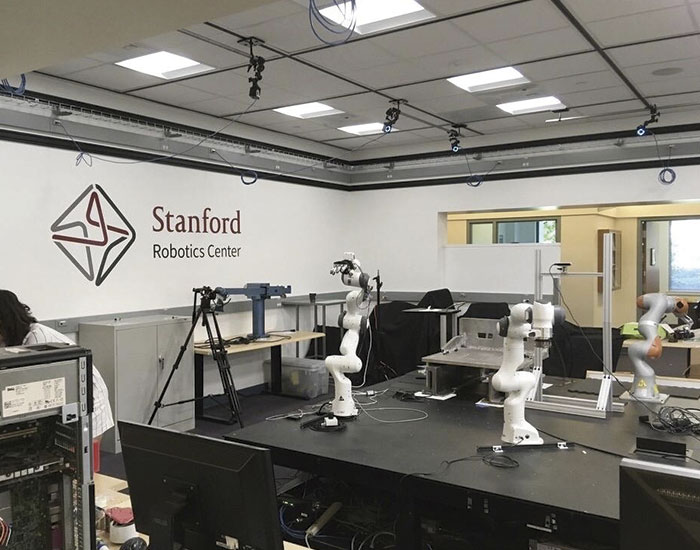
After completing my architecture degree at ORT, I began looking for programs abroad to further my career in the technical side of construction. I applied to the Master’s program in Civil and Environmental Engineering at Stanford University, which, along with the program at UC Berkeley, is among the best in the country in the fields of civil engineering and construction. After graduating with my master’s degree, I continued on to a Ph.D., conducting research within the CIFE framework. The research conducted at CIFE is multidisciplinary in nature, covering design, construction, and project management, with a tradition spanning more than three decades of pioneering the development of technologies and standards for construction. One aspect that sets it apart from other laboratories is its direct collaboration with industry leaders and the opportunity to apply theoretical advancements to construction projects.
How did you come to be interested in such a specific area of the field as robotics in construction?
Both the master’s and doctoral programs require mandatory courses from the Department of Civil Engineering, but they also offer the opportunity to take courses from any other school at Stanford. The university is renowned for its computer science program, and in 2017 I began my master’s degree a semester early by taking courses in that field.
Shortly thereafter, I had the opportunity to work on a research project with a Norwegian construction company that had used a robot to drill into concrete. This solution improved the quality of work and productivity on-site by automating the construction process, and it sparked my interest in continuing to study the subject at the doctoral level.
So far, I have taken courses in Machine Learning, Introduction to Robotics, and Experimental Robotics, which have allowed me to collaborate with professors in the Department of Computer Engineering.
Can you briefly explain what the research you're currently working on is about?
It is called REF—Robotics Evaluation Framework. I am developing a model that evaluates a robot’s performance on a construction site based on its impact on safety, quality, productivity, and cost. We have conducted experiments comparing the output of robots with that of traditional construction methods in tasks such as concrete drilling, drywall installation, and the layout of interior walls.
In recent years, technological advancements in computing, memory, and artificial intelligence, combined with the growing use of Building Information Modeling (BIM) in construction, have given rise to new startups and research in construction robotics. As these new construction methods begin to be tested and adopted on job sites, innovation departments within construction companies are taking on a new role: analyzing the impact of robotics on a project.
At CIFE, we work closely with the R&D (Research and Development) and innovation departments of the world’s leading construction companies, which grant us access to their projects. Some companies even have their own CVC (Corporate Venture Capital) arms to invest in startups and technologies of interest. In a way, together with these companies, Stanford can provide the theoretical framework and scientific validation for these innovations.
How has your architecture degree from Universidad ORT Uruguay helped you?
I am very grateful to the professors in the Department of Structures. I had the privilege of working with Daniel Chamlian in his structural analysis office during my undergraduate studies, after having been his student. In Daniel’s office, I met his father, Haroutun, who taught me the value of being methodical when tackling new structural problems.
On the other hand, Architect Laura Moya, PhD, introduced me to the world of research. Laura welcomed me with open arms as soon as I expressed my interest in her work, allowing me to join her team in researching the design, calculation, and construction of wooden structures at the Materials Testing Institute (FING). These two experiences shaped my education at ORT and helped guide me along this path.
How have construction companies responded to the introduction of robots into their day-to-day operations?
At first, it’s a challenge, because there’s a widespread myth about the threat of robots replacing workers. However, in our case studies, robots complement workers’ tasks, just as we use cranes or forklifts today. None of these machines have replaced workers; either they require an operator to manage the workstation, or they are robots that are limited to performing only a portion of the task.
What are the unique features of construction robots?
Construction robots face additional challenges compared to robots or machinery used in other industries—such as the automotive industry—because they must perform tasks in unstructured environments that change on a daily basis and require mobility and interaction with people.
In which stages of the process can robotics be implemented?
We can categorize them into areas such as progress monitoring, interior finishing, and exterior robots. For example, we have seen robots used to scan construction sites, install drywall, and tie structural steel bars.
How soon could robots be implemented in the construction industry?
Although robotics in construction may seem like a distant prospect, robots are already being used in the construction industry today. In Japan, for example, this topic has been discussed and implemented since the 1980s to address the labor shortage in the construction sector and attract new generations to the trade through the use of these technologies.
More recently, the United States and Europe have been developing and adopting robots on construction sites. In Peru, where we held a conference on robotics in construction for the Lima Chapter of the Civil Engineering Association, we observed significant interest in applying robots to infrastructure projects, such as mining projects. Within the Latin American region, Peru has been a pioneer in Virtual Design and Construction, laying the groundwork for automating construction processes. Chile and Brazil already have initiatives to use BIM in public projects, a process recommended to facilitate the use of robots in construction.