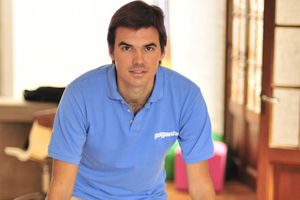
 Lanfranconi speaks with enthusiasm and conviction. He isn't afraid to take risks and acknowledges that Universidad ORT Uruguay played a big part in that.
Paganza is a free app that lets you pay your bills with nothing more than a scan of the barcode.
To use this app, you need a bank account, a smartphone or tablet, and to sign up on their website.
The app has won numerous awards, including the 2013 BBVA Open Talent and the Nova Award for Best Startup of the Year, presented by the National Agency for Research and Innovation (ANII).
In addition, its creator was recognized by the 2014 MIT Technology Review as one of the most outstanding young entrepreneurs under 35 in Uruguay and Argentina.
When and how did Paganza come about?
Paganza was founded in 2012 out of a need that Leonardo Vernazza and I felt. We had met while working together at Un Techo para mi País. I remember it was January 5th when we decided to launch the business. The idea came about for three main reasons: first, because we felt there was a need—like everyone else, we struggled with having to pay bills; second, we saw the rapid growth of smartphones; and third, we were motivated by the financial inclusion law, which at that time wasn’t yet a law but was in the works.
What kind of support did they receive?
First, we met with the board of the Center for Innovation and Entrepreneurship (CIE) to pitch the idea to them. At that point, the project was still in its early stages, and they helped us get involved in Uruguay’s entrepreneurial ecosystem. 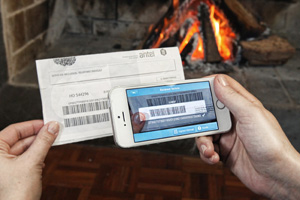 We also received support from the National Agency for Research and Innovation (ANII), as we needed an algorithm for the app that would allow us to scan the codes.
What benefits did having the CIE provide?
They gave us a warm welcome, helped us figure out how to implement the idea, and validated our project—because no matter how enthusiastic we were, we needed to bring it down to earth.
What was the process like when you reached out to the banks and pitched the idea to them?
What we were offering them was a value proposition: the ability to pay bills from their cell phones. We were providing them with yet another solution—one that, in this case, leveraged technology—and we were offering a new and practical solution, so we had no problem.
Did you think Uruguayan society was ready to use this kind of app that involves bank accounts?
It was anyone’s guess how it would work; we needed to build trust so people would feel comfortable making payments online. Fortunately, it was very well received. Paganza has been up and running for 24 months, and we’ve grown and resolved issues along the way. We’ve earned the trust we were aiming for. We’ve also gained the trust of the banks; we now partner with six financial institutions (Itaú, Discount Bank, BBVA, Banco República, Scotiabank, and HSBC).
How many users do you have?
We have 30,000 users.
Are you only present in Uruguay?
For now, we’re only in Uruguay. We’re working hard to grow the business, reach more users, offer more services, and establish Paganza as the most convenient and secure way to pay bills. We’re also exploring the possibility of entering the markets in Mexico and Colombia, but we’re still in the research phase. 
You were recognized by MIT Technology Review in 2014 as one of the most outstanding young entrepreneurs under 35 in Uruguay and Argentina. What ddoes this recognition mean to you?
Winning an award is a great honor; it’s something very valuable, and it motivates us to keep working hard. Things are very difficult, so this recognition is a huge boost.
What would you say to young people who want to start their own business?
From my previous experience, I learned not to play it safe professionally, to take a chance on something—in this case, Paganza. At Universidad ORT Uruguay—and this is something I want to emphasize—the spirit of entrepreneurship is strongly encouraged. It’s not just about studying to get a job, but also about taking risks on what you believe is worthwhile; they encourage you to take risks and give things a try. You always have to keep in mind that the odds are closer to zero than to 100; it might go well or badly, but it’s worth it—it serves as experience. It’s a way to create jobs and generate new projects.