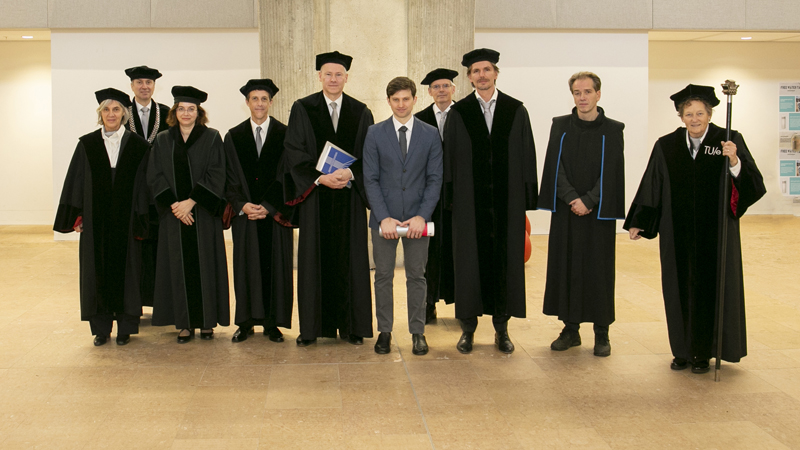
His time with the Research Group on Applied Mathematics for Telecommunications and Energy (MATE) not only marked a milestone in his career but also opened the door to an international adventure that led him to pursue a Ph.D. at Eindhoven University of Technology (TU/e) in the Netherlands, followed by a postdoctoral fellowship at the National Institute for Research in Digital Science and Technology (Inria) in Sophia Antipolis, France.
In this interview, we explore how these experiences have enriched his career, preparing him to tackle global scientific challenges and make significant contributions to his field of study.
What was your college experience like? You were part of the Research Group on Applied Mathematics for Telecommunications and Energy (MATE). What was that experience like, and what did you gain from it?
My college education was somewhat unconventional because I pursued two degrees at the same time. Between 2012 and 2018, I earned a bachelor’s and master’s degree in mathematics at Udelar, and between 2012 and 2017, I studied telecommunications engineering at Universidad ORT Uruguay. I currently work in applied mathematics research, so you could say I’ve finally found a middle ground.
Part of my job involves modeling real-world systems and developing algorithms for them. Another part involves formulating and proving theorems that help us understand these models and algorithms. Learning to think like an engineer is a great help with the former, while a strong grasp of mathematics is essential for the latter.
I was a member of the MATE group from 2016 to 2019. The experience was instrumental in my development, as it allowed me to take my first steps in research while learning from leading researchers such as Fernando Paganini and Andrés Ferragut. My master’s degree in mathematics was supervised by them and was based on my research work within the group.
In addition, during my time with the group, I wrote my first papers and gave presentations at international conferences. It is rare worldwide for master’s students to publish papers in journals and present at conferences, but it has been quite common within the group.
Challenge and Opportunity: PhD in Eindhoven
After completing his master’s degree, Diego decided to pursue a career in research by pursuing a Ph.D. at Eindhoven University of Technology (TU/e) in the Netherlands. He was admitted there after considering several options.
How did you get accepted, and what was your doctoral thesis about?
My intention had always been to pursue a Ph.D. in the United States. In fact, I applied to five U.S. universities and received two offers, which I ultimately turned down. In one case, I didn’t feel the advisor’s profile was the best fit for me. In the other case, my potential advisors had the right profile and were very strong researchers in my field, but my plan was to move with my girlfriend (who is now my wife), and the city where the university was located didn’t have much to offer her in terms of job opportunities.
Following Andrés Ferragut’s advice, I decided to send an email to Sem Borst (Full Professor at Eindhoven University of Technology) asking about the possibility of pursuing a Ph.D. there. Shortly thereafter, we had an online meeting with Johan van Leeuwaarden (Professor of Mathematics at Tilburg University), and we then agreed that I would pursue my Ph.D. at TU/e with both of them as my advisors.
I think it was a great decision. Sem and Johan are excellent researchers and were wonderful advisors, and at TU/e I found a large community of people conducting research in my field. Plus, my wife was able to find a job at a major global company.
Andrés Ferragut not only suggested that I pursue a Ph.D. under Sem, but he also helped me establish my first connection with him. He had traveled with me to a conference where I presented a paper on a topic Sem had worked on. That day, Sem was in the audience, and after my presentation, we talked and had lunch with Andrés.
At the time, I was a rather shy graduate student, so having Andrés by my side was crucial. He took the lead during our lunch conversation, where we discussed the possibility of pursuing a Ph.D. with Sem. To wrap up this story, Andrés served on the committee that evaluated my doctoral dissertation and was present a few months ago at my dissertation defense.
During my doctoral studies, I researched probabilistic models with applications in task distribution among data center servers or cloud computing platforms. My work focused on proving theorems that allow these probabilistic models to be approximated using fluid models based on differential equations. The importance of this lies in the fact that fluid models are easier to analyze, and through them, conclusions can be drawn about the quality of service of task-scheduling algorithms.
From a practical standpoint, one of the main contributions of my thesis was to study how to distribute tasks that must be executed in real time, such as streaming tasks. In this regard, one of my key findings was to determine the maximum quality of service that any task-scheduling algorithm can achieve. Furthermore, I demonstrated that certain algorithms approach this upper bound when the number of servers is large, which is often the case in real-world applications.
I also studied the impact of compatibility constraints between tasks and servers. These constraints are common in content delivery networks. For example, it is not possible to store an entire movie catalog on every server, so some movies are only available on certain servers. Similarly, different image classification or natural language processing tasks require different machine learning models, which cannot be loaded onto all servers. These types of compatibility constraints can be mathematically modeled using a graph, and some of the results I obtained during my PhD help us understand the impact of this graph’s structure on the quality of service provided to users.
Tell me what that experience was like and whether you felt ready to do it.
Doing my PhD in Eindhoven was incredible. I was fortunate to have excellent advisors—highly accomplished researchers who were deeply involved in my training and made a point of helping me integrate into the scientific community. In addition, I completed my PhD in a group with many professors and students working on topics similar to my thesis, and where conferences were organized that were attended by researchers from both Europe and the United States. I was also able to do an internship at Amazon, which gave me insight into what it’s like to conduct research in the industry.
Beyond the academic aspect, living in Eindhoven was a wonderful experience. In addition to getting to know Dutch culture, my wife and I were able to experience many other cultures, as Eindhoven is a cosmopolitan city. We also visited several other cities, taking advantage of the fact that traveling within Europe is relatively easy.
I felt very well prepared to pursue my Ph.D.; this was largely due to the guidance I received from Fernando Paganini and Andrés Ferragut during my time with the MATE Group.
Fernando and Andrés are outstanding researchers and teachers, and they closely guided me during the early stages of my training as a researcher.
Thanks to them, I started my Ph.D. with considerably more research experience than most other students. Before beginning my Ph.D., I had already published several papers at conferences and had completed a couple of papers that would be published in journals. As I mentioned earlier, this is not typical, and it was largely due to their guidance.
Postdoctoral Research at Inria: New Horizons
You're currently doing postdoctoral research at Inria. What's it like to be there, and how did that opportunity come about?
After finishing my PhD, I wanted to do a postdoc, and my wife wanted to get an MBA, so we started looking for places where we could both pursue our goals. It wasn't easy at all because we had to coordinate my applications for postdoc positions with my wife's applications to business schools.
In my case, Sem Borst’s help was crucial in identifying the people with whom I could continue to grow as a researcher. In some cases, I took the initiative and reached out to these people, but I also received offers during conferences.
To apply for these positions, I had to write research proposals and request letters of recommendation. In addition to my doctoral advisors, I was fortunate enough to also receive a recommendation from Fernando Paganini, who, like them, is a well-known figure in my field.
We considered several options in Europe and the United States. In the end, we decided that the best option was to move to Nice, where I began a postdoctoral fellowship at Inria.
My postdoc began recently, but so far the experience has been positive. I started working on a new topic in an effort to broaden my horizons. While there are many connections to the topic of my doctoral thesis, there are also many new things to learn. However, I am working with Konstantin Avrachenkov (Director of Research at Inria), who is a highly experienced researcher in the field and has been a great help.
Significant contributions to research
What is the potential impact of your research on your field of study?
I am currently studying dynamic selection problems, although the more precise technical term is "multi-armed restless bandits." One example is selecting which items to display on an online retail site. There is usually not enough space for all items, so a decision must be made about which items to display. This not only affects the sales of the items but also how the demand for each item evolves. The goal is to decide which items to display—possibly changing the selection over time—in order to maximize total sales.
Although the previous example is very specific, the problem has a wide range of different applications. For example, selecting crops for agricultural experiments or selecting patients for medical trials. There are also many other applications in information, communication, and production systems.
It is known that an optimal selection policy exists, and methods for calculating it numerically are also known. The problem is that the computation time depends exponentially on the size of the system—for example, the number of items available on the retail site. Therefore, it is generally not possible to calculate the optimal policy.
My goal is to develop a methodology that allows for the rapid calculation of near-optimal policies, so that they can be implemented in practice. While some such methods currently exist, they rely on the problem structure meeting certain conditions that are often not satisfied.
What advice would you give to students who are considering studying abroad?
I believe that having a good Ph.D. advisor is essential. This is the person who will guide the student’s research projects and provide crucial advice to help ensure that the student’s work is accepted at top conferences and in leading journals. In addition, the advisor can play a very important role when the student completes their Ph.D. and begins looking for a job, through contacts, letters of recommendation, and advice.
Choosing a good Ph.D. advisor is difficult, because students usually only have a few meetings with potential advisors before deciding which university to attend. In my case, the advice from Paganini and Ferragut was crucial, since they already know many researchers in my field.