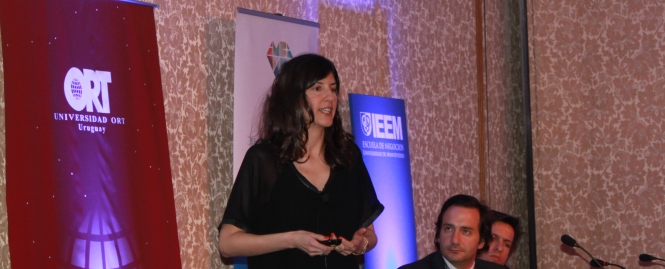
Interview with Sofía Lutz, a senior consultant at Korn Ferry International, on the occasion of her presentation at the 12th Latin America Conference for Deans and Directors of AMBA (Association of MBAs), which took place during the 25th anniversary celebration of the MBA program at Universidad ORT Uruguay.
Korn Ferry International is a company specializing in recruitment and human resources management that operates in 37 countries. It is considered one of the largest executive search firms in the world.
-Why is an MBA important when hiring staff?
-One of the greatest benefits of an MBA program is that students gain a much deeper understanding of themselves—their preferences, their strengths and weaknesses—and begin to ask themselves questions about their professional lives that they may not have considered before, leading them to rethink their career paths in light of their personal lives.
It’s an experience that brings you into contact with students from different backgrounds. You connect with them, share best practices, learn from their experiences, and discover how others have solved problems you’re facing today.
Plus, you build relationships, open yourself up to a world of people you didn’t know before, and that gives you a network—which is always a plus. Those are the most valuable intangible benefits of an MBA program.
I also think the university where you earned your MBA plays a big role. Let’s assume we’re talking about a prestigious university and program: it’s like a credential—it gives you a certain level of academic prestige that’s recognized as such in the professional world.
An MBA can accelerate your growth. You take control of your own professional development, and that can enable you to work much more closely with the company—because you can’t do it alone—to develop skills you lack or rethink your career path together with the organization.
-Does the job market value the university's reputation or the program's reputation?
-Yes, definitely. Companies have a pretty clear idea of which universities are prestigious, and they value the fact that a student who has completed an MBA program at one of those universities holds that credential.
Many companies, when they need to develop their own talent—especially “high potentials” or high performers—fund their education and ask them to pursue an MBA program. This is clear evidence of the value they place on such training.
-Is this happening in Latin America?
-There is a fairly clear understanding and awareness within the corporate world of which universities are most academically prestigious, and of the added value that comes from having completed a program—whether undergraduate or graduate—at an institution that is nationally or internationally recognized.
In practice, I don’t think that in Latin America this translates quite so directly or quickly into “I completed an MBA program at a prestigious university and now I’ve been promoted to director.”
-What is the vision of these organizations?
-Organizations often segment their internal talent, seeking to distinguish those who are “high potential” (15% or less of the workforce). Then there are what we call high performers, who may be very good but aren’t necessarily high potential, and there are those with average performance.
-How does the first one differ from the second?
-It has to do with a concept we at Korn Ferry call “learning agility.” Generally speaking, “high potentials” are people who learn very quickly and have the ability to tackle new situations as if they’d done it before. Not many people possess this skill.
-Is that the same as saying “adaptability”?
-It's more than that. It's not just about adapting. It's about adapting, leading, and being an agent of change.
You may have high-performing individuals who adapt very well to changing environments, but who struggle to be agents of change. A person with high learning agility not only adapts very well, but is also an agent of change in their own right; they will drive change and be more disruptive.
- What value do accreditations from associations such as AMBA hold?
-I don't think there's much awareness of this, so I believe there's significant room for us to establish ourselves in this area. The value is largely associated with the university itself; people haven't yet considered what lies behind it. It's a challenge.
-What skills do organizations look for in high-performing executives?
-One key aspect of leadership is the ability to inspire others. In practice, leaders are those who have the skill and ability to create a work environment that fosters motivation.
A leader becomes an inspiration to those they work with—not only to their direct reports but also to their peers, with whom they must collaborate across departments and whom they must influence to achieve results.
There isn't a single organization where you don't have to work closely with other departments. So one of the most important skills and qualities is the ability to be an inspiring leader who can guide and motivate people.
The old paradigm was that of a more hierarchical, top-down leader who issued orders and imposed goals to be achieved. The modern leader, who is characterized by being an inspiration, creates an environment of high motivation and high performance, where the people they lead and the teams they manage take ownership of and commit to the goals.
Another skill that is hard to find and difficult to develop—and one that is very important—is innovation. This is especially true in today’s world, which is constantly changing and moving at a rapid pace, where technology drives growth but also becomes obsolete faster than ever before.
You need people in leadership positions who possess and foster that vision, and who can lead an organization that is constantly innovating.
-Can a good MBA provide those skills?
-I think so. I don't think the MBA alone is enough, but I do think it helps, because it's an experience that takes you out of your little bubble and opens you up to a world you didn't know much about—or didn't know at all.