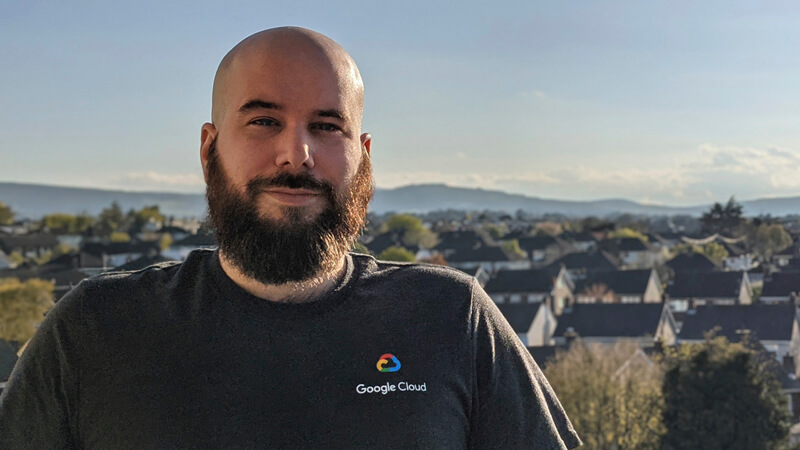
"Being in touch with some of the industry's brightest minds." That's how Francisco Revello, a graduate of the Bachelor’s Degree in Management and Administrationat at Universidad ORT Uruguay in Universidad ORT Uruguay, describes the opportunity that joining the team of a tech giant like Google represents for him.
Since 2019, he has served as Digital Marketing Manager for Google in Ireland and says that his path has led to achievements like this one thanks to his flexibility and the fact that he “doesn’t overplan.” While he still doesn’t know exactly what he expects from his professional future, the one thing he is 100% sure of is that he wants to remain involved in the tech industry.
In this article, Revello discusses—among other topics—his passion for marketing and technology, life in Dublin, and how he applies the skills he acquired at ORT to his current job.
"I consider my time at Google to be the most valuable learning experience of my career."
-
What does your role as a Digital Marketing Manager at Google entail?
I work in the Marketing department at Google Cloud. I focus on one of its products called Looker, which provides advanced business intelligence and data analytics tools in the cloud.
My role is part of the Demand Generation team, which focuses on acquiring new potential customers through digital channels.
My job involves developing acquisition strategies for the European, Middle Eastern, and African markets, and coordinating the implementation of specific marketing tactics across digital channels such as SEM, SEO, and content syndication.
-
What is it like to be part of a company as powerful as Google?
Working in digital marketing at Google is fast-paced, because the scale and impact of the campaigns are massive.
When I joined Looker, it was still a privately held company. Shortly thereafter, it was acquired by Google. That gave me the opportunity to experience what it was like to work at the fast pace of a high-growth startup, witness an acquisition process from the inside, and, finally, compare that experience with the work pace of a tech giant.
The contrast is stark, particularly when it comes to internal systems and the number of extra steps involved in every process. On the other hand, at a tech giant, you have access to best practices and some of the industry’s top talent. There’s a total obsession with measuring everything. For online marketing, that’s great, because you can make decisions and immediately measure their monetary value.
Attention to employee needs and benefits are also very notable aspects of companies like Google, and they were truly a fundamental source of support during the pandemic. -
Your work involves inbound marketing. What exactly is it, and how does it differ from traditional marketing?
Inbound marketing is one of the pillars of digital marketing strategies that has grown the most over the past decade. The central concept is to avoid interrupting the user’s attention with intrusive marketing tactics (that is, almost everything we know as traditional advertising).
In practice, it involves transforming your marketing assets, materials, and activities into content that your target audience is naturally seeking out. There are several components to this definition when applied to the internet, such as content marketing, email marketing automation, and SEO; but fundamentally, it’s about openly and freely educating the target audience to build trust during each potential customer’s research process, rather than pursuing a cold sale from the get-go. -
As a graduate of ORT’s Bachelor’s Degree in Management and Administration, how did your career begin to focus on marketing?
Although that wasn’t my initial goal, starting in my first semester I gravitated toward the more “creative” side of the program—which, fortunately, is quite broad—and that turned out to be marketing. I knew I wanted to work in information technology, given my lifelong interests.
Eventually, I was able to combine both areas by focusing on digital marketing. I chose elective courses and workshops that reinforced that choice, and I ended up earning my degree with a specialization in Marketing. Toward the end of the program, I was able to do my internship at an online marketing agency, and that was my first professional step. -
What was it like to decide to pursue your career abroad, and how has your experience in Dublin been?
During my third year at ORT, I had the opportunity to participate in a student exchange program at a university in Europe. Through experiences like that, even as a student, you can see how differently societies, economies, the news, and business operate in other parts of the world. From that moment on, I knew I would eventually return abroad to gain as much experience as possible.
After graduating, and following several years of working in the local market—already knowing that I wanted to build a career in the software industry—I noticed the extremely high concentration in Ireland of leading companies in their respective fields: Apple, Google, Facebook, Twitter, LinkedIn, Microsoft, Salesforce, and many others. The opportunity to access that market seemed incredible to me, so I looked for a master’s program in digital marketing at a university in Dublin that would serve as my gateway.
Dublin is considered a European tech hub, and as such, its job market offers an impressive mix of nationalities, languages, and opportunities. The experience has been amazing both academically and professionally, and I would recommend it to any graduate considering a similar path.
-
Which of the skills you acquired at ORT during your Bachelor's degree in Management and Administration do you use in your day-to-day work?
Even though it may seem somewhat unrelated to marketing, financial forecasting is a planning tool that is used very frequently. Every campaign involves budgeting and projecting results over time, and it will always be essential to demonstrate the return on every penny spent.
Another key tool—perhaps a more abstract one—is the ability to think in practical and actionable terms. The case study method, which I recall being used in all of Enrique Kramer’s classes (academic coordinator of ORT’s Bachelor’s Degree in Management and Administration), is very effective at forcing you to consider the context and the variables available to you when making decisions.
-
How do you envision your career over the next few years?
I try not to plan more than a couple of years ahead. That has given me the flexibility to, for example, decide to move to another country without knowing exactly how long I’d be staying there. The only thing that’s certain is that I’ll continue to be involved in the tech industry in some capacity. I consider my time at Google to be the most valuable learning experience of my career.