For educators, learning doesn’t happen only in courses, graduate programs, or formal settings. It also takes place in the hallways of an institution, in conversations with colleagues, in reflecting on a class that didn’t go as planned, and, increasingly, on social media and in digital environments.
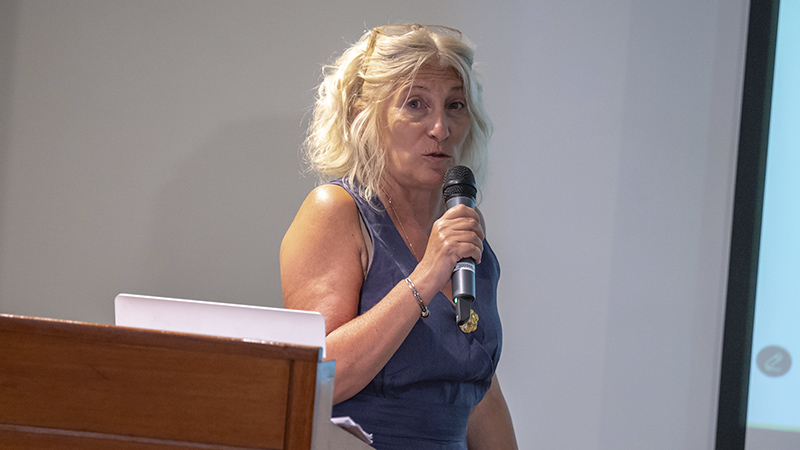
Laura Manolakis’s doctoral dissertation defense, titled “How Do Educators in Argentina Learn (In)formally in a Connected Society?”, centered on this expansion of the field of teacher education.
Beyond formal education
The graduate of ORT’s Doctor of Education program began with a clear assessment: the landscape of teacher education has changed. It is no longer enough to focus exclusively on initial training or the sequence of courses, diplomas, and graduate programs; today, it is also necessary to recognize other contexts and opportunities in which teachers build their professional knowledge.
“ The emergence of social media and digital platforms highlights the fact that spaces are beginning to emerge where teachers exchange information, share resources, discuss ideas, and form supportive communities, ”explained Manolakis, who added that these spaces are often “overlooked in teacher training strategies,” particularly from an educational policy perspective.
In addition, as he noted, there is a“lack of formalization of the learning that takes place in the workplace.”That is why Manolakis set out to investigate how Argentine teachers learn informally in a connected society, in order to deepen our understanding of the changes that digital technologies and social media bring about in professional development.
https://www.youtube.com/watch?v=Dke64Ok1w54
From a methodological standpoint, this was primarily a quantitative study, although it included qualitative components to give teachers a voice. For data collection, two questionnaires were used, developed by the team of Dr. Carlos Marcelo at the University of Seville —who served as Manolakis’s thesis advisor—with the aim of identifying formal and informal learning strategies on social media.
The centrality of reflection
How do Argentine teachers learn informally in a connected society? One of the study’s most significant findings was the central role of reflection in teachers’ learning processes.
While younger teachers tend to favor informal digital learning and co-creation, older teachers typically rely primarily on reflective practices. At the same time, Manolakis’s study found that those with graduate degrees are more likely to favor reflective and formal strategies, while those with lower levels of education rely more on observation and collaboration with colleagues.
However, this appreciation of reflection coexists with another, less encouraging observation: much of this journey is undertaken in solitude. “It is a highly individual endeavor, ”Manolakis stated, noting that, at times, there are no solid institutional mechanisms in place to promote genuine pedagogical analysis, systematic exchange, or the shared construction of knowledge.
Four Professional Learning Profiles
Based on her analysis, the graduate of the Doctor of Education program identified four broad profiles of teacher learning, a classification that is key to understanding that there is no single path to professional development.
- Reflective and collaborative: characterized by a strong emphasis on reflection on practice, planning, and collaboration with colleagues (this category is dominated by graduate-level instructors and those with more seniority).
- Pragmatists and experimenters: focused on creating and testing materials or methodological approaches (primarily secondary school and vocational education teachers).
- The formal and structured: characterized by their high participation in certified formal education and lower engagement in non-institutional networks or spaces.
- The " Digital Connectors": This group consists of educators who are very active on platforms and social media and place a high value on content curation (this group is primarily made up of younger educators).
Social media platforms that also educate
“Teachers’ digital journeys vary greatly depending on the types of networks they use, their purposes, and the value they place on them,” Manolakis said.
Another focus of his research centered on the use of digital social media. Although he noted that many of the platforms studied were not originally designed for educational purposes, in his words, they now make it possible to “go beyond the confines of the classroom and break down barriers.”
In Argentina, the most widely used platforms for professional development were YouTube and Instagram, followed by Facebook and Pinterest. LinkedIn and X ranked third, with more limited use and, in many cases, primarily among teachers with graduate degrees.
In turn, the doctoral dissertation identified differences in usage based on age, gender, educational level, and subject area. For example, younger teachers tend to prioritize more visual platforms (such as Instagram or TikTok), women prefer Instagram and Pinterest, and Twitch is widely used by physical education teachers.
“Professionals with less than five years of experience who are currently pursuing or have recently completed a college degree are the most active in the open digital environment,” he noted.
According to what Manolakis stated during his defense, the use of social media is not primarily aimed at sharing emotions or raising concerns, but rather at finding educational resources, updating knowledge, incorporating materials into teaching, and reflecting on one’s own practice.
What remains to be done
“Teacher training is a cause for concern, ”Manolakis stated, emphasizing the need to consider how to support the development of an increasingly dynamic teaching force.
One of the graduate’s key insights was that these informal, networked learning experiences hold significant educational potential, yet they are often overlooked by both educational policy and educational institutions.
In that regard, he emphasized that much of what teachers learn in their daily work, through conversations with colleagues, or through digital exploration is not formalized, documented, or integrated into broader professional development pathways.
For that reason—and to conclude—he suggested considering alternatives such as micro-credentials, teaching portfolios, and tools that allow for the documentation of learning achieved in non-traditional settings.
Image gallery

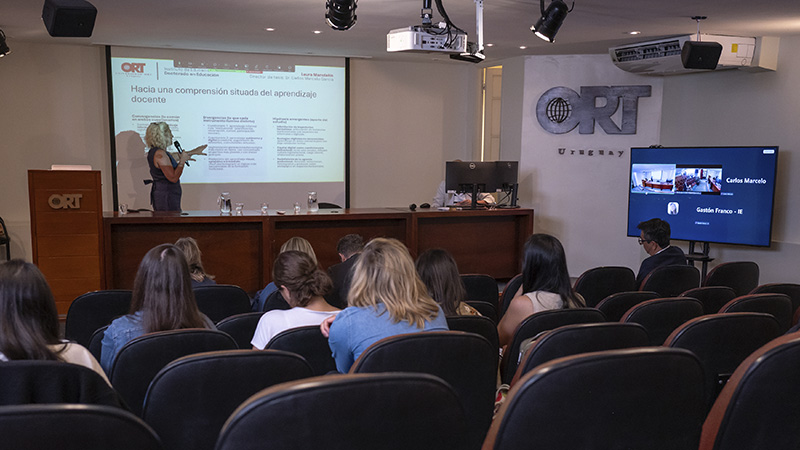
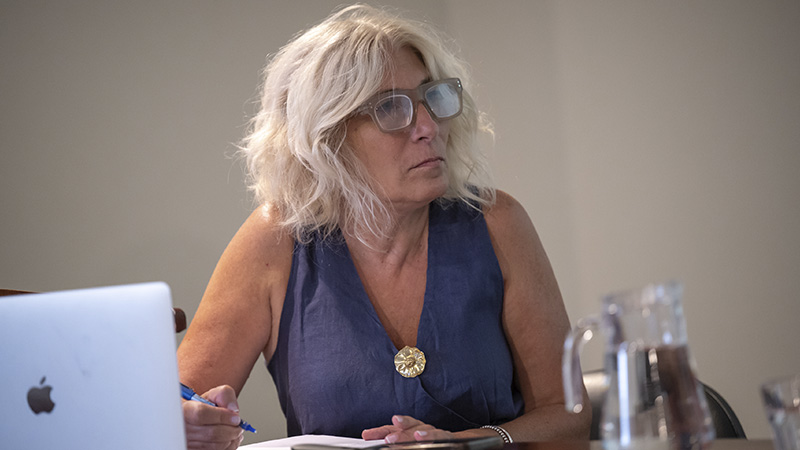
On Friday, February 27, Manolakis defended his doctoral dissertation in the auditorium of the School of Communication at Universidad ORT Uruguay.
The panel consisted of:
- Dr. Martin Rebour, advisor for graduate programs at the Institute of Education.
- Dr. Anna Espasa, professor at the Open University of Catalonia (Spain).
- Dr. Manuel Cardoso, Director of Research at the Center for Continuing Education in Higher Education (CAES).
Dr. Carlos Marcelo, professor of Teaching Methods and School Administration at the Faculty of Education Sciences at the University of Seville (Spain), served as Manolakis’s thesis advisor.