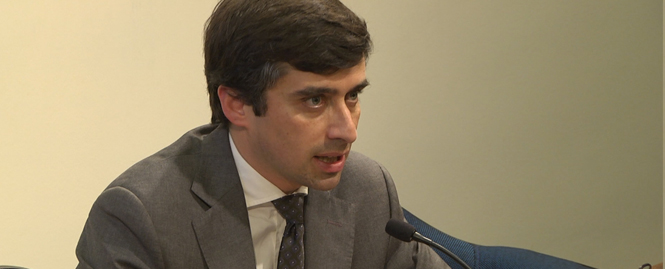
The problem in Europe lies in the tendency to link “Syrian or North African refugees” to terrorist attacks, even though “there is no proven connection.” That was the assertion made by Dr. Filipe Vasconcelos at the conference titled “The Impact of Terrorist Attacks on European Policy.”
For his part, Vasconcelos, a professor and researcher, emphasized that “Europe’s problem runs deeper than the simplistic narrative that far-right movements are trying to portray.”
The talk—which sought to explore the implications, manifestations, and consequences of the terrorist attacks in Europe—took place on Tuesday, April 19, 2016. It was the first lecture in the 2016 series organized by the Department of International Studies of the School of Management and Social Sciences.
What is terrorism?
“Premeditated, politically motivated violence perpetrated by subnational groups or state actors against non-combatants, with the aim of influencing the public.” That is the definition of terrorism provided by the U.S. Department of State. A concept that, in Vasconcelos’s words, is very “broad” and “comprehensive.”
The speaker emphasized that terrorism is politically motivated: “It is not something done for personal gain; it is something that has a broader justification—even if we do not agree with it.”
He also explained that it is an indirect act, usually committed against anonymous individuals, with the aim of drawing public attention to the act. That is why, in many cases, when an attack occurs, someone claims responsibility for it.
September 11, 2001, is a clear example. According to the professor, none of the more than 2,000 people killed were “a priority target” for those who carried out the attack. “The idea was to destroy the symbols of economic and political power through a large-scale massacre that would make us feel that ‘we have reason to fear.’”
At the same time, he noted that it is a concept that “strikes a chord with people” and gives them a “sense of vulnerability.” Although people often think that wars exist—but are far away and “don’t affect us”—terrorism is seen as something that, in theory, anyone could fall victim to.
Terrorism: A Concept in Flux?
“In terms of death tolls, what we see in Europe is that more people died from terrorism in the 1970s than today,” Vasconcelos stated. He added that, in the Western world, North America, and Latin America, “there has been no increase in the number of terrorist attacks.”
However, he pointed out that if the deaths resulting from the conflict in the Middle East are included, it becomes clear that the statistics have risen.
“Is there a new form of terrorism?” the speaker asked. He quickly answered, “I believe so.” In his view, globalization has led to a transformation of the concept.
While this shift is evident in various ways, it is particularly clear in the structures themselves. In the past, these groups mimicked regular armies, with a hierarchical structure. In contrast, new terrorist structures are beginning to operate in cells, as networks, with a high degree of autonomy, thanks to technological advancements.
He even pointed out that, in Europe today, we are seeing the emergence of “lone wolves.” These are individuals who, through the internet, have access to sources of funding and people who encourage them to take action. They also have access to a wide variety of information on how to carry out terrorist acts.
A complex issue
According to the expert, the problem in Europe lies in the connection that is often drawn between “Syrian or North African refugees” and “terrorist attacks.” However, he explained that “there is no proven connection”: “If we look at the passports of most of those who carried out attacks in France and Belgium, they are French or Belgian citizens,” descendants of earlier immigrants from North Africa.
He also emphasized that if we are going to start dividing citizens by gender, we must accept, for example, that all the foundations upon which the French Republic is built “will crumble.” Furthermore, Vasconcelos pointed out that “leaving people stateless around the world is not the solution to combating terrorism.”
“We are going to have to live with the terrorist threat coming from outside Europe, as well as the threat of domestic political radicalization. All of this is a result of the crisis,” he stated.
In addition, he noted that there is currently a “shift to the right” and greater “conservatism,” as well as an influence of far-right parties on moderate parties.
“Terrorism is a political, international, and global issue, but one whose roots can only be addressed structurally, within the realm of states’ own domestic policies,” he concluded.
Video:
https://youtu.be/DUBxW7HCMfQ