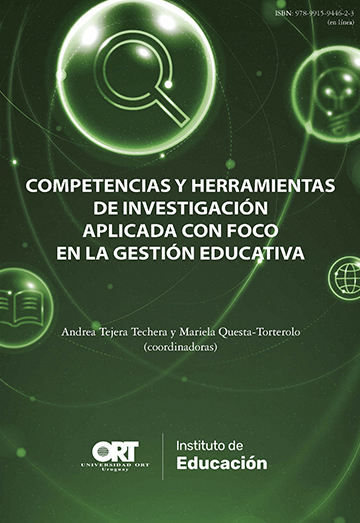
 “This book makes a very significant contribution, as it provides a methodological foundation for the various techniques and tools used in applied research, addresses diagnostics from an organizational perspective, and delves into the development of self-managed and participatory improvement plans,” said Dr. Andrea Tejera Techera, academic coordinator of the Master's Degree in Educational Management and the Master's Degree in Trainer Development, who is one of the editors of the e-book Skills and tools for applied research with a focus on educational management.
According to the Educational Management Coordination Office, it was deemed valuable to create a publication focused on applied research and educational management, since there was nothing else of a similar nature available in the field.
“This means that novice researchers have to approach the subject in a confusing way, since they must perform a series of steps to synthesize the contributions of various experts in the relevant fields, who do not always treat or label the topics in the same way,” he explained.
Dr. Mariela Questa-Torterolo, associate academic coordinator of the Master’s in Educational Management and the Master’s in Trainer Development, who also served as the book’s coordinator, agreed and added that it is “a resource for graduate students in education” and “a tool to help understand the logic behind the curriculum design process.”
“The book is a collaborative work inspired by applied research that seeks to describe and illustrate these concepts, as well as a compendium of tools for thinking about higher education and its implications for the management of educational institutions,” he added.
The proposal is based on the accumulated knowledge and experience of the Institute of Education at Universidad ORT Uruguay implementing educational programs that promote the use of applied research.
“It is a contribution, a resource, a framework for reflection, and a tool to help students reflect on research skills,” said Questa-Torterolo.
What can you find in the book? The first chapter, titled “What Is Research?” —written by Mariela Questa-Torterolo, Claudia Cabrera Borges, and Andrea Tejera Techera—presents a compilation of authors to contextualize educational studies, delves into the key aspects of applied research, outlines the competencies needed to carry out these processes of inquiry and intervention, and, finally, explores the methodological strategy of the case study.
“What tools support data analysis?” is the second chapter. The contribution by Mariela Questa-Torterolo and Andrea Tejera Techera presents the logic of data analysis through a case study. It also outlines strategies for deepening primary analysis and reflects on the need to develop research skills to ensure effective communication of the results obtained.
The third chapter, authored by Mariela Questa-Torterolo and Dora Sajevicius, explores the importance of collaboration, with an emphasis on digital tools that enable and facilitate advising, guidance, and the development of research skills. In “What strategies contribute to the management of resources for research and advising?” the focus is on coordination with faculty advisors and the formative assessment of student work.
Claudia Cabrera Borges and Miriam Kemna present “What are the main challenges students face regarding research skills and tools applied in practice?” The fourth chapter analyzes research skills and tools as applied in practice. More specifically, it identifies opportunities for improving a training program in educational research at the graduate level, in an effort to illustrate the results of a group of students.
Finally, the book concludes with “What Is the Impact of Training on Practice?”, written by Miriam Kemna, Yael Ferreira, and Mariela Questa-Torterolo. The fifth chapter features the perspectives of graduates from a training program and examines three innovations in educational institutions, with the aim of highlighting the importance of strengthening learning through practice.
“A project of this kind goes beyond immediate practices and institutional boundaries, opening itself up to the scrutiny of others—a fact that is particularly significant in academic communities,” stated Tejera Techera.
However, what are the distinctive features of this publication? The collection of authors who offer different perspectives on diagnostic studies and provide a wealth of specialized literature with up-to-date contributions in this field was one of the points highlighted by both Tejera Techera and Questa-Torterolo.
They also emphasized the rigorous theoretical and methodological approach, the contributions related to the case study and the specific analytical tools for management, as well as the shared assessment—based on the accumulated experience of the faculty and graduates—regarding the opportunities that the approach has allowed them to capitalize on within their respective roles.
Both coordinators also highlighted the creative process behind the project, which, according to Tejera Techera, was “extremely enriching for the entire team involved,” as it created “opportunities to empower the individuals, teams, and communities involved.”
In that regard, Questa-Torterolo highlighted the teamwork that was evident at every stage: “The driving force behind the creation was always the collaboration among the authors. Beyond the initial idea, the creative process was made possible by the unique perspectives each of us brought to the table, drawing on our diverse experiences in management and applied research.”
In closing, the leaders of the Applied Research Skills and Tools program, which focuses on educational management, reflected on the importance of developing projects of this kind. According to Questa-Torterolo, by systematizing tools that until now lacked “clear or accessible benchmarks,” this initiative will make a significant contribution to current and future students.
“It also contributes to the field of organizational diagnosis, which will encourage management professionals to analyze their institutions based on evidence—a step that is essential for bringing about the educational transformation proposed for the country,” he noted.
In addition, Tejera Techera believes that projects such as the digital book are “essential for strengthening knowledge management practices.” In particular, they are essential for “recording, systematizing, analyzing, and sharing information, as well as fostering the exchange of perspectives and fostering the holistic approach needed when considering educational issues.”
“We humbly aim to make a positive contribution to strengthening a research methodology and practice that we believe is particularly well-suited to educational management. Above all, at a time when we need all stakeholders in education to feel empowered to envision new paths and undertake changes that will have a positive impact on the entire educational community,” he concluded.