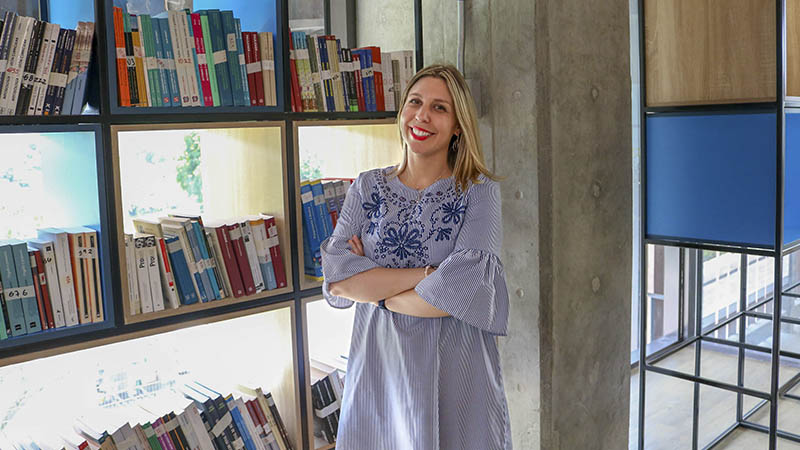
“Let us continue to make education the activity that sets us apart from others and fills us with pride,” said Dr. Lourdes Cardozo Gaibisso during the 2014 graduation ceremony at the Institute of Education at Universidad ORT Uruguay. Nearly 10 years later, the graduate of the Master’s in Education program has moved to a new country, adopted a new language, and joined a new university, but her commitment remains as strong as ever.
In late 2022, she founded the Science Literacy for Equity Research Collaboratory (SL4E), a research collaboratory focused on science literacy for equity, which is part of the Social Science Research Center at Mississippi State University—an institution she has been affiliated with since 2021.
What is a collaboratorium? It is a research space that brings together experts from different fields to seek creative and innovative solutions to a common problem, with the aim of promoting the exchange and collaborative production of knowledge.
Cardozo Gaibisso—who currently serves as a research associate and assistant professor of Linguistics and TESOL (Teaching English as a Second Language) at Mississippi State University—explained that the collaborative allows her to work with other colleagues engaged in research, as well as with students at the university, since one of its missions “is to prepare the next generation of researchers.”
SL4E, in particular, is an initiative aimed at advancing our understanding of scientific literacy among culturally and linguistically diverse students.
Currently, the collaborative is home to two research projects that share a common thread: a focus on understanding the pedagogical models used to teach science to multilingual students in secondary and higher education (particularly migrants and those from Latin America):
- SISTEMAS (Stimulating Immersive Science Through Engaging Multilingual and Authentic Scenarios): a project that, through a summer camp and the creation of a video game incorporating the principles of multilingualism, promotes opportunities for students to engage with content related to the biological sciences, such as genetics and nutrition. Conducted jointly by Mississippi State University and the University of Georgia, the project aims, on the one hand, to introduce students to the world of science as early as possible. On the other hand, it seeks to promote healthier habits and greater health awareness.
- SMILE (Scientific and Multilingual Inquiry Learning in Engineering): a project that connects students from linguistically minority communities with opportunities to develop computational thinking skills, as well as to learn about physics and the aerospace industry, a growing sector in the state of Mississippi. Within this framework, the research has a twofold purpose. First, to conduct a study tracking a cohort of students to analyze the impacts of a pedagogical model based on computational thinking, linguistic support, and multimodal support. Second, to build a connection between the community, businesses, and organizations near the schools, not only to keep students engaged and prevent them from dropping out, but also to help them find potential future employment opportunities.
The collaborative also offers professional development opportunities to in-service teachers who work with multilingual students, according to the professor and researcher. The idea behind it is to “improve the quality of science teaching and learning”and promote “access to information for underrepresented populations in the state of Mississippi.”
What I find most interesting is that, at the end of the day, the issues we research—which have to do with the professionalization of teaching and improving student learning—and the issues that concern us are one and the same.
However, what are the differences between research work in Uruguay and in the United States? Although the two countries are thousands of miles apart, are the challenges the same? Even though funding, available resources, and incentives for research are greater in the United States, Cardozo Gaibisso pointed out that “the educational needs and the questions are very similar.”
What has changed, in her view, is the context. “In Uruguay, we don’t have a large number of students who speak another language; we do have cases of immigration, but they mainly occur within the continent and involve people who speak the same language,” she explained.
Cardozo Gaibisso also emphasized that the field of research has made tremendous strides since he completed his master’s degree in education at ORT 10 years ago: “Uruguay has made significant progress in professionalizing the role of researchers, and there is greater support for in-service teachers to train as researchers.”
“I still believe that the standard of research training in Uruguay is very high—much higher than we realize,” he said.
Regarding her education at Universidad ORT Uruguay, she noted that it was “the first link in the chain leading to the final result.” She had completed her degree in English education at the Artigas Teachers’ Institute at a time when, in her words, “it was a different program and I had no training in research,” so she acquired her foundational training as a researcher at ORT.
“I learned the most essential concepts in class: everything from conducting fieldwork and methodological issues to academic writing, and even how to present research to different audiences. I learned all of that at ORT.”
It was at that moment that he realized he wanted to continue studying and conducting research. “It wasa turning point and, at the same time, my springboard, ”he said.