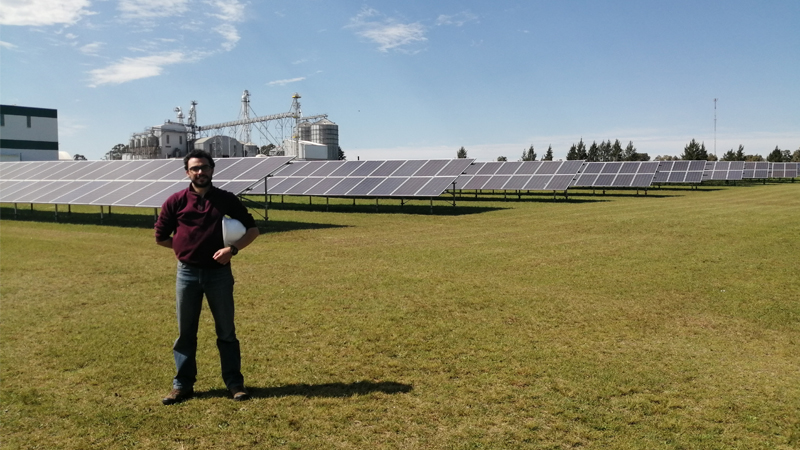
According to Rodríguez, his interest in electricity and electronics has been a part of his life since he was very young. However, continuous learning and a desire to take on new challenges have been key to his professional development.
Learn more about his time at Universidad ORT Uruguay a student of Electrical and Electronics Technician* and his current professional challenges in this interview.
How did your interest in electricity and electronics begin?
I was one of those kids who took their toys apart to see how they worked. After taking them apart, I’d end up putting together something completely different from the original toy, and what I enjoyed most about the whole process was the cycle of taking it apart, designing it, and putting it back together.
As I grew up, that gradually turned into anatural interest in technology, which eventually led to apassion for electricity and electronics.
You recently became the Chief Technical Product Officer at MGI. What does this new challenge mean to you?
It came as a surprise. Just one year after graduating, being entrusted with this responsibility by the company I had been working for only a short time was a recognition of my professional attitude and the skills I had acquired during my academic career.
On the other hand, that surprise changed my academic plans, as my new responsibilities made it necessary for me to specialize in management.
"Taking toys apart gradually turned into a natural interest in technology, which ultimately led to a passion for electricity and electronics."
What does your day-to-day work involve?
Primarily, I provide support to the Sales Department by addressing technically complex inquiries from customers. I identify appropriate solutions so that the sales team can provide quotes.
In addition, I coordinate certain projects for the Technical Department, primarily those related to electrical safety and those involving work at heights or in hard-to-reach areas—fields in which I have specialized.
Finally, I am responsible for reviewing bid documents, sourcing suppliers and products both domestically and internationally, and preparing technical proposals for the bids the company submits. In this regard, a member of the sales team assists me with pricing and submitting proposals.
How do you remember the moment you decided to study to become an electronics technician at ORT?
Ironically, my original training was in business administration, which gave me work experience in that field. Tired of that line of work, I took my wife’s advice to look for something more in line with my interests and decided to enroll at ORT to study for a technical degree in Electrical and Electronics Engineering. It was a time filled with uncertainty, but it turned out well.
What did your time at ORT teach you?
Above all, what I would later come to understand as the secret to technical competence: thinking like a technician. Since this is a field that is constantly evolving, with technological advances emerging almost daily, it is difficult for curricula to teach everything in the traditional way. But the faculty made sure that my classmates and I had the ability to investigate, think, interpret, and solve any technical problem that came our way. I believe that, above and beyond specific knowledge, how we were taught to think prepared us to deal with the challenges of professional life.
"ORT taught me what I would later come to understand as the secret to technical competence: thinking like a technician."
You are currently pursuing a Master of Business Administration (MBA). What motivated you to continue your studies, and how has it benefited your professional career?
As I progressed in my career, I realized that there are management issues that go beyond technical training, and that to grow professionally, it is necessary to understand and address them. That is why, when I started in my current position, I decided to pursue an MBA, which, combined with a strong technical foundation, forms the cornerstone of a promising career.
What would you say to young people who are considering studying to become an electronics technician?
I would encourage you to go for it—it’s a wonderful challenge. There will be days when you feel completely lost, and others when you’ll be magically amazed by technology, science, and engineering. And almost without realizing it, you’ll find yourself at the Palacio de la Luz (headquarters of the National Administration of Power Plants and Electrical Transmissions [UTE]) registering your degree. Without a doubt, this degree program changed my life and put me in a place I never dreamed of being.
* (The title of Technician in Electrical and Electronic Engineering is part of the Electrical and Electronic Systems Technician program. It is earned by completing a one-semester Integrated Installations Project.)