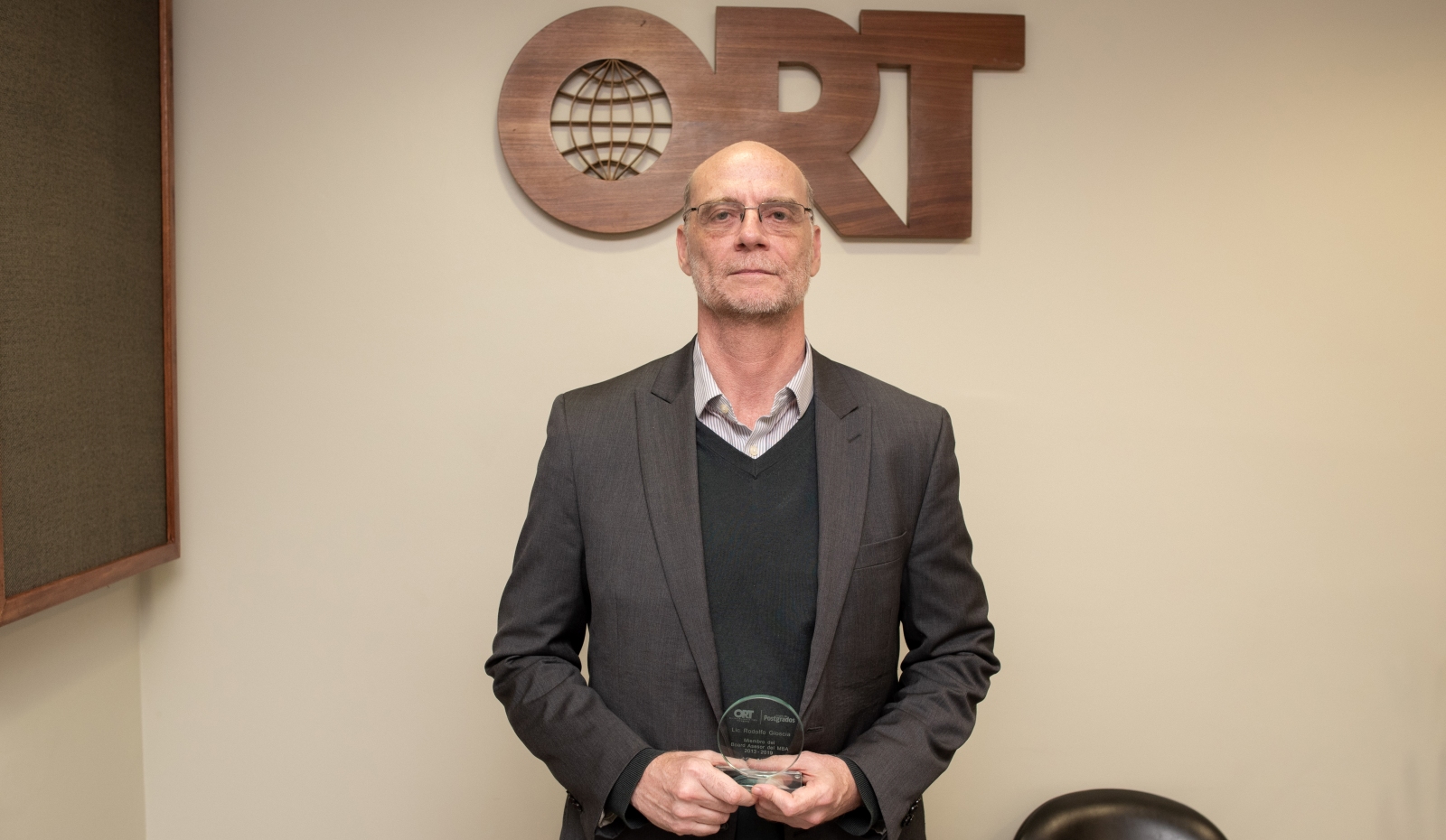
Rodolfo Gioscia, MBA, general manager of Manos del Uruguay, professor and chair of the Family Business Management program at Universidad ORT Uruguay, and outgoing board member of the Master of Business Administration (MBA) program, gave a talk at the Tower of London alongside Fernando López Fabregat, Uruguay’s ambassador to the United Kingdom, and Walter Hughes, chief innovation officer at Humphreys & Partners Architects.
Gioscia, López Fabregat, and Hughes discussed what it’s like to do business with Uruguay, as well as the commercial and diplomatic relations between the two countries. Gioscia also shared the story of Manos del Uruguay as a nonprofit organization with over 50 years of experience in the market, whose social mission includes the development and empowerment of women, and which operates sustainably without external funding.
“Right now, sustainability is very precarious, because we’re in a post-industrial world making handmade garments,” said Gioscia. “I was recently in Barcelona and visited a museum with Roman ruins, and what did I see? Weaving and loom tools. Two thousand years have passed; things are a bit more sophisticated now, but the product is still made with those same tools. The magic, the challenge, is that the product made in Fraile Muerto is sold on the Champs-Élysées.”
Gioscia said that holding the presentation at such an iconic location was very exciting. “I told the artisans that, in a way, it’s you who will be at the Tower of London.”
What did you talk about during the presentation?
About Manos del Uruguay: a 51-year-old nonprofit organization dedicated to promoting not only the professional but also the personal development of women in Uruguay, particularly in rural areas.
From there, to work with major brands like Ralph Lauren, you first need to have a really good product. That’s the key. Then there’s the consistency of having consistently been reliable.
Why is Manos del Uruguay an important social project?
One of Manos’ goals has been to bring work to where rural women are, rather than setting up a warehouse in Montevideo to employ 200 people. Because the quality of life for someone in the countryside who doesn’t earn a high income is much better than coming to Montevideo to work in a factory.
When Manos was founded, the family situation was often as follows: the husband worked as a laborer, and the wife stayed home with the children. This created a certain social dynamic that began to change as women started working.
“Manos del Uruguay seeks to promote the development—not only professional but also personal—of women in Uruguay, particularly in rural areas.”
What are your plans for the future of Manos del Uruguay?
We are facing many challenges right now. The Uruguayan market is small; moreover, it is affected by the instability in our main neighboring country. Tourists from Argentina, who always shop at Manos, are coming less frequently. So, we are promoting the brand abroad, through distributors in key countries and via our website.
Manos isn't a fashion brand. Manos is fashionable. It's about design. If we had defined ourselves as a fashion company, we wouldn't stand a chance. A fashion company has to produce four collections a year. Manos can't do that. Plus, the types of products that can be made by hand are limited.
But we do value design and the quality of the craftsmanship. Furthermore, the concept of responsible consumption gives us a competitive advantage. Someone who buys a garment from Manos knows which artisan made it. This is no small matter, and more developed countries are beginning to recognize its value. But we do all this with great difficulty and effort, without many resources or funding. We will always be present in the Uruguayan market, but our growth will come from abroad.
Given that today's consumers are more aware of industrial processes, how is the business model of a social initiative like Manos del Uruguay valued?
For a well-informed group of people with significant purchasing power, sure. But with the rest of the public, it takes time. One of the things happening is that, under the current mindset, you need a certain level of purchasing power to buy products made in a more ethical way. We’ll never be able to compete with mass-market brands, but in terms of sophistication, it’s different, because all these other qualities are valued.
What steps have you taken to adapt to the arrival of major foreign brands?
It's very difficult. The Uruguayan market is oversaturated with clothing. Domestic companies are importing a lot of goods, and new brands have also entered the market. Yet the market remains the same. Therefore, what we have to do is stay true to our specialty products. Although that's creating a challenge for us, as our prices are becoming increasingly higher than the competition's.
So, one of the things we did was import summer clothing from Italy—a line we call Manos del Mundo. These are items that can’t be made here, such as linen pants and blouses, but they help drive sales of our collection, since they’re carefully selected by our product development team.
“The concept of responsible consumption gives us a competitive advantage. Someone who buys a garment from Manos knows which artisan made it. This is no small matter, and more developed countries are beginning to recognize its value.”
You are a graduate of the Bachelor’s Degree in Management and Administrationand an MBA, and you are the CEO of a leading company in the country. From these perspectives, what do you consider to be your main contributions to the MBA board?
Having been at the university for so many years—first as a student and later as a professor—allowed me to get to know the organization. Furthermore, a company like Manos, which is an SME with limited resources but operates in sophisticated markets, requires you to have different skills and to adapt. The stakeholders include artisans and designers who live in very different worlds. I hope that this diverse range of perspectives has helped to continue strengthening the ORT MBA brand, which is so important to all of us.
I had the privilege of working at my family’s company. Now I work at Manos, which I love as if it were my own. And at ORT, which I also consider my second home. That makes me want to stand up for it and make it better.