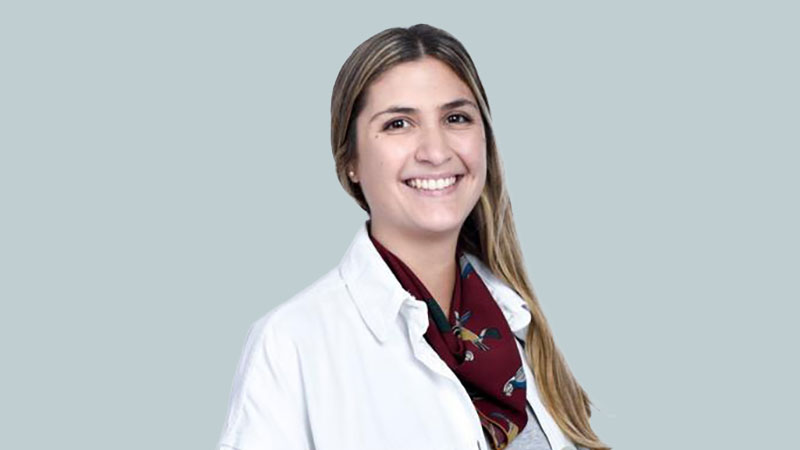
His entire life has been tied to the countryside. So it’s no surprise that agriculture is his area of expertise in journalism.
Networking is essential for anyone working in the media, so in that sense, it wasn’t difficult for her to break into the world of agricultural journalism. But that doesn’t take away from the fact that she stands out for covering a field that has historically been dominated by experienced men.
Manuela García Pintos, a graduate of the Bachelor of Communication program with a concentration in Journalism at Universidad ORT Uruguay, talks in this interview about what it feels like to break that stereotype and about her passion for telling the stories of those who, far from the country’s capital, have no voice.
When you decided to pursue a bachelor’s degree in communication with a concentration in journalism, did you already know that you wanted to work in journalism, specifically covering agriculture?
I wasn't quite sure what to do, so I ended up choosing my major by process of elimination. But I come from a family of farmers; my husband is a veterinarian and a farmer, so I love the countryside. And ever since I was a little girl, farming has always been a part of my daily life.
My first college assignments were on agriculture, because I was familiar with the subject matter and had contacts who could serve as interviewees. Although I gravitated toward that field out of convenience, it’s also something I’ve always enjoyed.
At the same time, I began to realize that this could also be a possibility for my future career as a communicator. When I started my bachelor’s degree in Communication, I had a hard time imagining myself away from the countryside and living in Montevideo. I didn’t really see myself in the future, but then I saw an opportunity to combine both fields: communication and agriculture. Later, I finally decided on journalism because I started working in the media.
How did you get your first job? What media outlets did you work for?
My first official job was in the press room at Expo Prado. A friend who worked at the Rural Association of Uruguay (ARU) asked me if I’d be interested in joining the team, and I said yes. For me, it was a side gig, and it meant having to be there for the 10 days of an event I’ve loved since I was a little girl. Being there out of obligation was the best thing that could have happened to me.
Thanks to that job at Expo Prado, where I worked for three or four years, I was able to meet many journalists from the provinces as well as from Montevideo, which opened doors for me to work at various media outlets.
I did internships at La República and Búsqueda, and I worked at Radio Carve and El Observador. I’ve always covered agriculture. Today, I work at El País as an assistant editor, I write for the ARU magazine, and I’m a producer for the program *Hablemos de Agro* on Channel 10.
At least until recently, agricultural journalists were generally men with extensive experience covering that field. Was it difficult to break into that world despite your prior connection to the agricultural sector? Did you find it hard to build the necessary trust between source and journalist, or to get your colleagues or editors to respect your work?
It wasn't hard for me to break into that world, because, coming from a farming family, people knew me or we always had a mutual acquaintance. In journalism, connections always make things easier.
What did happen to me, though, is that I started working at a very young age. It caught people’s attention that a young girl—a woman—was involved in a field that, I’m not saying is sexist, but is dominated by men.
A few years ago, there were very few female journalists covering agriculture. I think there were three of us in total, and the others were much older than me. Today there are a few more, and I love it.
What has been—and still is—difficult is the part about socializing or building rapport with the interviewees, because you go to a meeting and they’re all men, and quite a bit older than me. So, obviously, I have a hard time finding things to talk about.
There are other situations that are annoying, like when you’re talking to them and they say a bad word and then apologize. Or when, at press conferences, male journalists say, “Let her ask first.” There’s no need for that. These are situations that can be upsetting, but I know it’s always done with respect.
Agriculture is a very niche topic given the type of audience that’s interested in it. However, Uruguay is a country that runs on what the countryside produces. Do you think it’s important for the general public to learn about agriculture as well? In the articles you write, do you use language tailored to an audience that’s familiar with the subject, or do you also try to engage the general public?
It’s absolutely crucial. Last September, I published an opinion piece in El País on this very topic. Out in the countryside, we’d been discussing the issue and calling for action to address the drought we were facing for quite some time, but the problem didn’t reach Montevideo until 10 months later.
At the Expo Prado, the lack of knowledge about the countryside becomes apparent when the ranchers are there with their bulls and children come up to them saying they have udders. Sometimes this can feel like a lack of respect, and such comments can lead to other issues.
There is a serious lack of awareness regarding agriculture, but the agricultural sector also needs to engage in self-criticism, learn to be more patient, and understand the perspectives on both sides of the fence. There is a communication problem for which the agricultural sector is responsible, because it does not reach out to communicate.
As for my articles, I tend to write features and stories about farmers, young people, and rural women. We all have a story to tell, no matter how small. I like telling stories because we’re all important and we all deserve a voice. My articles focus on people, so I write for a wide range of readers.
You’ve produced radio programs, written for one newspaper and now another, contributed to a magazine, and today you also produce television programs. Which medium do you enjoy working in the most, and why? Which one do you think presents the greatest challenges?
The medium I enjoy the most is print media. Radio is wonderful, but just like television, I don't like being on camera. I just produce, coordinate, and organize—which I love. In fact, I'm even too shy to sign my articles in the newspaper.
Print media poses a major challenge. The world is moving toward digital, and while we at El País are also very strong in that area, we’re still very much focused on print, at least in my section.
Thinking in digital terms is extra work every day, because the headlines, content, and file sizes are all different… The visual aspect is different in terms of graphics, links, and photos. Creativity knows no bounds in the digital world, but letting go of the print edition is very difficult… We’re Uruguayan—we don’t like change (laughs).
Journalism students are always told that journalism is a service to society. In that sense, what do you think is the contribution you aim to make as a journalist?
This ties in with the previous question. I like to give a voice to those who don't have easy access to communication.
Sometimes, when I interview someone, they always tell me they have nothing to say, but once the interview starts, they realize they have plenty to share, no matter how small the details may be.
Giving a voice to those who don't have one, giving them that platform, ensuring they have access to the media… That is my role as a journalist in society.
What tools or concepts you learned at ORT are particularly useful for your day-to-day work?
One of the things that made the biggest impression on me and that I liked most about the program was learning that everything communicates, that we are always communicating, and that we can never escape communication.
I always put that into practice, and it has helped me pay attention to everything—to be very observant—not just about what is said, but also how it is said, why it is said, and in what context it is said.
I pay attention to everything visual and physical. That’s the most valuable tool he gave me.