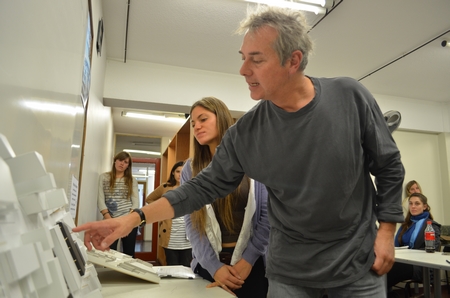
 Two years before graduating, he had already begun working as an assistant at the Pontifical Catholic University of Chile, and since then he has combined his academic work with projects from his studio. Chilean architect Mathias Klotz, the designer of projects such as Casa Klotz, Colegio Altamira, and Bodega Las Niñas, has taken his projects to South America, Asia, and Europe, where he has also given dozens of lectures. On April 19, 2012, he gave a lecture in the auditorium of the Faculty of Architecture at Universidad ORT Uruguay his recent projects. In the interview we conducted with him, Klotz stated that “architecture is not about creating something unique, but about solving a practical problem.” In this regard, he recalled that during his student years, “the prevailing view was that the client was merely an excuse for one to carry out one’s project, but over time I have come to understand that the client is the key person.” He added: “A project that does not fully satisfy the client has no chance of success, even if it is built.” Furthermore, the architect said he has always been “quite skeptical of spectacular architecture, which is a cancer of contemporary architecture.”
-You have served as dean of Diego Portales University continuously since 2003
-Yes. At our university, the dean is selected based on a recommendation made by a search committee composed of faculty members, the academic vice president, and representatives from other schools. A shortlist of three candidates rector presented to the rector , who then selects the dean. The rector may rector propose candidates. In my case, it was a shortlist proposed by the faculty members. Deans do not have fixed terms; rather, they hold positions of trust appointed by rector. They are evaluated annually and can be asked to step down at any time.
-What has it been like to hold that position for nearly a decade?
-I joined Diego Portales University in 2001 to establish the School of Architecture. There was already a School of Design that had been in existence for seven years. During my tenure as dean, I established the School of Art, the master’s program (now in its fifth iteration), and other academic units; one is called the External Services Unit, which is an architecture office within the faculty run by faculty members and students who work independently. It has been a job that has blended bureaucracy with the protocol inherent to the position, but it has given me the opportunity to take on new projects year after year. Now we’re considering establishing a School of Landscape Architecture that would operate in parallel with the School of Architecture. Once our growth is complete and things become routine, either they’ll fire me or I’ll leave [laughs].
-How do you balance your role as university dean with your own architectural practice?
-I work about half a day at the university and half a day at my studio. At each of these institutions, I have a team of directors who are excellent and highly competent. They do their jobs flawlessly. The key is the team. If I had a poor team, I wouldn't be able to get anything done, either at the university or at my studio.
-Doesn't one activity get in the way of the other?
-The thing is, I’m interested in academia. My first position as an assistant was in 1988 at the Catholic University. As soon as I finished my studies, I became a teaching assistant, then an instructor, and so on. It’s not that one thing takes away from the other; one complements the other. That’s how it’s always been, and I hope it continues to be that way.
-How has your view of architecture changed from when you first started in this profession until now?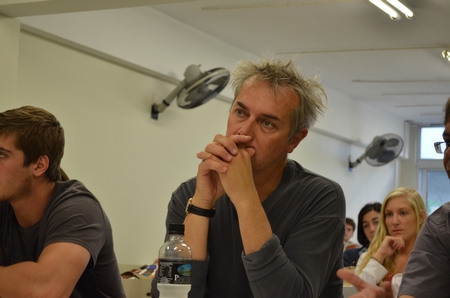 -To put it bluntly, when I was studying architecture, the prevailing view was that, deep down, the client was just an excuse for us to carry out our own project. But over time, I’ve come to understand that the client is the key person. A project that doesn’t fully satisfy the client has no chance of success, even if it’s built. In fact, we’ve done projects that were built and won awards, such as the Altamira School [which won second prize at the Miami Biennial in 2002], but which never really clicked with the team running that school. To this day, we receive complaints that it is poorly designed or that certain features don’t work. There must be a seamless integration of the requirements with the architectural proposal. If that doesn’t happen, things don’t work out.
-Do you think that the shift in your understanding of architecture is a natural path that every architect goes through?
-At my school, I’ve tried to emphasize that architecture isn’t about creating something unique, but about solving a practical problem. The right way to work is to solve the problem in its entirety—including the context, which isn’t just the physical environment around us, but the whole web of social and public interests, and so on, that underlie this project. In a presentation I gave recently, the explanation of the architecture took up 30% of the time, and the remaining 70% was devoted to explaining the business model behind the renovation of that site.
-You once said that “good architecture draws attention precisely because it doesn’t draw attention.” Is that what you’re getting at here?
-Not only that. That phrase refers strictly to architectural terms. I’ve always been quite skeptical of spectacular architecture, which is a cancer of contemporary architecture. The moment architecture became a consumer product—not so long ago—just like an advertising flyer, we architects lost a lot of ground. I think the Calatravas are the worst thing that could happen to architecture. But today there isn’t a mayor in any city who doesn’t want a postcard of his work or who doesn’t hire him, and he keeps churning out the same suspension bridge that doesn’t actually hang, and so it pops up everywhere. To be completely politically incorrect, here in Uruguay they have an example that is absolutely dazzling. They built a new airport because the old one had become too small, but the new airport they built has absolutely no room to grow. None. And it has four jet bridges. That airport is obsolete. They just inaugurated it, and it’s useless. It serves them today, but the day after tomorrow it won’t serve them anymore. They have a white elephant that appears on every postcard but, as an architectural project, doesn’t solve the problems, because no one can design an airport to last five years. You have to design it for 50 years.
-In your opinion, which architect or architectural trend best embodies the “good architecture” you’re talking about today?
-I find Lacaton and Vassal’s approach extraordinary. They are a pair of French architects based in Paris. I encourage you to study their work, because the line of thinking they follow in each project is absolutely unique. It’s very intelligent and isn’t based on a superficial, image-driven approach to what they produce. Their projects are very different from one another. It’s very difficult to recognize Lacaton and Vassal just by looking at an image of one of their projects. That’s probably a good sign that they’re focused on the problem of architecture and aren’t repeating a model, a formula, or a form.
-One of the projects you have recently completed is the library at Diego Portales University. What did it involve?
-At a university that was severely overcrowded, the decision was made to free up space in the academic departments and consolidate all of those departments’ libraries into a single building. The space previously occupied by the libraries was repurposed as student study rooms, because that was a major shortcoming. A university where students stay after class is a good university in terms of physical infrastructure. When there’s no space and they have to go home, two-thirds of the appeal of a university is lost—namely, that it’s a meeting place for faculty and students. And it’s even better if that interaction can happen with students from different majors. I think it’s great that we have students from economics and architecture here. Besides, the architecture students are going to go find economist girlfriends who’ll be able to support us [laughter]. All those cross-pollinations that university life can produce need to be encouraged.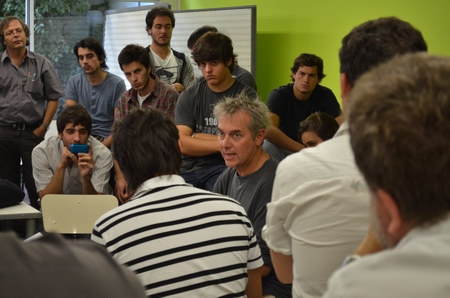 -Of the other projects you're working on, is there one that stands out in particular?
-Everything I'm working on interests me. From the commercial projects we undertake (for example, we’re building all the food outlets for a massive chain in Santiago, which might be the most mundane project, in the sense that it’s purely commercial) to the social housing complex, which is a project that interests me greatly because of the opportunity to create something where growth is possible under a dignified, intelligent, and economical framework; to make better use of the resources that are currently being wasted.
-What is the structure of your firm?
-There are eight architects from different places. I have two Spaniards, and the rest are Chileans from various universities. There must be a couple from my school, then there’s one from the Catholic University, another from the University of Chile, and then we have interns, of whom there are always three or four.
-How does the internship program work?
-At the school, we offer three degree programs. One is the traditional route, where students complete a degree project under the guidance of a faculty advisor in a dedicated classroom. The second is a master’s program, in which students undertake a project and then write a thesis. And the third option is through the architecture studio, which has become extremely popular.
Back when I was in school, there were spots for about 200 students nationwide, and now there are probably 2,000. Also, in the past, out of all the students eligible for higher education, there was only room for 7% of them. Even though education was free, it was the students from the best schools—whose parents could afford college—who went. Students from public schools couldn’t go because the spots were filled. The admission system is based on scores: you finish high school, and all students take a nationwide test. That gives you a score, in addition to your grades from your last four years. Who had the best scores? Students from the best schools—which were private—and they then went to college for free. Today, in Chile, 52% of students who finish high school go on to college. That’s a European standard. Of that 52%, a high percentage of students in our department are first-generation college students. Furthermore, they come from diverse socioeconomic backgrounds, so their transition into the workforce is more complex because they lack a professional network. That is why we established that high-performing students can opt to do a one-year paid internship at a faculty member’s studio and must submit three reports on that internship. In one year, the student can truly understand, learn about, and participate in a project, from the initial design phase through to, at the very least, the start of construction.
I always have an intern in my firm who came in through that route. Once they graduate, either we hire them, or someone always calls me asking for a good young architect. Those students have a head start. It can also happen that they get their act together, team up with a couple of friends, and start their own firm. This third route offers a much more democratic path to employment than the others because it gives students a very real and very good opportunity.
Related content
Video of the conference
Mathias Klotz's Website
*Mathias Klotz was born in April 1965 in Chile. He earned his degree in architecture from the Pontifical Catholic University of Chile in 1990. He has taught studio courses at the Catholic University, Central University, Federico Santa María University, Diego Portales University, and the University Institute of Architecture in Venice. He has led seminars for undergraduate and graduate students in Argentina, Mexico, Spain, and Uruguay. He served as director of the School of Architecture at Diego Portales University (2001–2003) and has been dean of the Faculty of Architecture, Art, and Design at the same university since 2003. He has given lectures in Germany, Canada, China, Ecuador, Spain, the United States, France, Italy, Sweden, Uruguay, and Venezuela, among other countries. His work has been published in numerous specialized journals. He has built in Argentina, Chile, China, Spain, Lebanon, and Uruguay. Among his awards are: in 2011, the Modular Building Institute Distinction Award (Restaurant Rucary); in 2010, the Green Good Design Award (Casa La Roca); in 2002, second place at the Miami Biennial (Colegio Altamira) and third place at the Miami Biennial (Casa Reutter); in 2001, the Borromini Award, under-40 architect category, Rome; in 2000, finalist for the Mies van der Rohe Award (Reutter House); in 1998, finalist for the Mies van der Rohe Award (Müller House). Notable works include: Klotz House, Müller House, Reutter House, Altamira School, Las Niñas Winery, Single Non-Commissioned Officers’ Pavilion, Ponce House, and the Diego Portales University Infrastructure Plan. Most recently, he built the new central library at Diego Portales University and is working on numerous projects related to the reconstruction of the waterfront.
Interview published in April 2012