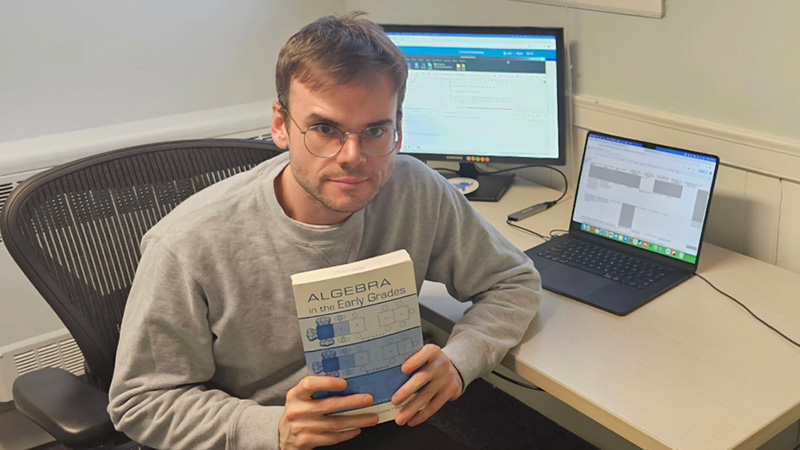
The career progression of Mathías López, a graduate of the Master’s in Education Universidad ORT Uruguay at Universidad ORT Uruguay, has been more than just a simple accumulation of achievements. His professional development has grown exponentially as he has pushed the boundaries of knowledge.
The reason? In 2023, he was accepted into the PhD program in Science, Technology, Engineering, and Mathematics (STEM) Education at Tufts University: a competitive program in Massachusetts (United States) that admits approximately five students per year.
In addition, he was named a Provost Leadership Fellow in the Doctoral Category. This distinction is awarded specifically to students who have demonstrated a high level of academic achievement in their doctoral applications. Tufts University honored only five students in 2023, and López was the only one from the field of education.
ORT's Master's in Education provides excellent preparation for pursuing a Ph.D. anywhere in the world.
A new way of looking at mathematics
How do children begin to use algebraic thinking? In September 2023, López began her studies at Tufts University with the goal of researching and specializing in the development of early algebraic thinking. She also aims to explore how students’ intuition works, specifically in the field of mathematics.
In the final thesis for the ORT Master’s in Education, titled Current Status of Algebra Instruction for Students Aged 6 to 12: A Review of Articles Published Between 2019 and 2021, the graduate had already explored the topic. In particular, he conducted a literature review regarding the early teaching of algebra.
Since this was a topic “rarely explored in Uruguay,” he contacted the academic experts he had cited in his thesis. As he was interested in continuing his research in this area, they recommended that he apply for a Ph.D. program at Tufts University, given the presence of distinguished scholars and faculty in the field of algebraic thinking.
Today, López is working with the scholars whose work he read a couple of years ago. His doctoral research is being supervised by Dr. Barbara Brizuela, an international authority on early algebra. As López puts it, this is “an enormous privilege.”
When I tell my Uruguayan colleagues that I’m working with these researchers, they can’t believe it, because they’re the very people we cite whenever we want to talk about algebraic thinking.

He didn't waste any time. It's been only a few months since he moved to Massachusetts, and he's already part of two research teams.
First, she is collaborating on a project that examines how first- and second-grade students work with graphs. Second, she is part of a team that is researching the use of graphs and tables, but in fifth and sixth grade.
What’s new, in his words, is that the research focuses on young children. “When you think of that age group, you tend to assume they aren’t capable of a lot of things, but we’re showing the potential these children have. Our greatest achievement is not underestimating them, because they know a lot,” he said.
In addition, he has already had the opportunity to publish an article as the lead author, which he described as a major achievement.
A formula for research success
“The ORT prepared me very well,” López said. Although Tufts University, in the graduate’s words, has a “very high academic standard,” he has had no major difficulties keeping up with the courses. In fact, many of the topics covered are similar to those he studied during his master’s program: “I just took a course in quantitative methodology and felt well prepared.” That is also what has allowed him to “manage his time well” and “get started” on his research.
During the application process, he had to submit letters of recommendation and two essays. One explained his motivation for pursuing a Ph.D., and the other was an academic essay summarizing the most relevant aspects of the final project he completed for his Master’s degree in Education.
Thanks to that work, he was recognized for the high quality of his research. Every year, the Tufts website recognizes a small group of doctoral students, and in 2023, López was one of the lucky few. As he admits, if it weren’t for the work he did during his Master’s in Education and the thesis he wrote, he wouldn’t be where he is today.
I owe this award to ORT, which prepared me very well.

All I know is that I know nothing
What are the future prospects? There is one thing López is very clear about: he wants to continue his research and keep promoting this approach to mathematics, which is centered on children’s perceptions.
“I started the master’s program thinking I knew quite a bit about my research topic, with a pretty heavy load on my back. But as I progressed through the program, I’m not sure if I just added to that load, but now I know less than when I started,”he said, adding that he sees it as a positive thing, since it makes him “learn more.”
The reason is that, for him, that is what academia and research are all about: having more and more questions than he did before. “Every time I make progress, I feel like I know less about my field, and that actually makes me happy, because it means there is so much to learn, ”he concluded.