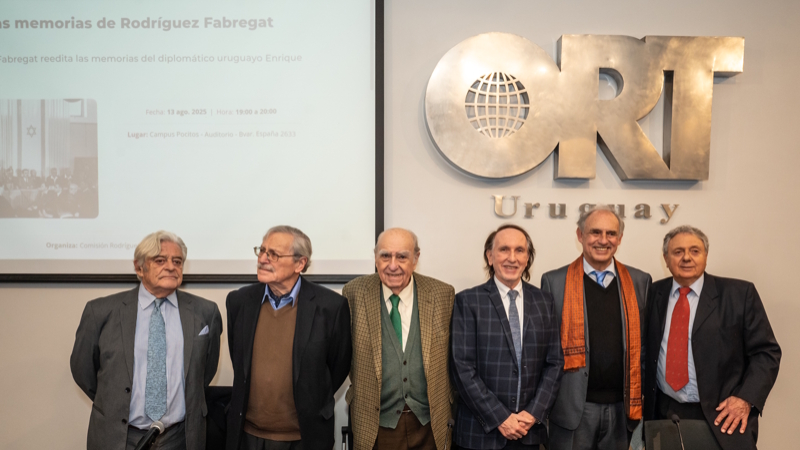
To mark the reissue of the diplomat’s memoirs by the Rodríguez Fabregat Commission, the event was attended by former presidents of the Republic Dr. Julio María Sanguinetti and Dr. Luis Alberto Lacalle Herrera, as well as the former mayor of Montevideo and former Minister of Education and Culture, Dr. Ricardo Ehrlich. The event was moderated by journalist Tomás Friedmann.
Recognition of the State of Israel
Former President Luis Alberto Lacalle Herrera offered a personal reflection, shaped by his faith, his historical background, and his understanding of the current context. “For me, speaking of the Holy Land as a Christian means going to the very roots of my faith. It is there that we find the source of our values, and in the land of Abraham, our father, we find our faith,” he said.
In his view, what happened in 1947 at the United Nations cannot be separated from the long history of that territory.
He recalled that it had been a contested region for centuries, fought over by empires such as the Persian, Ottoman, Roman, and British, and even by Alexander the Great. “It may be the place where the most blood has been shed,” he said, underscoring the complexity of the conflict.
Referring to Enrique Rodríguez Fabregat, he highlighted his central role in that historic moment: “For anyone with even a modicum of education, it is impossible not to know that Rodríguez Fabregat existed and that he was primarily and decisively involved” in the 1947 vote. He said he prefers not to refer to this milestone as the “creation” of the State of Israel, but rather to speak of the recognition of a reality: “There was once again a state there, where there had been a presence for 3,000 years.”
He admitted that he was moved when reading the recently reissued memoirs. He also highlighted the way Rodríguez Fabregat took on his responsibilities at the UN: "He does so with a sense of responsibility that one wishes we could see in the United Nations today."
A bridge to the present
Ricardo Ehrlich joined the panel at the suggestion of the President of the Republic, though he clarified that he was not speaking on behalf of the President. In his remarks, he proposed an introspective reading of Enrique Rodríguez Fabregat’s memoirs.
"I opened a book and found a bridge to the present," he said, referring to the evocative power of Rodríguez Fabregat’s account in a world that is still searching for ways out of the conflict. Through the diplomat’s account, he said he had glimpsed "a glimmer of hope. "
He highlighted two traits in particular: humanity and courage. Humanity in Rodríguez Fabregat’s ability to empathize with the suffering of war victims. “When, in his memoirs, he recounts ‘the painful paths,’ the camps, and the hospitals, he speaks of ‘descending into the circles of hell,’” Ehrlich quoted, emphasizing the raw intensity of the account. Courage in terms of the active stance the diplomat took in a Palestine torn by tensions and threats. He recalled that Rodríguez Fabregat titled that phase of his work “working in the shadow of the gallows.”
"I'm talking about humanity. I'm talking about courage," he concluded, making it clear that Rodríguez Fabregat's legacy is not limited to a historical event, but continues to speak to the present.
The teacher who became a politician
Former President Julio María Sanguinetti was the last to speak, delivering a speech steeped in both personal and political memories. "This event brings back a flood of memories, impressions, and thoughts so overwhelming that I find it difficult to put them in order," he remarked.
Sanguinetti highlighted Rodríguez Fabregat’s talent in both the written and spoken word: “Enrique was extraordinary as a writer and extraordinary as a speaker.” He recalled that Rodríguez Fabregat’s original calling lay in teaching and literature, and that he had no aspirations to a diplomatic career: “As his son Daniel says, he had never even dreamed of becoming a diplomat. He was a teacher, a man of letters, and a politician.”
"The magnificent state of Israel was the last time the two superpowers were in agreement," he said, referring to the support of the United States and the Soviet Union.
He recalled in particular his return to political life in 1962, when he was invited by then-President Luis Batlle Berres to join the slate for the National Governing Council. “We welcomed him at the *Acción* newspaper with applause. His first speech was on the plaza in front of the Solís Theater. I remember he gave an extraordinary speech, inspired by the world. He was an impressive orator,” he recounted. “When Luis Batlle called him, he called the politician. That was exactly what was needed at that moment. We were just emerging from the war.”
Legacy and a Look to the Future
Raquel Fogel and Ernesto Stolowicz, members of the Rodríguez Fabregat Commission, paid tribute to Prof. Charlotte de Grünberg for always supporting them in their work and offering them encouragement. "It was an honor to work with her."
"The Jewish people have enjoyed 77 years of independence, and we are truly proud to have established a state like the modern State of Israel," they emphasized. However, "the entire Jewish people feel they have unfinished business: to bring about the creation of a contiguous Arab state—a sister state—that lives in harmony with the State of Israel."
For her part, Israel’s ambassador to Uruguay, Michal Hershkovitz, paid tribute to Rodríguez Fabregat for her leading role in the partition.
"Uruguay has played a pivotal role in Israel’s history," he said, noting that Uruguay’s recognition and support were far from symbolic: Israel established its first embassy in Latin America in Montevideo. “Since then, our diplomatic, cultural, and cooperative ties have grown stronger in many areas. This friendship has endured across administrations and political parties.”