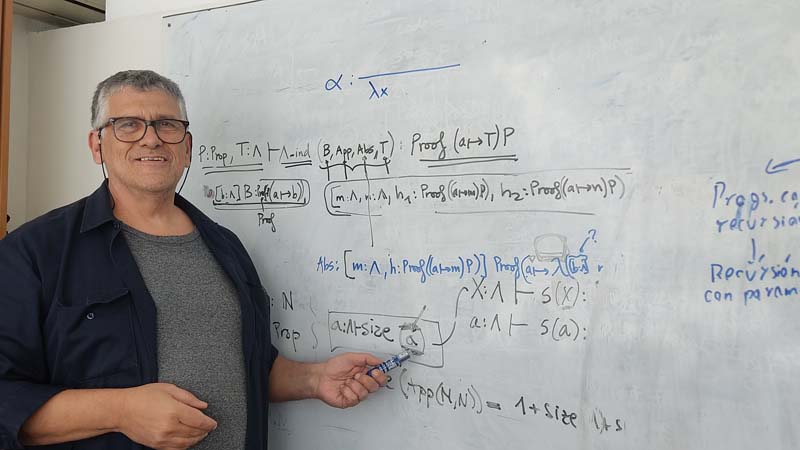
You've been with ORT for over 25 years. What do you remember about those early days? What was your role when you first joined?
I joined the university in 1997, shortly after returning from Sweden with my brand-new doctorate, as the academic coordinator for Systems Engineering, while also teaching and conducting research.
What I remember first and foremost is that shortly thereafter I left my position as coordinator to try my hand at what they call the industry, at a local consulting firm. But eventually I returned to academia.
I look back with much greater fondness on my Programming 1 classes in the Bachelor of Systems Science program, where we used Visual Basic. There were many students with high school degrees in medicine who had absolutely no experience in math or programming, and at least a few of them ended up learning a lot—or so I believe.
What have you enjoyed most about all your roles as a professor, coordinator, instructor, or researcher? You will continue to fulfill some of these roles.
I enjoyed them all, at different times and to varying degrees, but the ones that have stayed with me the longest are research and teaching—I’d say in that order.
You’ve taught many students—did you always feel called to be a teacher?
Well, I'm not entirely sure how to define a calling, but if it means a desire to take on courses and degree programs, the answer is definitely yes.
How do you see students changing over time?
It’s risky to generalize, but I’ve noticed some very positive trends becoming more pronounced in recent times. One is what I would call greater freedom of thought, which I believe makes them more inclined to do things for enjoyment rather than out of obligation.
Another possible consequence of this is that, as long as it is financially feasible for them, they are increasingly choosing to continue their studies and make decisions based on what they have learned rather than rushing into the job market.
What challenges have you faced throughout your career?
The answer would be very long if I were to go into detail, but I’ll mention two. First, motivating the students in every class—ideally, all of them. Another, unforgettable moment was that sort of “triple somersault” that 2020 entailed.
You’re going to continue working as a professor and researcher. Why have you decided to keep doing that?
At the risk of sounding a bit "anti-cultural," I'll be honest: deep down, it's all about hedonism.
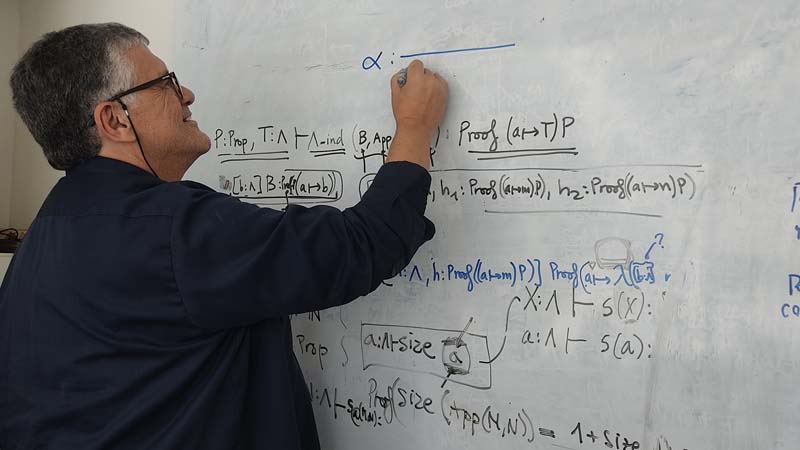
Some of his students and colleagues remember him as a teacher, mentor, and colleague
Inés Kereki, student and colleague: “Tato was my professor when I was studying Systems Engineering at the School of Engineering at Udelar. He was one of the best professors I ever had; I remember how clearly he explained every topic and made everything seem easy. I especially appreciate his friendly demeanor, his patience, and his ability to convey knowledge. Years later, I had the pleasure of reconnecting with him as a colleague here at Universidad ORT Uruguay being able to share and discuss ideas.”
Helena Garbarino, student and colleague: "I've known Tato since I first started as a student at the School of Engineering (Udelar). As a professor, he taught me how to program, as well as logic and abstract thinking. Everything was abstract in Tato's classes! His lecture notes are among the few things I still have from that time. Many years later, we reunited as colleagues at ORT, where I continued to learn from him every day and share his love for knowledge and teaching."
Verónica Tortorella, student: “Tato played a pivotal role in my time at the university and in shaping the person I am today. He was my Logic professor in my second semester, and it was the best course I ever took. He was also the one who sparked my desire to teach and gave me the opportunity to start as a teaching assistant at the age of 19. A few years later, I came full circle by becoming a logic professor myself. After I graduated, he recommended me for a scholarship from the National Agency for Innovation and Research, which allowed me to enroll in the Master’s in Engineering (Research Track), where I took several courses taught by Tato. We taught classes together, developed new courses, created midterms and exams, participated in seminars, and shared many barbecues, and for all of that, I am eternally grateful to him. What’s more, it was at a barbecue organized by the Computer Theory Department at his house that I met my boyfriend, with whom I’ve been together for over seven years, so Tato is like the godfather of this relationship.”
Juan Michelini, student and associate professor of Theoretical Computer Science:“Years ago, I sought out Tato to be my mentor. Those who know him are aware of his courage, compassion, and honesty. In every seminar, the joy with which he understands and explains his subject shines through. He is everything a mentor should be.”
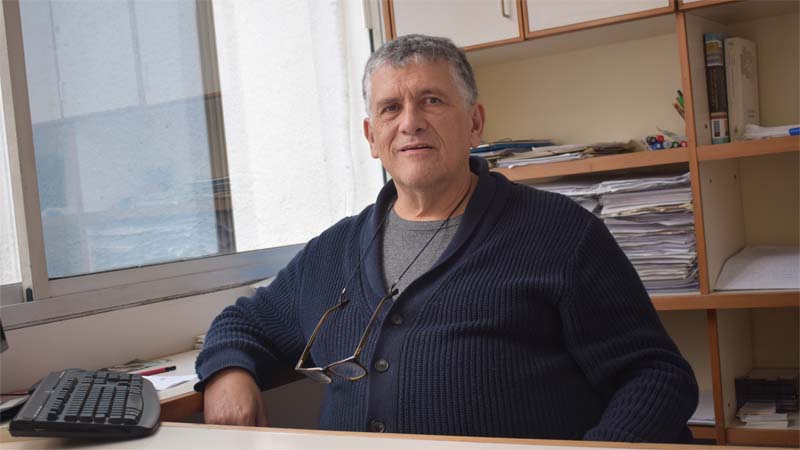
To get to know Tato—as everyone calls him—better, and to learn more about his tastes and sensibilities, we put together a sort of Proust Questionnaire
A movie that left a lasting impression on you?*
* and *King and Country* by Joseph Losey.
A song?
"Merits and Deservings," by Fernando Cabrera.
What is your greatest achievement?
That my family still puts up with me—and even loves me.
What talent would you like to have?
I'm not sure if it counts as a talent, but I think so—more patience.
Where would you like to live?
In Montevideo, without people sleeping on the streets.
Is there anything you would change if you could?
I would replace greed with love, or at least with kindness.
A pleasant routine?
My breakfast while reading the newspaper—still in print.
Unfinished business?
Philosophy.