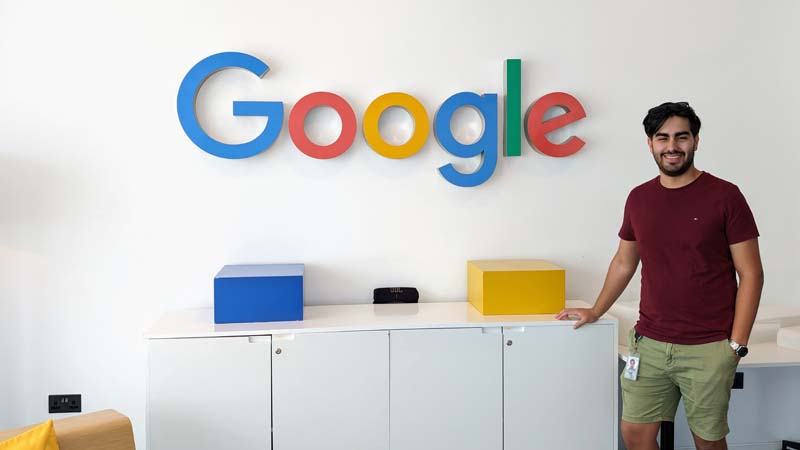
Iván joined Google in April 2022, after completing a six-month hiring process that included technical interviews and immigration procedures. “First, I was interviewed by a recruiter. Then I had a technical interview via video call, followed by three more that involved logic and programming problems, and a final one where they assessed whether I was a good fit for the company culture—what they call ‘googliness’,” he explained.
He currently works on the Android Media Solutions team, developing libraries for multimedia features on Android devices—from watching a video to editing an image.
ORT, the starting point
Iván’s connection with Universidad ORT Uruguay in high school, when he was studying computer science at UTU and, at the same time, pursuing a degree in Software Engineering. “I was in my fifth and sixth years at UTU in the mornings, and in the afternoons or evenings I went to ORT. I don’t know how I managed it. But it was essential for everything that came after.”
He chose ORT because he considered it the best option for technical degrees: “I did a lot of research and felt it was a well-structured program with a solid foundation. It wasn’t a short or one-off course, but a comprehensive and rigorous program that covered programming, databases, algorithms, data structures, application design and development, and software engineering.”
A training program that left a lasting impression
Iván particularly highlights the program’s practical focus. “We had six hours of programming lab time each week. You don’t see that everywhere. It was real code, real problems. Later, when I got to college in Abu Dhabi, many of my classmates were just starting to learn to code, and I already had a lot of practice under my belt.”
He also values the close relationship with the teachers: “After the first semester, it was clear who was serious about the program, and the teachers gave us very personalized attention. You could tell they wanted us to understand. They helped us, gave us challenges, and sat down with us to work through problems.”
In addition, he participated in programming competitions and extracurricular projects, experiences that later helped him both in gaining admission to New York University and in job interviews.
“I had already worked in a team, implemented solutions, and developed for Android. All of that gave me a huge advantage.”
A bridge to college and the world
“While I was finishing my degree in Software Engineering, Iván received a scholarship to study Computer Science at New York University Abu Dhabi, an American university with a campus in the Middle East. It allowed me to continue my studies at a world-class university, with a flexible approach and a global community,” he said.
The university’s system allowed him to tailor his own academic path. He earned a Bachelor’s degree in Computer Science and a minor in Sound and Music Computing, which combines programming with audio processing and digital music. He also studied Arabic as part of the liberal arts model offered by the university: “As long as you meet the requirements for your major, you can explore other areas. I combined computer science, music, and language. That breadth is something I value immensely.”
The experience was challenging both academically and personally. “There were about 350 students in each class, from all different majors, and all from different countries. Every class had people who spoke different languages and came from completely different cultural backgrounds. That forces you to adapt, to listen, and to work as a team. And it really broadens your horizons.”
But Iván wasn’t starting from scratch. “When I arrived at the university in Abu Dhabi , I already had a solid foundation from ORT. I was already familiar with many subjects, such as algorithms, databases, and architecture. That gave me confidence and allowed me to focus on new material without the shock of learning everything for the first time. It really helped me stand out.”
During his stay, he also worked as a research assistant and explored various areas of computer science. “It was a very rewarding experience, both technically and personally. The academic standards were extremely high, but so was the support. There was always someone willing to help you, guide you, and open doors for you.”
What you learn at ORT goes beyond
“What ORT gave me was a very solid foundation. I’d already been exposed to algorithms, architecture, and software engineering. It wasn’t all new to me. I was able to go to class with greater confidence. Even today, at Google, many of the skills I use stem from what I learned there: knowing how to reason, break down problems, and design maintainable solutions.”
For Iván, the degree program not only gave him technical knowledge, but also a way of thinking.
“Being a good programmer isn’t about mastering a language, because languages change. It’s about understanding the concepts, knowing how to use the tools, and knowing how to solve problems.”
Recommendations for future programmers
For those about to start the Software Analyst program, Iván is clear:“Make the most of your classes, even if something isn’t required. That extra effort really shapes you—try out things outside of class: games, web development, hardware. There’s so much to explore and learn; take part in programming contests or extracurricular activities. These are opportunities for growth, and talk to people. At ORT, there’s always someone willing to help you.”
Learn more about Software Analyst