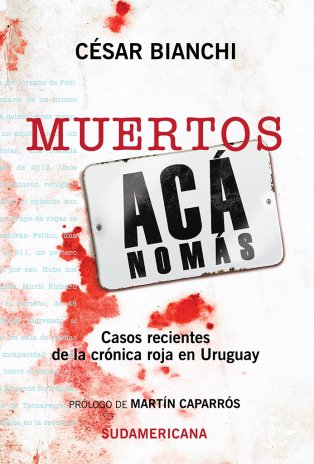
Some of the stories he tells involve premeditated murders, others accidental deaths, and still others stem from jealousy, but they all have one thing in common: they took place in Uruguay.
All the stories in the book received extensive media coverage when they happened. Why did you decide to choose those kinds of stories?
Because they were good stories, because they made me question things, because they caught my attention and shocked me for some reason.
In some cases, because of greed, cruelty, or even chance.
I tried to analyze and explain in detail some cases that had made it to television, but to recount them from the beginning, in greater depth.
Did you ever think that the stories in the book were less well-known, or had a lower profile?
The Velázquez family's case wasn't widely known; it didn't make much of a splash at the time.
I wrote that article to submit it to an international contest, and I was lucky enough for it to win and go viral on social media.
As a result, the case gained greater attention. But I didn’t choose the stories based on how much media coverage they had received previously, but rather on whether there was a compelling story behind them to tell.
Do you think that the phenomenon of media coverage of murders has meant that there are no longer any low-profile homicides in Uruguay?
I don't know what you mean by "low-key," but it's clear that people are very interested in crime stories and tabloid news. That's true today, and it was true back in the 1960s, when morning papers would sell out their entire print runs based on that kind of news. The media simply amplify these realities.
The foreword was written by Martín Caparrós. What does a perspective like Caparrós’s bring to *Muertos acá nomás*?
A great deal, particularly because of his talent as a storyteller and chronicler. I valued his writing because he is a master of narrative journalism on the continent. His byline undoubtedly lends prestige to the book.
Do you think the book you wrote helps promote best practices in the field of crime reporting?
I hope so. It would be a great compliment to my work if that were the case. I set out to develop a genre that’s still in its infancy in Uruguay—narrative journalism—and apply it to crime stories, just as I previously published a book of life stories about Peñarol fans [A lo Peñarol] and, before that, about sex workers [Mujeres bonitas]. What matters are the stories, and how to tell them, of course. If I managed to make a handful of cases more visible and easier to understand, so much the better.
How did you try to make your writing different from the narrative the media presents today when reporting on murders, violence, and so on?
By drawing on the tools of narrative journalism and, to some extent, literature. By telling stories in a different way, shifting the perspective or focus to other things that go beyond the urgency that newspapers place on breaking news.
I didn't worry about the news, which had already been published in newspapers. I was concerned with other matters: uncovering emotions, recreating key moments, asking questions again... And I must confess that reading so many masters of the feature story helped me. I learned about feature stories by talking to (and listening to) many distinguished feature writers, but above all, by reading their work.