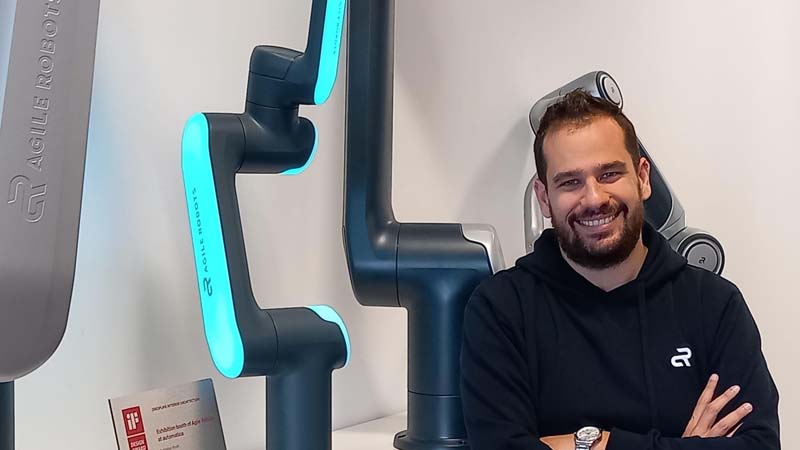
After completing his Ph.D. at the German Aerospace Center, Ismael has taken on a new role as Technical programme at Agile Robots, leading innovative projects in the field of industrial production and artificial intelligence strategies in robotics.
Although Ismael finds it difficult to offer advice to younger generations interested in robotics, he emphasizes the importance of adaptability, critical thinking, and cultural openness as crucial elements.
When I interviewed you in 2017, you were pursuing your Ph.D. in robotics in Germany. How would you describe that experience, and what did you learn from it now that it’s over?
What I learned most is the importance of being able to adapt to new challenges. When I started my PhD, I was working with specialized robots designed for tasks we refer to as the “Factory of the Future.” In that context, the goal of my work was to develop a system capable of automatically programming a robotic system—even without any prior expertise in the field—so that the system could autonomously assemble a given product. By the end of my PhD, I was working on algorithms to optimize the trajectories of robotic arms in space, designed to assemble telescopes or satellites. It was a significant shift, but ultimately, with the technical tools I had acquired along with my ability to adapt, the problems could be solved.
One thing I would highlight about this experience is the people I worked with—experts from all over the world who are not only brilliant in their respective fields but are also always willing to lend a hand to move projects forward. This, combined with the diverse cultural perspectives each person brings to the table, made it a truly enriching experience.
Are you still living in Germany? What is your new role, and what are your responsibilities?
In April 2023, I completed my Ph.D. at the German Aerospace Center, and I continued working on the various projects I was involved in until the end of January 2023. In early February, I began working at a company called Agile Robots, where I serve as Technical programme in the Artificial Intelligence department. My responsibilities include leading some of the department’s projects, particularly those related to industrial production (which is closely related to my doctoral research), discussing the strategy for applying new artificial intelligence technologies in robotics, and coordinating collaboration with external institutions such as universities and research centers, among others.
With the younger generations who are drawn to the field of robotics in mind, what advice would you give them based on your personal and professional experience?
It’s not an easy question, since this is a field that’s advancing rapidly, and something new appears in specialized journals every day. It’s clear that a strong background in math, physics, and programming is always helpful, but I think the ability to adapt is essential. On a personal level, for me, the experience of living in other countries and getting to know other cultures is something that broadens your horizons and is priceless—though, of course, the experience of moving abroad can be very tough, and I understand that not everyone values it the way I do.
Are there any skills or areas of knowledge that you consider essential for those who want to enter this field?
In the field of technology, the ability to think critically and adapt is essential. A decade ago, no one was talking about Large Language Models; today, they are a valuable tool—one that doesn’t solve everything, but can create things that were once unimaginable. In another decade, we will likely be talking about a new revolutionary technology that will help us, but we will also need to be able to understand what it can and cannot do.