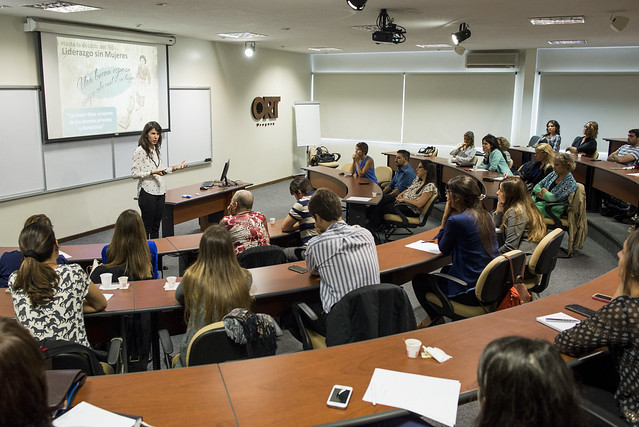
“When you give a talk on male leadership, will you invite me?” That was the question eight-year-old Mati asked his mother, Carolina Bellora, a visiting professor and consultant on organizational change in companies across Argentina, Chile, Brazil, Bolivia, Mexico, and Spain. Bellora was preparing for the conference “Female Leadership,” which took place on Thursday, March 17, 2017.
The professor began her presentation with this anecdote. She noted that while people talk about “female leadership,” it is rare to hear the term “male leadership.” She explained that “leadership” is generally assumed to be masculine by default.
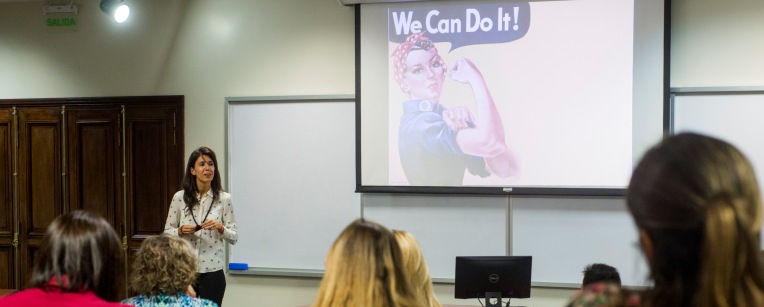
We can do it!
The expert showed a picture of a serious-looking woman wearing a headscarf and flexing her muscles, alongside the words“We can do it!”

He explained that this poster was created by graphic designer J. Howard Miller in 1943, with the aim of boosting morale during wartime. It gained popularity in the 1970s through feminist groups. Today, it serves to advocate for women’s rights and highlight their vital role in society.
Bellora stated that until the 1960s, women were invisible in political decision-making. They were expected to take care of the home and children, in addition to facing other social pressures. Since 2000, women have been given a greater role in leadership, but their access to executive positions has been limited by a supposed “biological issue.” The visiting professor noted that while it is true that during pregnancy it is the woman who carries the child, once the child is born, all responsibility should be shared.
“When it comes to household chores, we have this assumption that no one is better suited than us to handle these unpaid tasks. Why is that? Where does it come from? Is there any scientific evidence to support it? Not really,” Bellora said.
Education and Politics
Through education, stereotypes of “girls” and “boys” are formed. There is an expectation that girls should play with dolls and boys with toy cars. These kinds of attitudes shape the way adults tend to have separate topics of conversation as they grow up.
“There is no recognition of women as political figures,” said Bellora. In this regard, she pointed out that while politicians’ physical appearance is generally not criticized, that of female politicians is. There is a perception that women are there to be seen, not to be heard. Women in politics—as in other fields—must confront the glass ceiling and the glass walls.
“The glass ceiling refers to the inability to rise to higher leadership positions,” Bellora said. As for the glass walls, she explained that “women in organizations are concentrated in roles with lower economic and social value.”
He cited the example of nurses, who “contribute enormous value, albeit indirectly,” and therefore “it is much harder to demonstrate.”
Women now play a significant role in higher education. According to UNESCO data, women account for 54.4% of students in higher education in Latin America. However, they tend to pursue careers that are less valued by society and offer lower salaries.
Challenges
There are several factors that hinder women's access to senior positions:
- Advertising. Bellora stated that it reinforces gender-based stereotypes of leadership. She illustrated this point with a 2015 pen advertisement featuring a smiling woman and the following message: “Look like a girl, act like a woman, think like a man, and work like a boss.”
- The burden of household chores. “Do you know who has the heavier workload? Women. The thing is, half of a woman’s work goes unpaid,” Bellora said. There is still a perception that men “help out” rather than being partners.
- The lack of female role models in leadership, genuine commitment from men, women’s social capital, and equity policies.
What can we do?
There are several possible answers. Between 1960 and 1990, the focus was on equality through affirmative action. Between 1990 and 2000, the focus shifted to diversity through gender education. Since 2000, the focus has been on integration driven by inclusive environments.
For Bellora, in addition to being a human rights issue, diversity is in companies’ best interest from a business perspective. Including women means “tapping into enormous human potential.”
Video of the event:
<iframe width="560" height="315" src="https://www.youtube.com/embed/MAkw4clMt1s?si=veBKb8t4kOW8iZqO" title="YouTube video player" frameborder="0" allow="accelerometer; autoplay; clipboard-write; encrypted-media; gyroscope; picture-in-picture; web-share" referrerpolicy="strict-origin-when-cross-origin" allowfullscreen></iframe>
Image gallery: