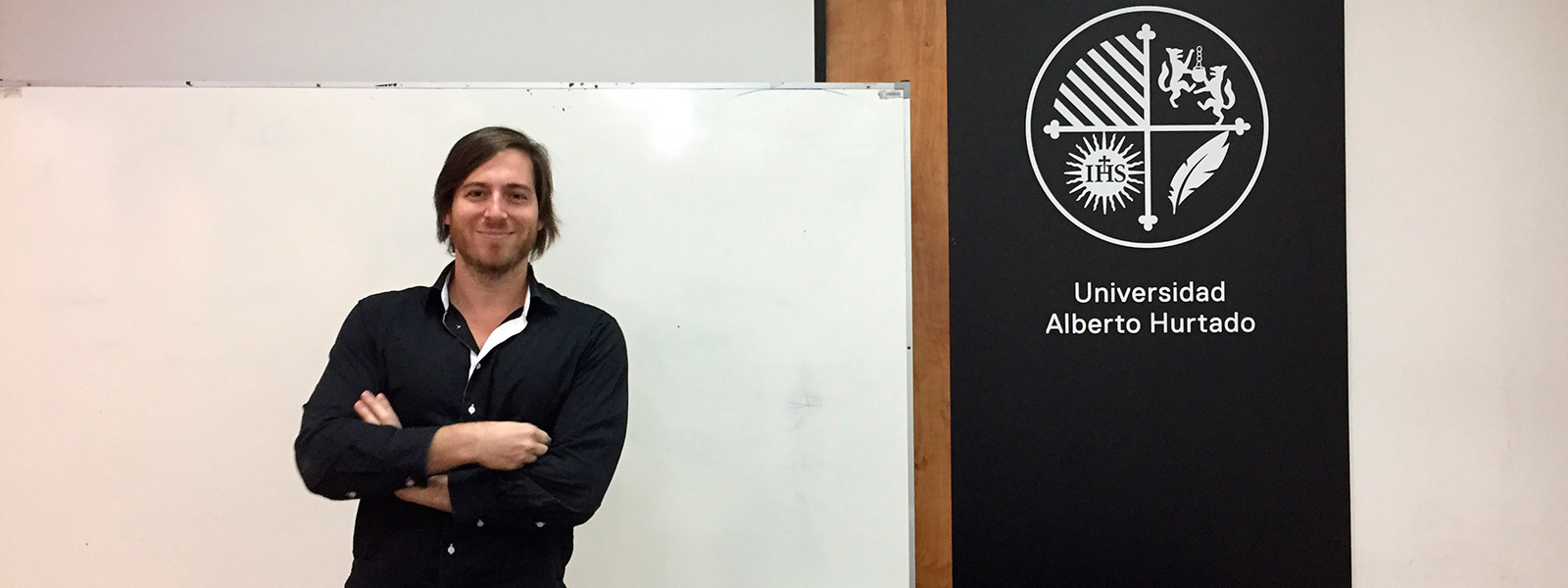
Interview with Juan Andrés Campiglia, a graduate of the Bachelor’s program in Economics who is currently pursuing a Master’s degree in Economics at Alberto Hurtado University. Campiglia is the founder and director of Interactivo Web, an innovative system for website development.
What is Interactivo Web?
Designing and developing a website the traditional way is a slow and costly process. This poses a significant barrier for small and medium-sized businesses just starting out and puts them at a disadvantage compared to large brands. Even when they manage to invest in a good website, it tends to quickly become outdated because no one in the company has technical skills to edit it.
Our solution was to develop software to create high-quality websites quickly and easily, allowing us to significantly reduce production costs and pass these savings on to our clients. They can log into the system and update the site at any time, without needing any prior knowledge (nothing a Facebook user can’t do).
During your time as an entrepreneur, you went through ORT’s Center for Innovation and Entrepreneurship. What tools did you gain there?
That’s where we took our first steps as entrepreneurs with FashionAttitude.com, a project that would eventually become Interactivo Web. We were still very green as entrepreneurs—we had plenty of enthusiasm but little experience. The CIE assigned us an excellent mentor who helped both the project and us mature significantly, which was vital for making the leap to the next stage in Chile.
The CIE selection process is valuable in and of itself. An important part of life as an entrepreneur involves correctly presenting all the key points of the project in just a few minutes and convincing a panel that the project and the team are worth investing in. It’s a great first experience in this dynamic.
How did the startup come about?
We started out like most entrepreneurial stories: a group of friends with an idea. It was the beginning of the e-commerce boom, and one of its largest markets was largely underserved: apparel. Our goal became to create a marketplace specifically for selling clothing and accessories. With this project, we were selected by StartUp Chile, where we had the opportunity to share experiences with entrepreneurs from all over the world.
We then decided to offer websites for all types of businesses, not just clothing, to generate a steady cash flow that would help sustain everything else. Under this new direction, we were selected for SEED, the Minas Gerais acceleration program, where we were able to focus on scaling the project until we no longer depended on external funding.
What are your responsibilities as the director of the startup?
In this type of venture, there are many decisions to be made, everything changes very quickly, and the strategic decision-making process must run smoothly. As internal processes are refined and the client portfolio grows, administrative and financial tasks become increasingly important.
In the early stages, a large part of the work involves securing funding for the startup. This stage is not only the most difficult, but also the one that requires the most sacrifice. You find yourself waiting for the email that will tell you which country you’ll be living in next semester, and counting down the months the company has left if nothing comes through.
What skills did your degree give you that helped you start a business?
There’s no doubt I couldn’t have done it without the foundation I gained from my bachelor’s degree in economics. The most important aspect for me was the financial tools, since initially I was focused primarily on putting together the project’s financials, which are quite complex. As the project progressed, I chose the elective courses that added the most value to the venture, focusing on finance and business administration. I tailored my degree program to my specific needs, both in terms of knowledge and schedule.
You are currently pursuing a master's degree in economics at Alberto Hurtado University. What skills is the program equipping you with for your career development?
A master’s degree represents another step forward in academic knowledge. The topics in economics remain the same, but they are explored in greater depth. If I had to highlight one specific aspect, it would be the technical tools we use to address various types of economic problems. These are essential for conducting research, which is generally complex in terms of both technical implementation and theoretical development. I also gained my first experience as a researcher at Alberto Hurtado University, working on a paper about public policy, and as an instructor, serving as an assistant professor.
How did ORT’s Bachelor’s Degree in Economics prepare you to pursue a master’s degree at one of Latin America’s leading universities?
I’m really satisfied with the program. Here, I had the opportunity to measure myself against top-tier economists from various Latin American countries—a wonderful challenge that really broadens your perspective—and I always felt confident in the foundation I’d built during my undergraduate studies. I can say without hesitation that you’ll graduate ready to continue your studies abroad. My participation in the master’s program was directly encouraged by ORT professors, whom I thank for the opportunity to continue growing as a professional.