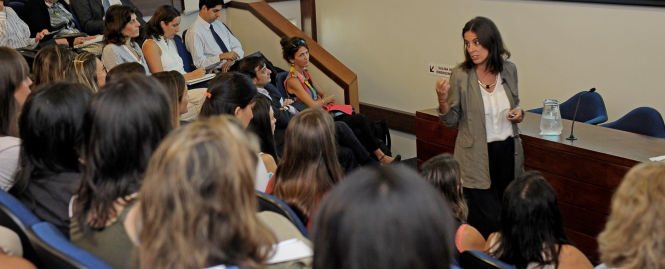
Interview with Mariana Gattoni, a visiting professor for the course "Strategic Human Capital Management" in the Specialization Diploma in Human Resources, the Master's in Human Resources Management, the Master of Business Administration (MBA), and the Master's in Technology Business Management (ICT).
Gattoni, who holds a bachelor’s degree in psychology from the University of Salvador (Argentina), is a professor in the Human Resources Program at Torcuato Di Tella University. She holds a master’s degree in Strategic Human Resources Management from the University of Belgrano and Torcuato Di Tella University. She is a certified coach through Korn/Ferry International.
-What is a value proposition?
-Today, the value proposition is a strategic priority for organizations, as it acts as a magnet that attracts talent and then encourages that talent to commit to staying and adding value for stakeholders.
To a large extent, the availability of the organizational capabilities needed to execute the business strategy depends on this value proposition. The value proposition of a multinational corporation, an SME, or a public-sector company will not be the same.
To establish it, it is important for the organization to have a clear understanding of itself, including its unique selling points, the type of employees it needs, and the profiles required based on what it offers, as well as to be aware of what its competitors are offering. Fundamentally, creating a genuine and consistent value proposition requires a healthy dose of self-criticism.
-Does high performance help determine potential?
-While high-potential individuals generally perform very well—since they deliver superior results—not all high-performing individuals have high potential.
Potential can be measured using a concept known as learning agility. It is the ability to learn from experiences, build on that knowledge, and then apply it to new situations. High-potential individuals generally know what to do when they don’t know what to do. They are characterized by their strong ability to adapt to change and their self-awareness.
-What is the difference between training and development?
-Training is geared toward acquiring new knowledge, while development focuses on acquiring new attitudes or behaviors. We now know that people develop more by performing their job duties than by attending training courses. The 70-20-10 formula tells us that a development plan should focus 70 percent on on-the-job assignments, 20 percent on coaching, and 10 percent on training.
-What kinds of work assignments help people grow?
-Some examples of work assignments that facilitate the acquisition of new skills include participating in company turnarounds, working at startups, moving from line management to staff roles or vice versa, international assignments, scaling up operations, leading or participating in multidisciplinary projects, leading virtual teams, lateral and cross-functional moves, and influencing others without formal authority.